

Recovery strategies are often discussed in terms of how quickly an athlete feels ready to train again. But recovery interventions can also influence the adaptations we are trying to create.
Cold water immersion is a good example. It may improve soreness and short-term recovery, yet repeated use immediately after resistance training appears capable of attenuating strength and hypertrophy adaptations.
Heat represents an interesting alternative.
Heating increases blood flow, may increase tissue capillarization, can alter anabolic signaling pathways, and has been proposed to increase heat shock protein expression.
This systematic review and Bayesian meta-analysis examined whether heat therapy performed shortly after resistance training enhances hypertrophy or strength compared with resistance training alone.
If athletes use a sauna, hot-water immersion, or another heating strategy after lifting, will they gain more muscle or strength?
What Did the Researchers Do?
The researchers identified six training studies that met their inclusion criteria.
Participants were healthy young adults, generally 19 to 25 years old, with studies including trained and untrained individuals.
Training interventions lasted 4 to 12 weeks, with resistance training performed 2 to 3 times per week.
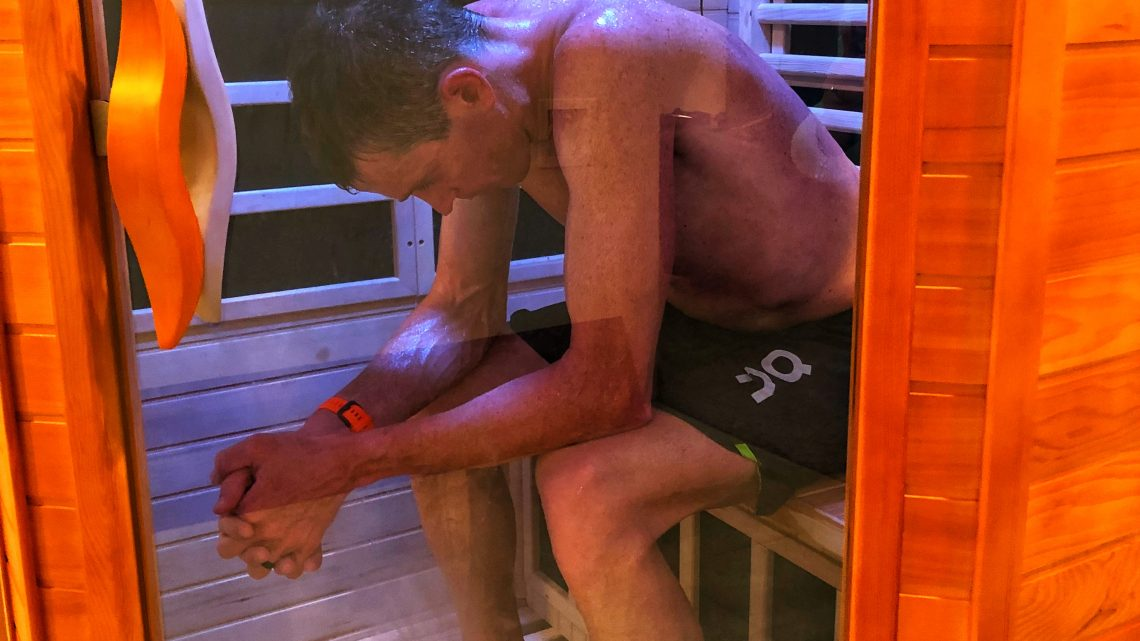
Heat was applied within 30 minutes following training and included sauna in 2 studies, hot-water immersion in 3 studies and heating pads in 1 study.
The heating protocols varied considerably:
- 10 to 40 minutes
- Approximately 38°C to 100°C
- Whole-body or localized heating
- Usually immediately or shortly after lifting
Resistance training ranged from full-body to lower-body programs.
Muscle growth was assessed using DXA, BIA, MRI, ultrasound, biopsy, and circumference measurements. Strength outcomes included 1RM, 3RM, 6RM, maximal voluntary contraction, and dynamometry.

The Performance Academy: Gain access to the best performance and rehab minds in the world through premium masterclasses, live and recorded events, plus a network of coaches and therapist around the world. Education, community, and networking under one roof, all at your fingertips.
What Were the Results?
Hypertrophy
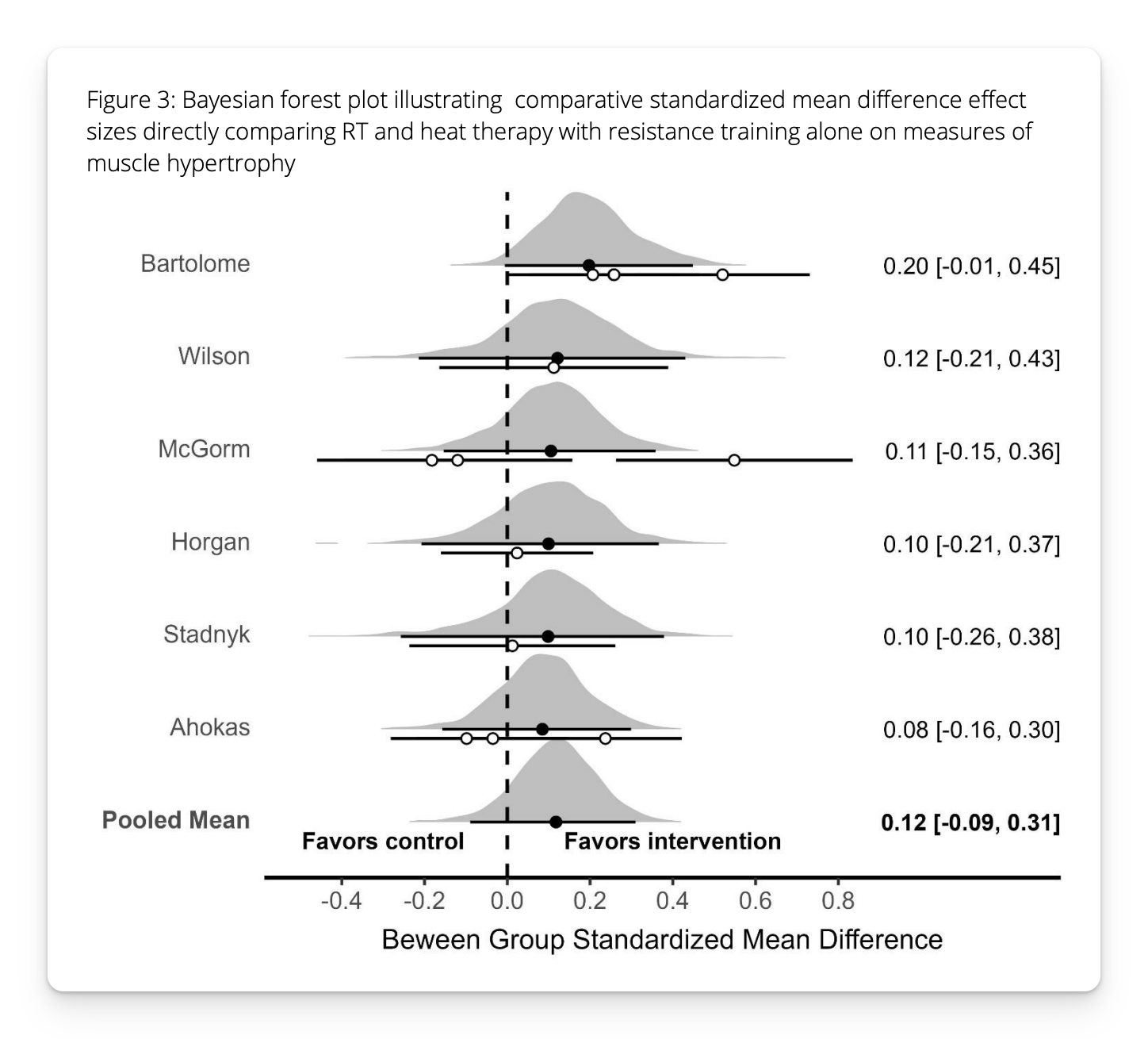
The direct comparison between resistance training plus heat versus resistance training alone slightly favored heat.
There was an:
- 89.7% probability that heat produced some positive effect
- 58.7% probability that the effect was at least small
- Only a 3.0% probability that the effect was at least moderate
- Essentially no probability that the effect was large
So the best estimate favors heat, but the expected effect is small and uncertain.
Strength
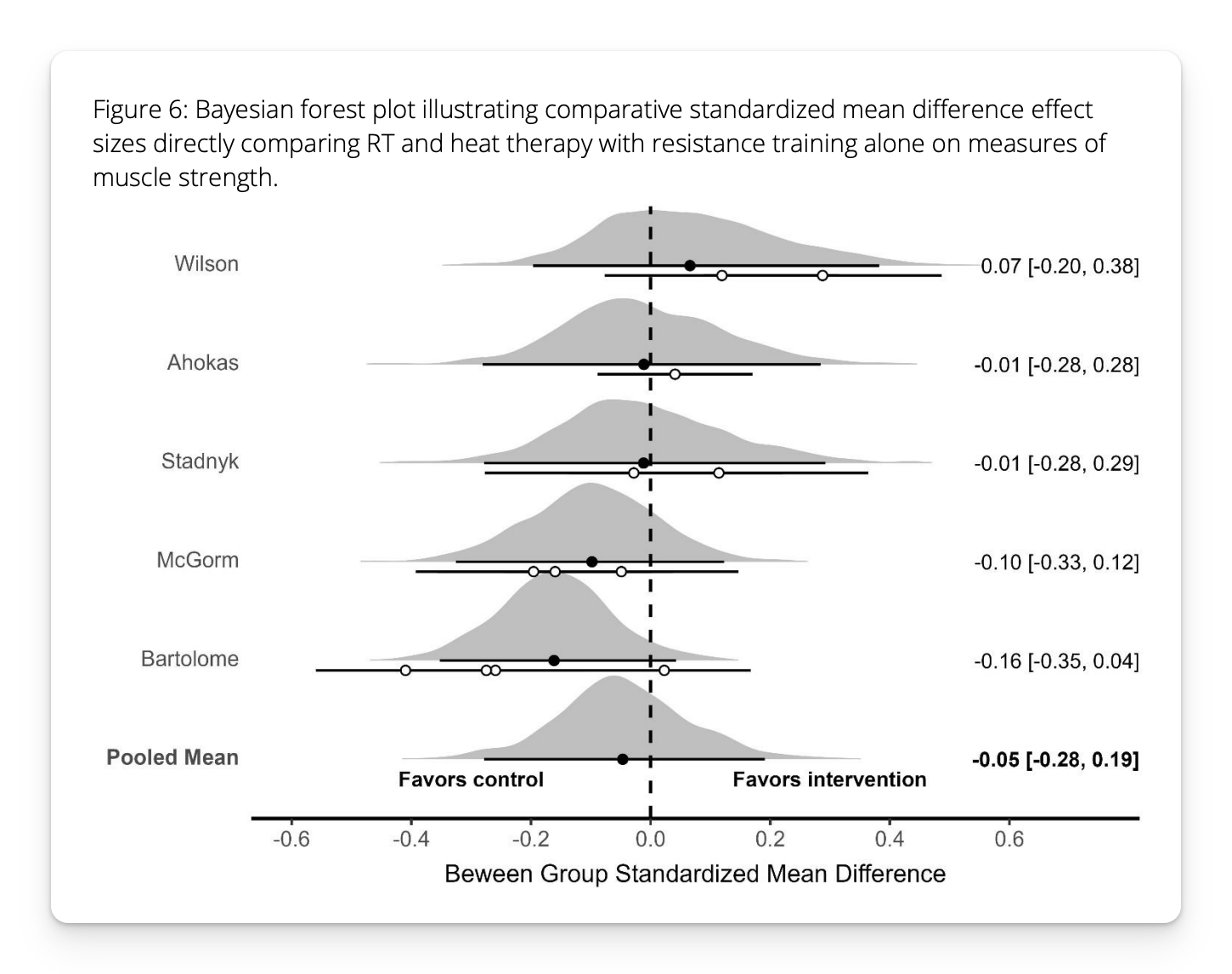
There was little evidence that post-training heat improved strength compared with resistance training alone. Both groups increased strength over time, but adding heat did not appear to provide any additional benefit.
The credible interval also included potentially small effects in either direction.
In practical terms, heat does not currently appear to enhance strength development.
What Does This Mean?
There is a small signal suggesting post-training heating may modestly enhance hypertrophy.
Several mechanisms could theoretically contribute:
- Increased muscle blood flow and nutrient delivery
- Increased tissue capillarization
- Changes in Akt/mTOR and other anabolic signaling pathways
- Increased heat shock protein activity
However, mechanistic plausibility does not prove that heat causes meaningful additional muscle growth. The authors also point out that acute signaling responses do not reliably predict long-term hypertrophy. And despite the small hypertrophy signal, strength adaptations were essentially identical between conditions.
Limitations
There are several important reasons to stay conservative with these findings.
- Only six studies were included and five of six studies were rated poor quality, with one rated fair.
- Heating protocols varied dramatically in temperature, duration, and modality.
- Samples were generally small and consisted of young adults.
- Many hypertrophy outcomes came from DXA, BIA, or circumference, which are much less direct measures of muscle growth than MRI or ultrasound.
There is also a practical issue hidden inside the meta-analysis. A 40-minute sauna at 100°C, 10 minutes of hot-water immersion, and a localized heating pad are very different physiological exposures. Pooling them tells us something about the general concept of heat, but very little about the dose coaches should actually prescribe.
Coach's Takeaway
- Post-training heat looks promising for hypertrophy, but the likely benefit is small, and there is currently little evidence that heating improves strength adaptations.
- I would not build a hypertrophy program around sauna or hot-water immersion and training volume, effort, exercise selection, progression, nutrition, and sleep remain far more important.
- The most interesting contrast may be with cold exposure. Repeated post-lifting cold immersion may interfere with adaptation, while heating appears neutral and potentially slightly beneficial.
I hope this helps,
Ramsey
Reference: Hopper A, Coleman M, Piñero A, et al. (2026). Feeling the heat: a systematic review with meta-analysis on the effects of post-resistance training heat therapy on muscular adaptations. Sport Sciences for Health, 22, 323.


