

Ankle sprains are common in basketball. Between landing on someone’s foot, stopping hard, and changing direction, the ankle has plenty to deal with.
As coaches, we need ways to prepare athletes for those demands. Single-leg lateral hops are one option, but choosing the exercise is only part of the job. We also need to understand how to progress it.
This study examined how hopping cadence and distance affected ankle mechanics and muscle activation. It gives us a clearer picture of the immediate demands of these progressions, although it cannot tell us which produces better adaptations over time.
When we ask athletes to hop faster or farther, how does the demand on the ankle change?
What Did the Researchers Do?
Study Design
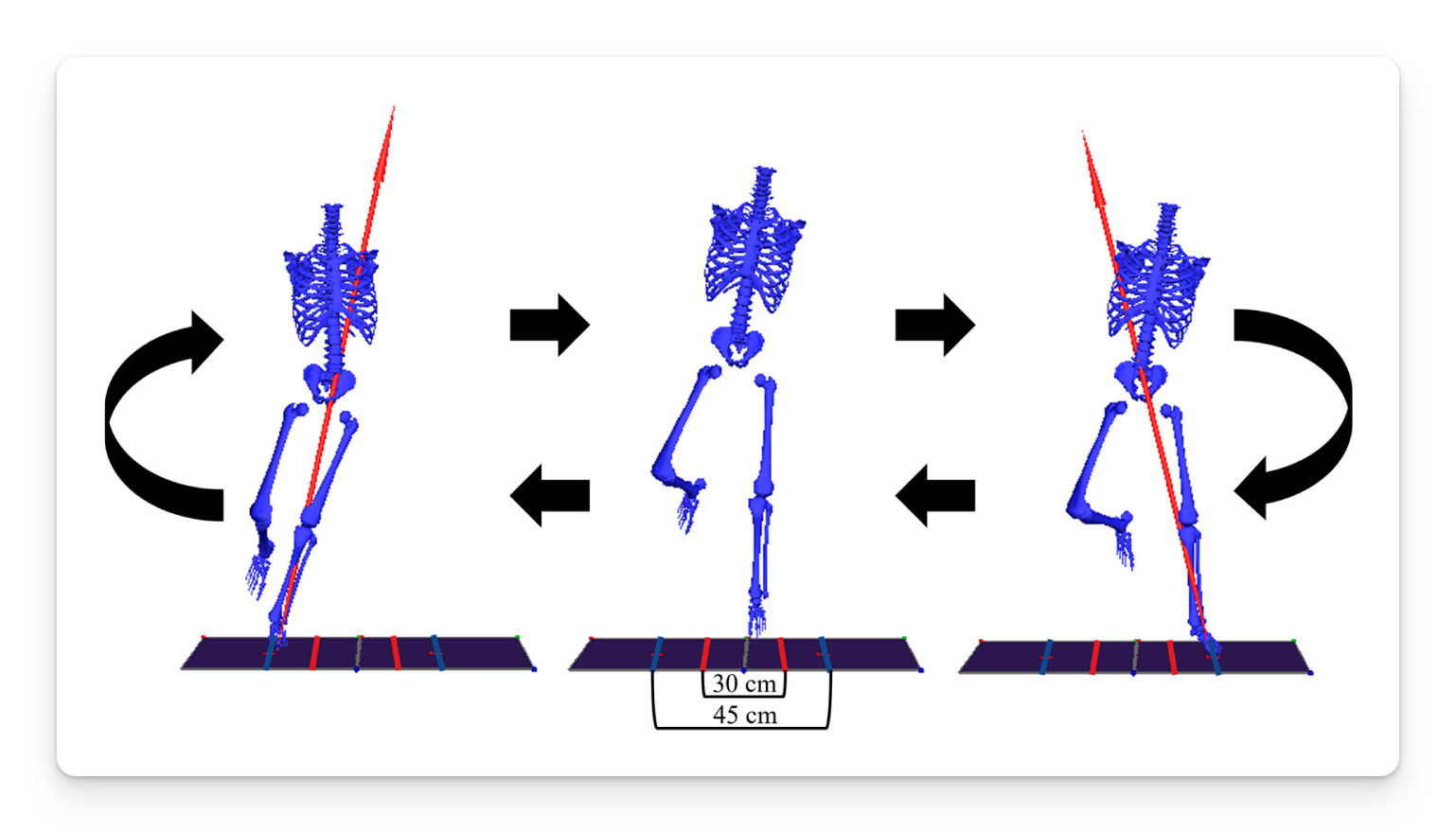
Twelve trained male team-sport athletes completed repeated side-to-side hops on his dominant leg under four conditions:
- Slow and narrow: 60 beats per minute over 30 cm.
- Fast and narrow: 120 beats per minute over 30 cm.
- Slow and wide: 60 beats per minute over 45 cm.
- Fast and wide: 120 beats per minute over 45 cm.
Participants completed three successful trials per condition in random order, with 20 individual hops per trial and one minute of rest between trials.
Measurements
Motion capture, force plates, and surface EMG measured ankle movement, joint moments, joint power, and activation of the soleus, lateral gastrocnemius, tibialis anterior, and peroneus longus.
Two measurement details worth clarifying:
- Joint moment describes the net rotational demand at the joint ⮕ It does not directly measure the force experienced by an individual muscle, tendon, or ligament.
- “Landing contact time” ran from touchdown to maximum knee flexion ⮕ It was not the full time from touchdown to leaving the ground.
Muscle activation was expressed relative to each muscle’s highest recorded activation across the tasks, rather than a maximum voluntary contraction.
What Were the Results?
Faster hopping increased ankle joint moments.
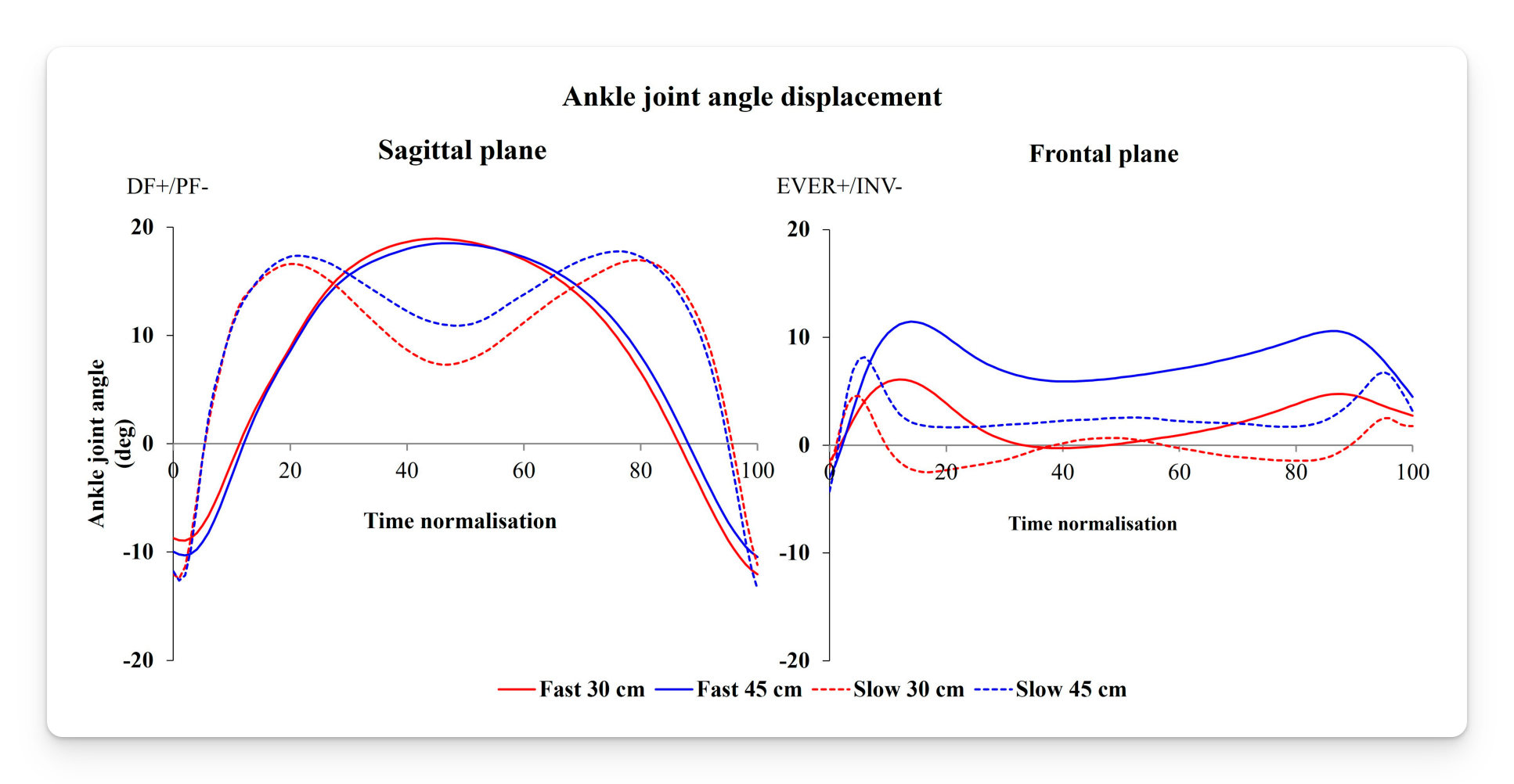
At both distances, faster hopping increased the magnitude of the sagittal-plane ankle moment and increased the frontal-plane eversion moment.
For example, at 30 cm, sagittal-plane moment magnitude increased from approximately 2.28 to 2.97 Nm/kg.
The landing phase also shortened from approximately 0.19–0.20 seconds to 0.16 seconds. Remember, these values represent touchdown to maximum knee flexion, rather than total ground contact.
Faster hopping increased positive ankle power in the sagittal plane.
Peak positive power during take-off increased from:
- 5.23 to 6.21 W/kg at 30 cm.
- 5.07 to 5.96 W/kg at 45 cm.
This finding remained significant after adjustment for multiple comparisons. Several apparent differences in negative power and frontal-plane power did not.
Wider hopping increased frontal-plane movement and joint moment.
Increasing distance from 30 to 45 cm increased frontal-plane ankle range of motion:
- From approximately 7.5° to 12.6° during slow hopping.
- From approximately 8.1° to 14.2° during fast hopping.
The eversion moment increased by 0.102 Nm/kg during slow hopping (95% CI: 0.065–0.139) and 0.150 Nm/kg during fast hopping (95% CI: 0.090–0.211).
The distance effect was significantly larger at the faster cadence.
What Does This Mean?
Speed and distance provide different loading options.
Faster cadence increased ankle moments, increased sagittal-plane positive power, and shortened the measured landing phase. Wider hops particularly increased frontal-plane movement and rotational demand.
These findings also show why muscle activation alone gives an incomplete picture of exercise demand. Wider hops changed joint mechanics without a detectable increase in peak activation of the measured muscles.
That does not establish unchanged muscle force or unchanged loading of individual tissues.
The study also did not measure tendon energy storage, elastic return, or movement efficiency. Explanations involving greater use of elastic energy remain speculative.
Limitations
- Acute comparisons: The study measured immediate responses, with no training intervention, performance improvements, or injury outcomes.
- Incomplete movement coverage: Only lateral contacts and four lower-leg muscles were analysed. Hip and knee contributions remain unclear.
- Measurement uncertainty: Trial-to-trial reliability was not formally assessed, and EMG cannot establish individual tissue forces.
Coach’s Takeaway
- Choose the progression around the demand you want to change ⮕ Faster cadence and greater distance affected ankle mechanics differently.
- Consider changing one variable at a time ⮕ This is a reasonable coaching approach for observing the athlete’s response, although the study did not test a progression sequence.
- Keep the conclusion within the evidence ⮕ These are options for manipulating exercise demand. Their effects on long-term performance and rehabilitation still need testing.
I hope this helps,
Ramsey
Reference: Suwanmana, S., Jamkrajang, P., Robinson, M. A., Kim, H., & Limroongreungrat, W. (2026). Ankle Biomechanics and Muscle Activation During Repeated Single-Leg Lateral Hopping: Effects of Speed and Distance. Biomechanics, 6(3), 76.


