

Athletes repeatedly land and decelerate as their ability to produce force declines. Understanding how fatigue changes these movements can inform how we organize training and interpret movement assessments.
The quadriceps and hamstrings contribute differently to knee mechanics. Researchers compared fatigue of these muscle groups to determine whether each produced different changes during a single-leg landing.
Does fatiguing the quadriceps or hamstrings change how athletes land, and which changes depend on the muscle group fatigued?
What Did the Researchers Do?
Design
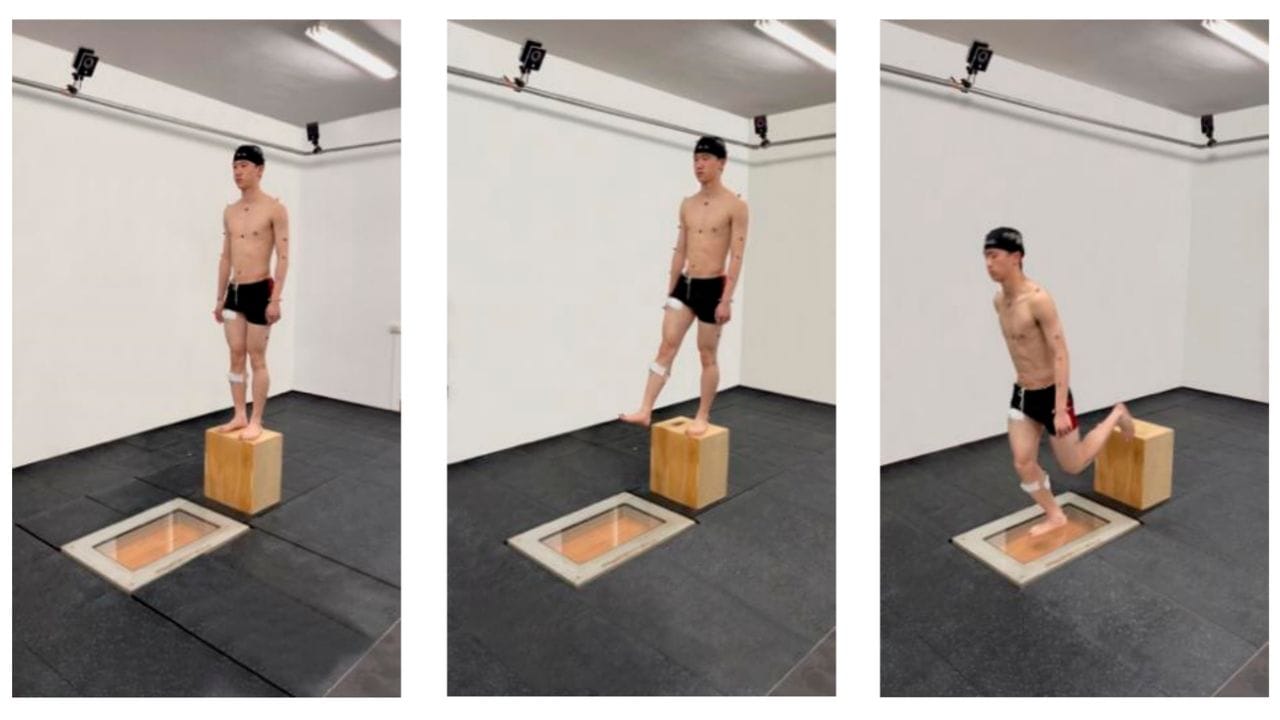
Researchers randomized 108 male football and basketball athletes aged 20–25 into quadriceps or hamstring fatigue groups. Ninety-three completed testing: 45 in the quadriceps group and 48 in the hamstring group.
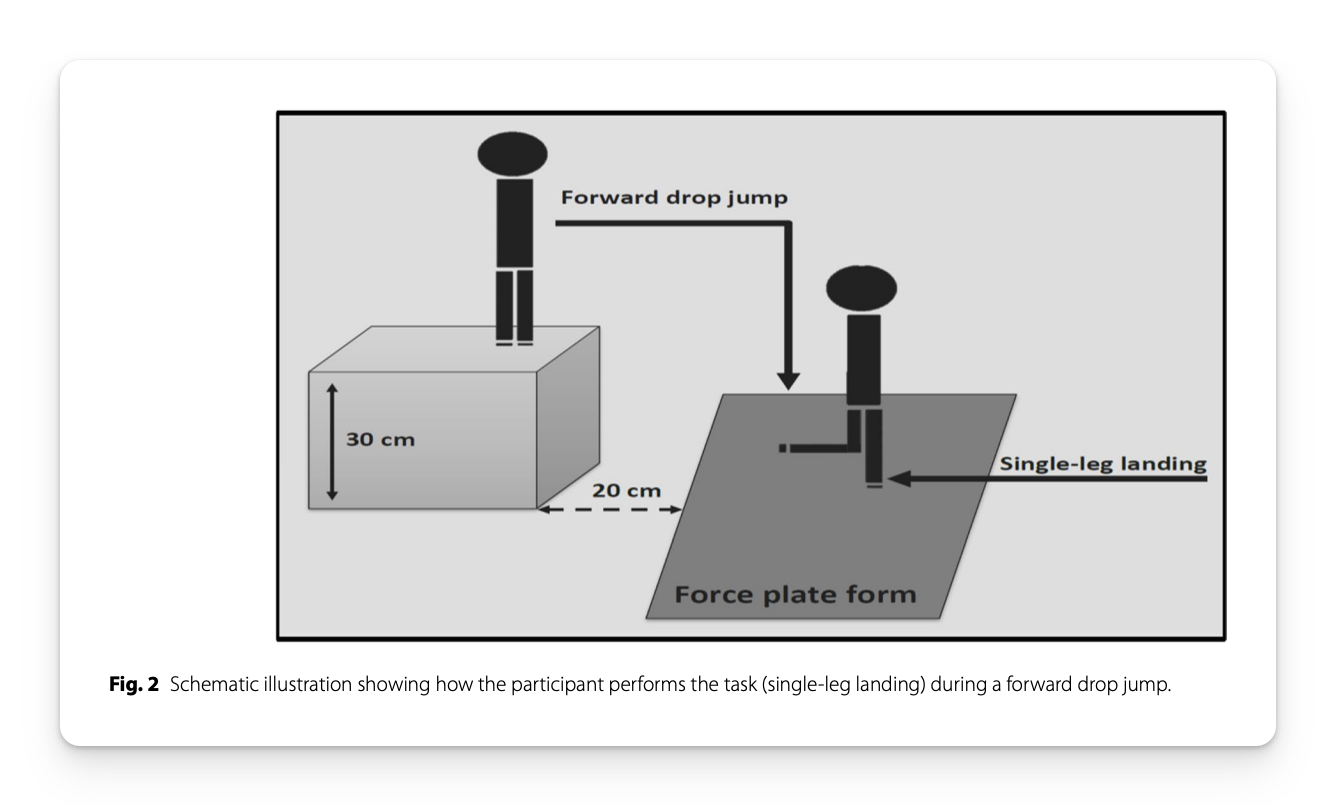
- They performed a forward-drop jump from a 30-cm platform, landing on their dominant leg.
- Successful trials required forefoot contact and a stable landing without corrective steps.
- Three trials were averaged before and after fatigue.
Fatigue
- Fatigue was induced using repeated maximal concentric knee extensions or flexions on an isokinetic dynamometer.
- The criterion was torque falling below 50% of baseline maximum for five consecutive cycles.
- Post-fatigue landing testing began approximately 30–45 seconds later and finished within 3–5 minutes.
Measures
- Motion capture and force plates measured knee flexion and vertical ground reaction force.
- Inverse dynamics estimated knee moments and anterior tibial shear force.
- Researchers compared changes between groups and explored relationships among the post-fatigue measurements.
What Were the Results?
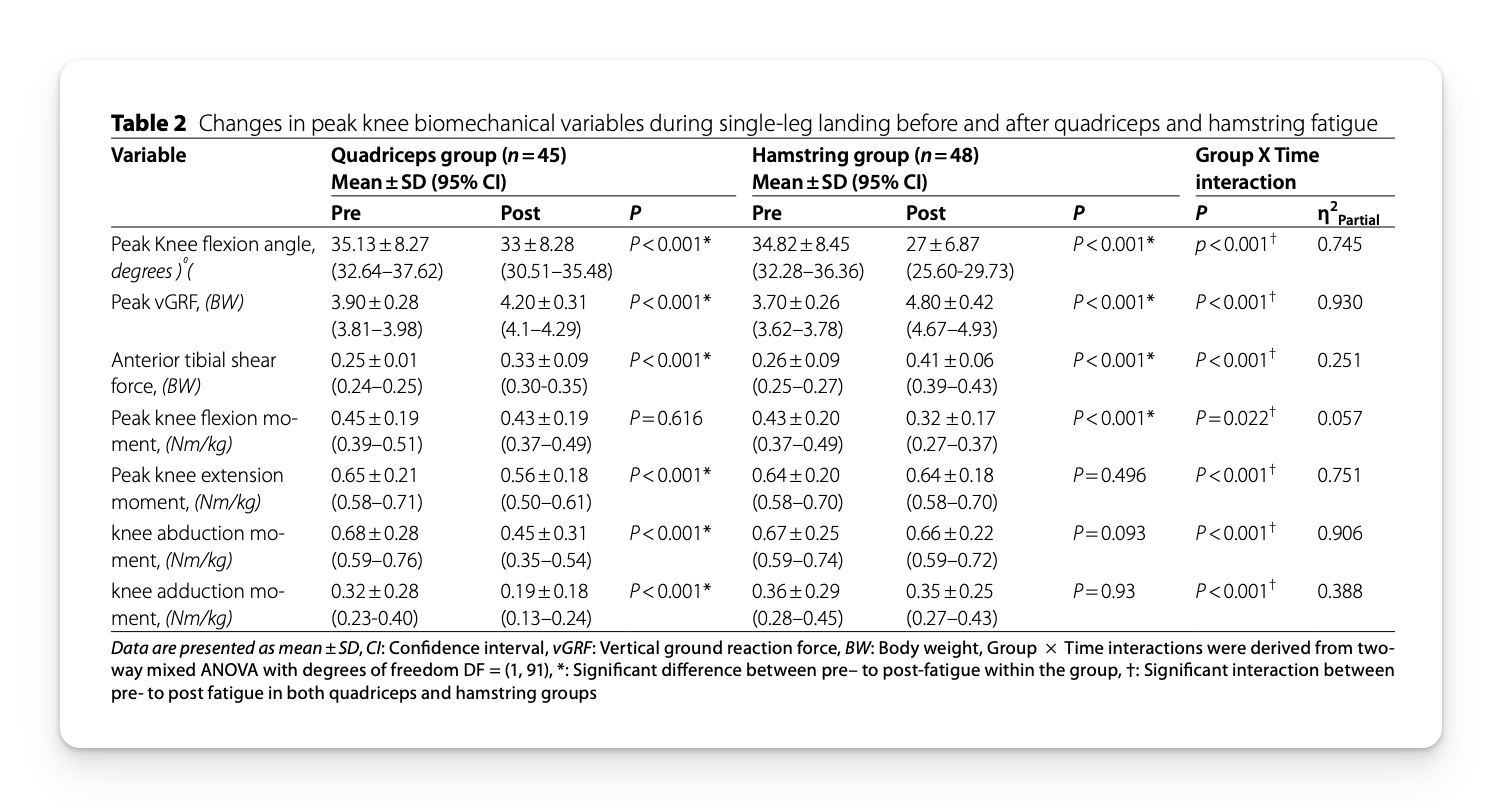
Both fatigue conditions reduced peak knee flexion and increased peak vertical landing force. Changes were larger after hamstring fatigue.
- Peak knee flexion ⮕ Decreased from 35.13° to 33° after quadriceps fatigue and from 34.82° to 27° after hamstring fatigue.
- Peak vertical force ⮕ Increased from 3.9 to 4.2 times body weight after quadriceps fatigue and from 3.7 to 4.8 times body weight after hamstring fatigue.
- Estimated anterior tibial shear force ⮕ Increased from 0.25 to 0.33 times body weight after quadriceps fatigue and from 0.26 to 0.41 after hamstring fatigue.
The changes in knee bend and landing forces were significantly larger after hamstring fatigue than quadriceps fatigue.
What Does This Mean?
Under these testing conditions, athletes landed with less knee bend and higher peak vertical force after fatigue. Hamstring fatigue produced larger changes than quadriceps fatigue.
The findings show that local muscle fatigue can influence landing strategy. They do not establish that hamstring fatigue is more dangerous overall.
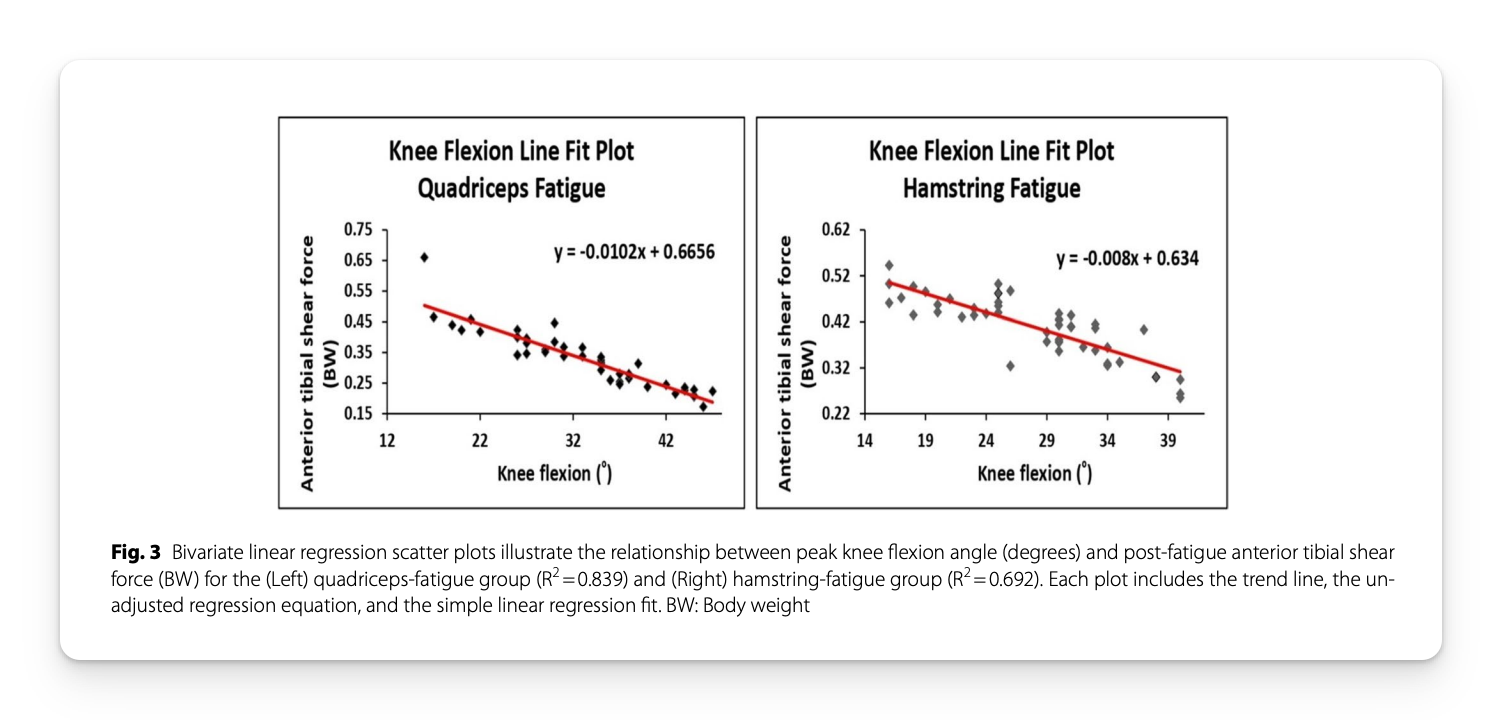
Anterior tibial shear force was a model-derived joint reaction measure. It was not a direct measurement of ACL force or strain. Similarly, the relationship between knee flexion and estimated shear force partly reflects their shared biomechanical model. It does not prove that coaching more knee bend will reduce injury risk.
Limitations
- Isolated concentric fatigue and a planned drop landing differ substantially from competition.
- Fatigue could have partially recovered during post-fatigue testing.
- Baseline torque was measured at 120°/s, while fatigue repetitions used 300°/s, complicating interpretation of the fatigue threshold.
Coach’s Takeaway
- Watch how landing strategies change with fatigue ⮕ Higher peak force and reduced knee excursion describe a movement response, not an individual injury forecast.
- Consider exercise order ⮕ Substantial local fatigue before landing practice may change the movement being coached.
- Train fatigue mechanics ⮕ Should we consider training mechanics while athletes are fatigued?
I hope this helps,
Ramsey
Reference: Mahmoud, W. S., et al. (2026). Is there a difference in knee biomechanics due to fatigue of the quadriceps versus hamstrings during landing on a single limb? A randomized comparative laboratory study. BMC Sports Science, Medicine and Rehabilitation, 18, 459.

The Performance Academy: Gain access to the best performance and rehab minds in the world through premium masterclasses, live and recorded events, plus a network of coaches and therapist around the world. Education, community, and networking under one roof, all at your fingertips.


