

Most of us have watched an ACL injury clip and paused it when the knee moves inward. That frame can tell us something about the knee.
But its the sequence around it that can tell us how the player got there, what happened as the foot accepted load, and which parts of the movement differed from one injury to the next.
A new study by Zago and Della Villa used 33 reconstructed ACL ruptures from elite men’s soccer to synthesize five years of work on injury mechanics.
What tends to happen at the knee as the foot accepts load during ACL rupture, and how similar are the movements that get players into that position?
What did the researchers do?
- They reconstructed 33 complete ACL ruptures from official matches across six professional leagues and two international competitions during the 2020–21 through 2022–23 seasons.
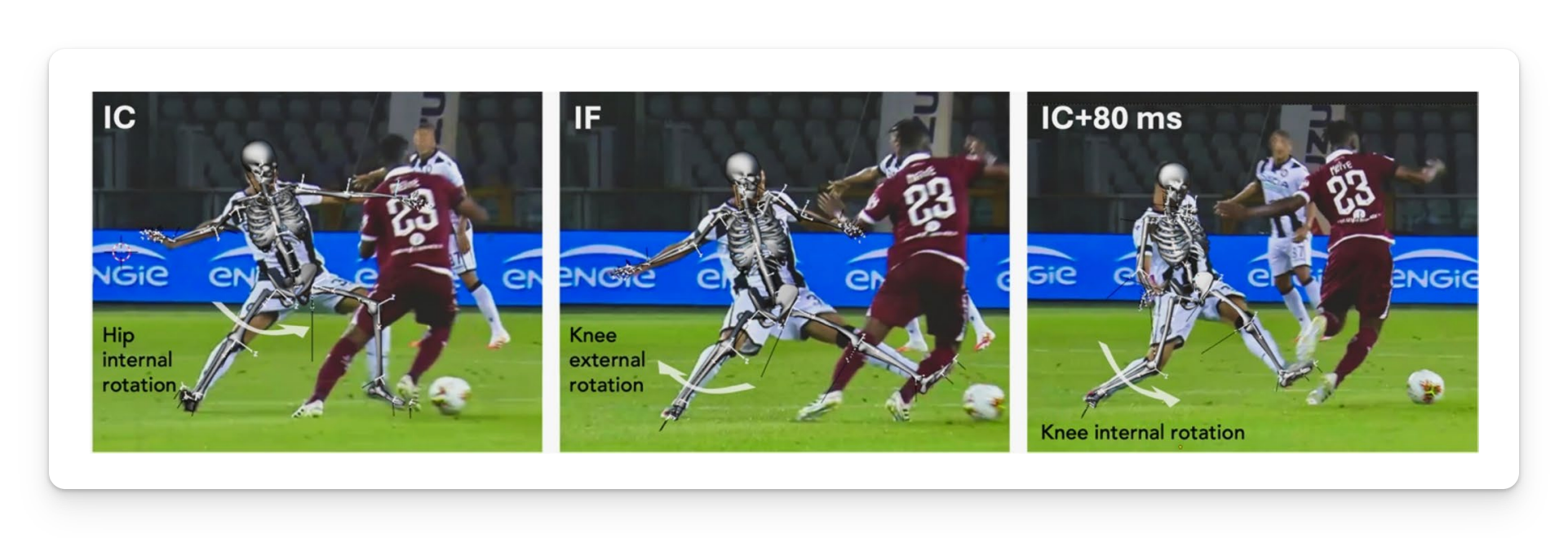
- They built a 3D reconstruction from broadcast video. The researchers synchronized camera views, calibrated them against the known dimensions of the pitch, and fitted a digital skeleton to the player across selected frames. They interpolated between frames to estimate how the trunk, pelvis, and injured limb moved.
- They examined the lead-up and the loading phase. The reconstruction typically covered about 500 ms before foot strike to 200 ms after it. Table 1 compares initial contact with a suspected injury frame 80 ms later. The analysis was descriptive and included no matched uninjured plays.
What were the results?
Pressing was the most common non-contact scenario
- Of the 33 ACL injuries, 24 were non-contact (73%) and 9 involved indirect contact (27%).
- Among the 24 non-contact cases, 54% occurred during pressing, 21% during offensive changes of direction, 17% while regaining balance after kicking, and 8% during jump landings.
- All nine indirect-contact cases involved a duel, such as tackling or being tackled.
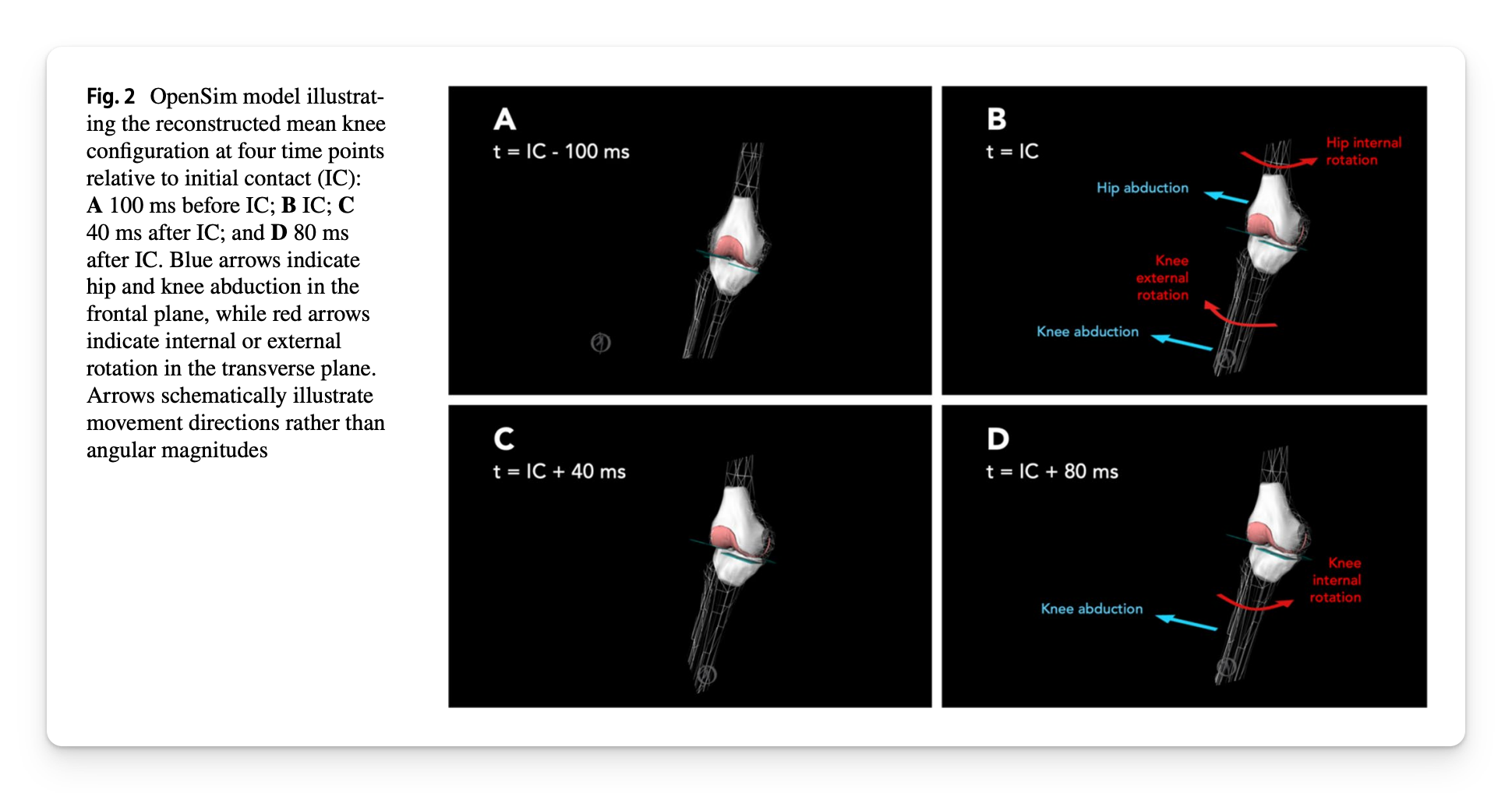
The knee bent further and shifted toward valgus
- From foot strike to the suspected injury frame, mean knee flexion increased from 41.3° to 47.0°.
- Over the same window, mean knee abduction increased from 2.6° to 4.2°.
- The valgus shift occurred across a wide range of knee flexion angles, roughly 10° to 90° across cases.
Knee rotation changed direction after foot strike
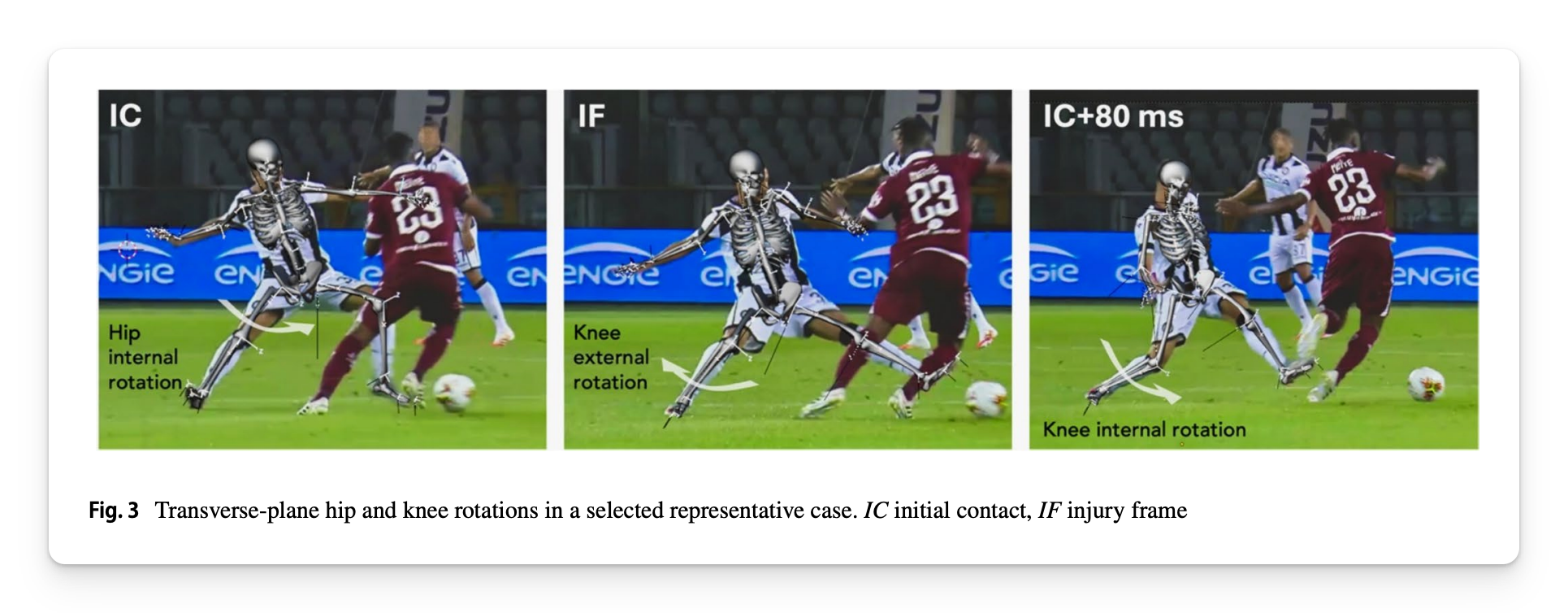
- Relative to the shin, the thigh first rotated inward, then frequently reversed toward outward rotation.
- Viewed from the thigh, the same sequence is described as the shin rotating outward, then inward.
Whole-body positions varied considerably
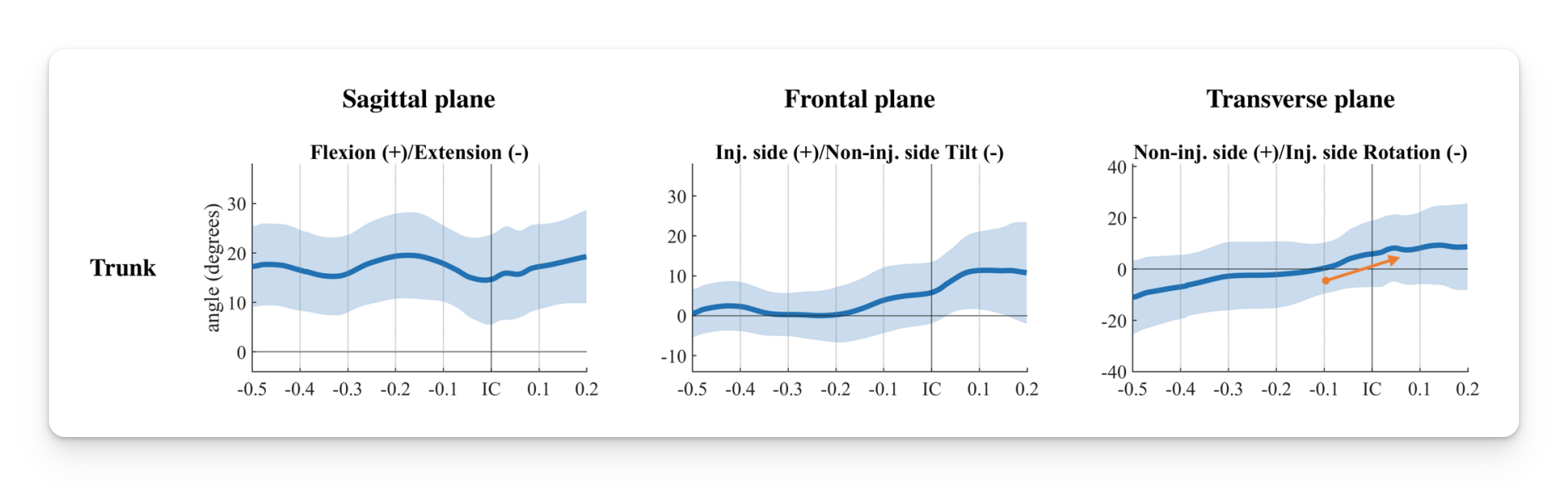
- At foot strike, trunk lean toward the injured side averaged 5.8°, with a standard deviation of 11.7°. Trunk rotation varied even more.
- An attacker changing direction and a defender entering a tackle could arrive at a similar knee motion from different whole-body positions.
What does this mean?
Valgus is one visible piece of a three-dimensional event
- The knee can flex, move into abduction, and change its direction of rotation during the same brief loading phase.
- The sequence gives you a better sense of how the knee moved into and through it the injury frame that is often emphasized.
The knee pattern was more consistent than the movement that preceded it
- A late press and a tackle give the athlete different information, different foot-placement options, and different amounts of time to adjust.
- The authors argue that technical coaching belongs in the prevention conversation for exactly this reason.
Limitations
- There were no matched uninjured plays so we don’t know how often these same knee motions occur when players press, cut, or tackle successfully.
- The angles and timing were estimated based on camera views, model fitting, and interpolation which introduce uncertainty; the 80 ms mark is the paper’s suspected injury frame.
- These were elite male players whose ruptures had usable broadcast footage.
Coach’s takeaway
- Watch the two or three steps before the plant ⮕ When reviewing a press, look at how fast the player closed space, when they began braking, and when the ball carrier gave them a reason to change direction.
- Progress the decision alongside the physical demand ⮕ A planned closeout lets you coach the approach and braking steps while a live attacker who can cut asks the defender to use those skills while reading the play.
- Review successful reps alongside the messy ones ⮕ Compare how the player enters, brakes, and adjusts across similar situations; this gives you something more actionable to coach than a knee position in a single frame.
The researched do a great job of explaining what these results mean and specifically I love this quotes from the conclusion...
ACL injuries are not purely mechanical phenomena but also involve contextual determinants, perceptual and decision-making processes. Practitioners would want players to be able to safely stabilise joints in a complex, dynamic, ever-changing and sport-specific sensory environment, which impacts on how the injury happens. Thus, prevention has to move in the direction of discipline specificity and context exposure.
I hope this helps,
Ramsey
Reference
Zago M, Della Villa F. (2026). 3D Biomechanics of Anterior Cruciate Ligament Injuries in Football: What We Have Learned in the Last Five Years. Sports Medicine.


