

We know speed = stride length × stride frequency. But athletes do not simply keep increasing both forever.
At some point ground contact gets too short, muscles cannot keep producing more force and the body must change strategies.
This study explored:
- Which muscles drive stride length
- Which muscles drive stride frequency
- Why sprinting mechanics shift as speed increases
The major takeaway is that there appears to be a muscular “handoff” during sprinting.
Lets break it down.
How does sprinting speed alter the muscular strategy used by the athlete?

What Did the Researchers Do?
To estimate how individual muscles contributed to sprinting across different speeds, researchers combined motion capture, force plate data, EMG, and musculoskeletal computer modeling.
Subjects
- 9 trained runners
- Both males and females
- Tested across multiple running speeds
Running Speeds
Subjects ran at:
- ~3.5 m/s
- ~5.0 m/s
- ~7.0 m/s
- ~9.0 m/s (max sprinting)
Measurements Included
- Stride length
- Stride frequency
- Ground contact time
- Aerial time
- Vertical impulse
- Muscle forces
- Joint accelerations
The researchers then estimated how much each muscle contributed to:
- Vertical support force
- Hip acceleration
- Knee acceleration
- Swing mechanics
What Were the Results?
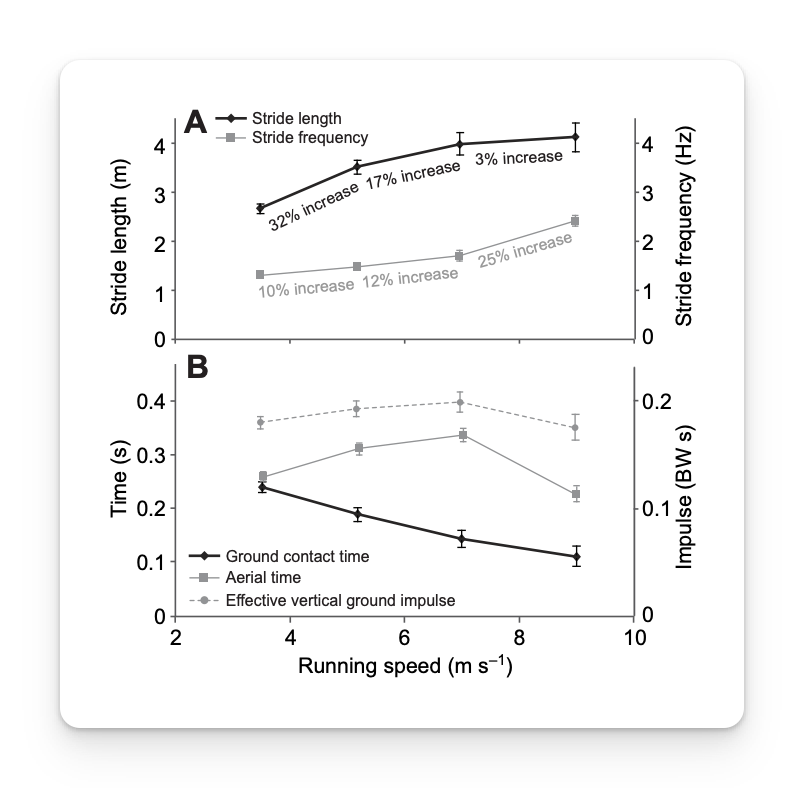
Up to ~7 m/s, athletes mainly got faster by increasing stride length
From 3.5 to 7.0 m/s:
- Stride length increased substantially
- Stride frequency increased modestly
- Vertical impulse increased
- Aerial time increased
This means athletes primarily ran faster by producing more support force into the ground.
The key muscles were the Soleus and Gastrocnemius. The Soleus alone contributed up to ~50% of vertical support force.
In other words, early speed development is heavily ankle-driven. The plantarflexors are major engines for:
- Projection
- Support
- Longer strides
Above ~7 m/s, the ankle strategy started breaking down
As sprint speed increased:
- Ground contact time became extremely short
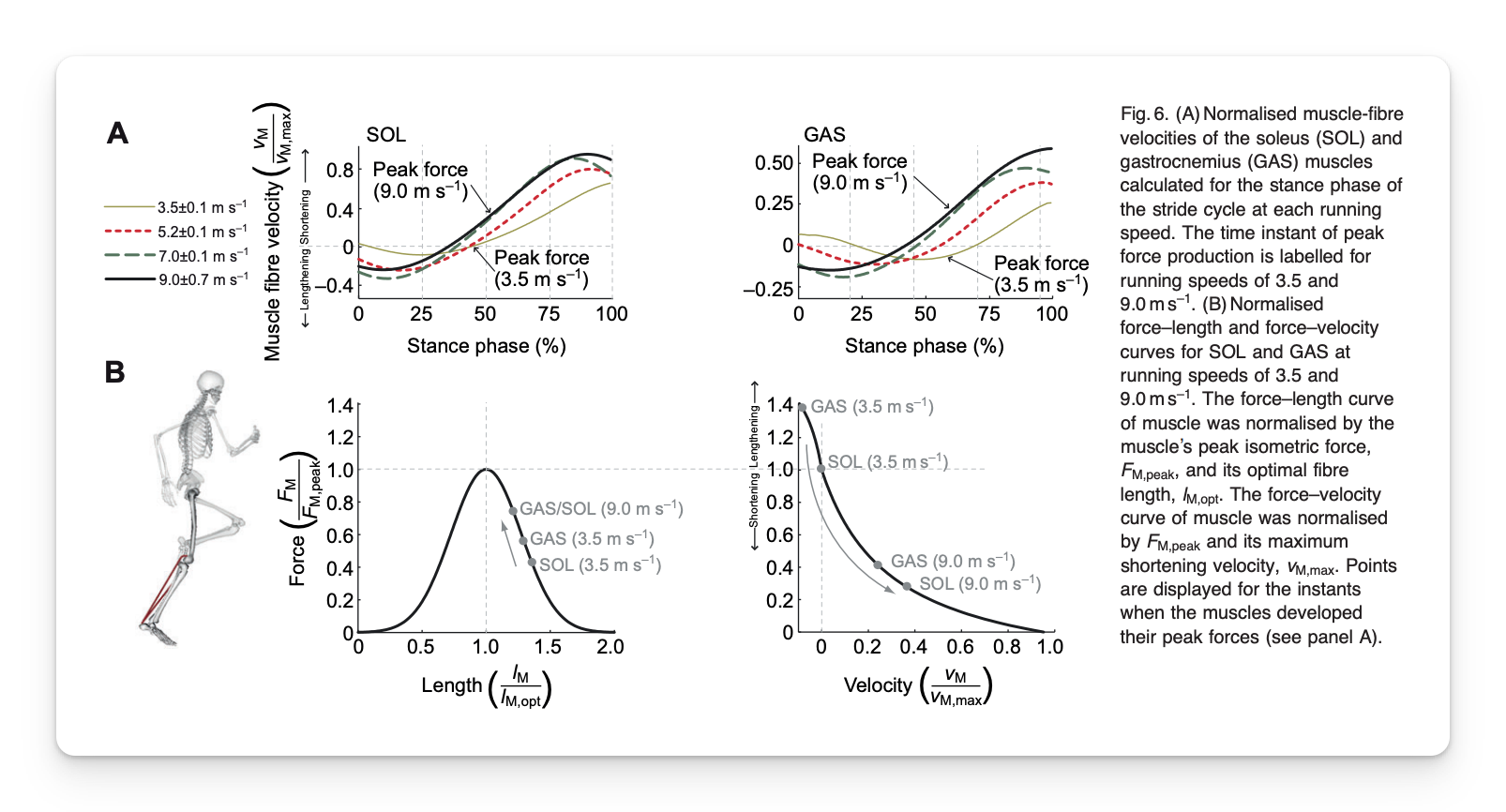
- The plantarflexors shortened faster
- Force-producing ability dropped
This was one of the most important findings in the paper. At sprinting speeds:
- Soleus shortening velocity became very high
- Force capacity dropped dramatically because of force-velocity limitations
The researchers estimated that the Soleus force-generating capacity dropped from ~100% to ~30% and Gastrocnemius dropped from ~140% to ~40% because the muscles simply do not have enough time to produce large forces.
The sprint strategy shifted toward stride frequency
Once athletes passed ~7 m/s:
- Stride length stopped increasing much
- Stride frequency became the dominant strategy
To achieve this, hip flexors accelerated the leg forward faster and hip extensors reversed the leg faster during late swing
The main muscles driving leg shift are the Iliopsoas, Glute max, and Hamstrings.
These muscles created larger hip accelerations, larger knee accelerations, and faster swing mechanics.
The increase was massive between 7.0 and 9.0 m/s, and in some cases, muscle forces nearly doubled.
In other words, max velocity sprinting becomes a hip-driven movement problem, not just a force production problem.
What Does This Mean?
- At lower speeds, the primary goal is to produce support force and increase stride length, driven primarily by the soleus and gastrocnemius
- At higher speeds, the primary goal is to increase limb velocity and stride frequency, driven primarily by the hip flexors, glute max, and hamstrings
- The ankle may partially limit top speed because the plantarflexors become mechanically constrained at very high sprint speeds, where contact times become extremely short and muscle shortening velocities become too high to maintain force production, creating a classic force-velocity limitation
- Hip function becomes increasingly critical at maximal velocity, where faster athletes may separate themselves through superior swing mechanics, hip power, stiffness, and front-side timing, helping explain why sprint drills, hip projection work, and max velocity mechanics become more important as sprint speed increases
Limitations
- This was a muscle modelliung study, so muscle forces were not directly measured
- Steady state only, accelerations was not tested or measured
- Small sample of 9
Coach’s Takeaway
- Acceleration and early sprint speed appear heavily ankle-driven, with the plantarflexors playing a major role in support force production and increasing stride length
- As sprint speed increases and contact times shrink, the ankle becomes increasingly mechanically constrained because shortening velocities rise and force-producing capacity drops
- Top speed sprinting shifts toward a more hip-dominant strategy, where the hip flexors, glutes, and hamstrings help drive stride frequency and limb velocity
- Speed training likely needs to evolve across the sprint spectrum rather than treating “speed” as one quality
- Early acceleration training may emphasize force production, projection, resisted sprinting, and ankle stiffness, while max velocity training may place greater emphasis on hip power, limb speed, front-side mechanics, and elastic coordination
I hope this helps,
Ramsey
Reference
Dorn TW, Schache AG, Pandy MG. (2012). Muscular strategy shift in human running: dependence of running speed on hip and ankle muscle performance. Journal of Experimental Biology, 215, 1944–1956.


