

Longer muscle fascicles, particularly in the biceps femoris long head (BFlh), are commonly associated with faster sprinting. They may support higher shortening velocities because more sarcomeres can be arranged in series.
We also know that eccentric resistance training can increase fascicle length. What has been less clear is whether sprinting itself is enough to meaningfully remodel muscle architecture.
This study isolated a sprint-focused training block as much as practically possible and asked whether repeated exposure to maximal velocity, acceleration, and resisted sprinting could change muscle architecture without substantial concurrent sport or resistance training.
Can sprint-focused training lengthen muscle fascicles, and if it does, does that automatically make athletes faster?
What Did the Researchers Do?
Fourteen recreationally active field-sport athletes completed an 8-week sprint-focused intervention:
- 10 females and 4 males
- Average age: 21.6 years
- Approximately 4 years of training experience
- 3 supervised sessions per week
- Training adherence was approximately 99%
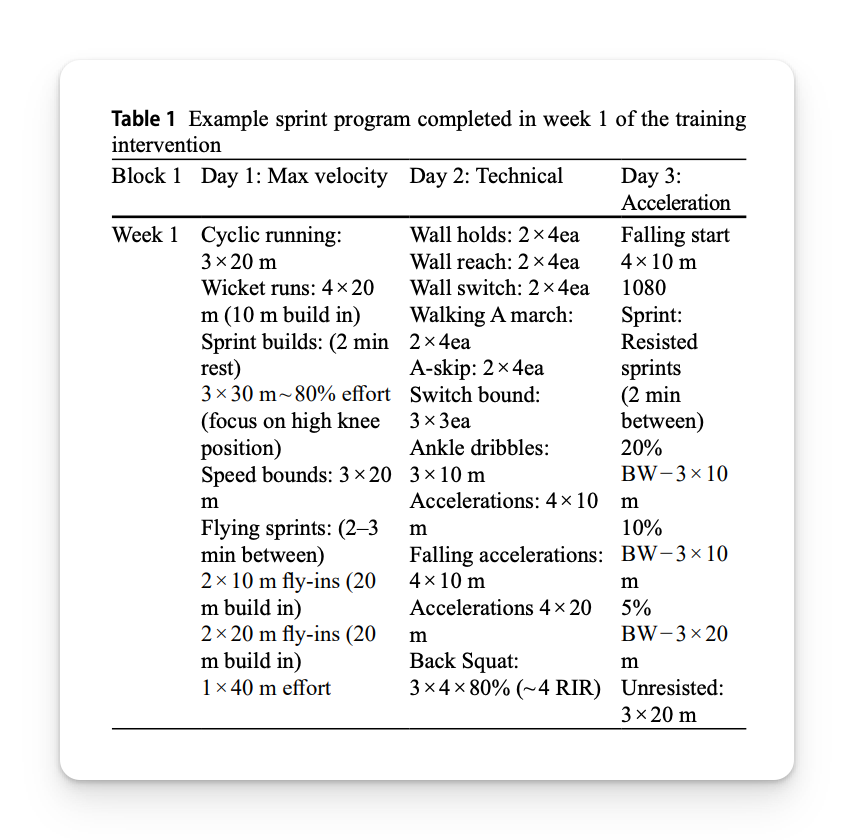
Training included:
- Maximal-velocity sprinting
- Resisted sprinting
- Unresisted acceleration
- Sprint drills and technical work
- One weekly dose of back squatting, 3 × 4 at 80% 1RM, intended primarily to maintain strength
To isolate the effects of sprinting, participants were not permitted to perform additional lower-body strength work, sprinting, or sport training.
Researchers measured:
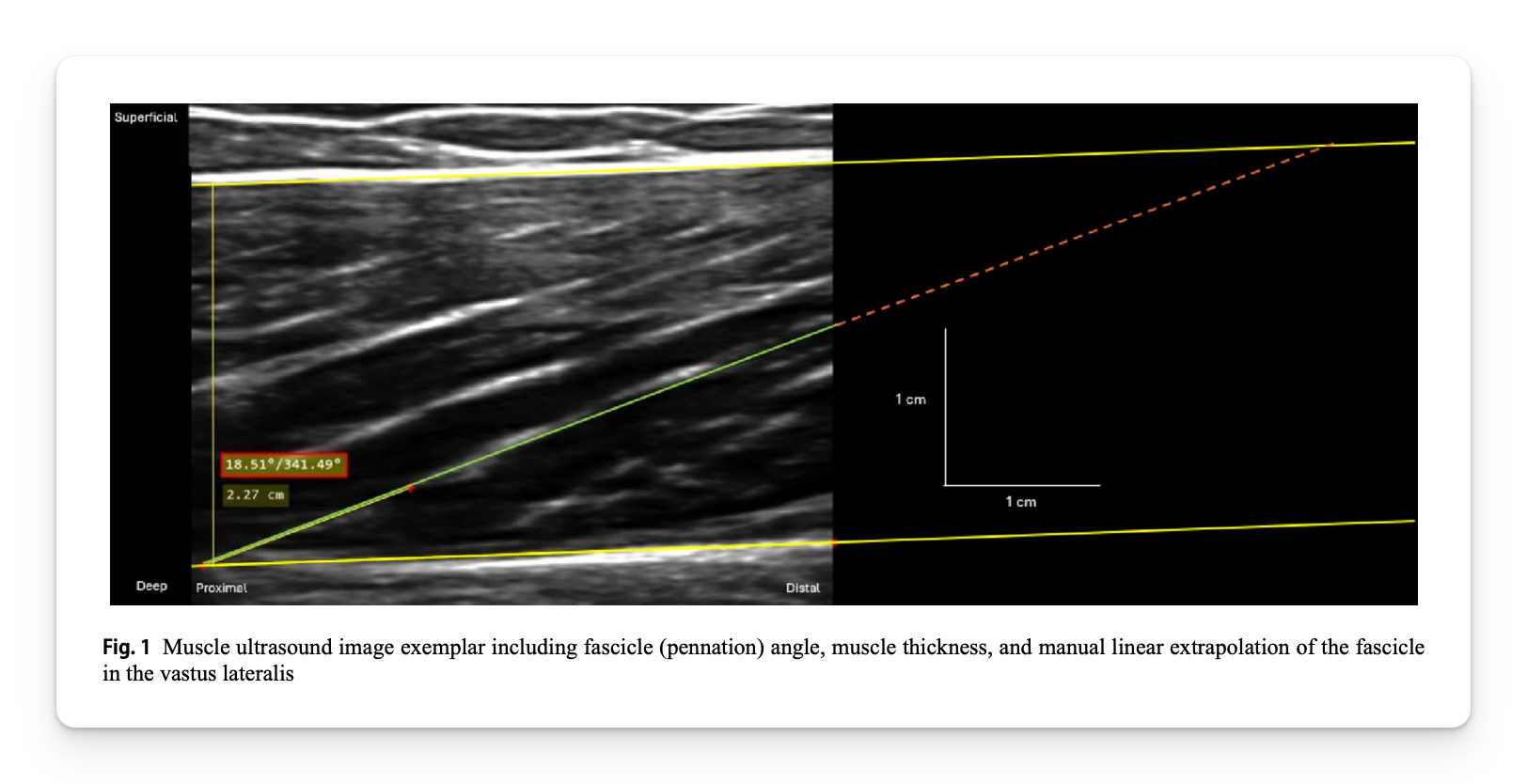
- BFlh and vastus lateralis (VL) fascicle length was estimated using 2-D ultrasound
- Muscle thickness and pennation angle was estimated using 2-D ultrasound
- 5 to 40 m sprint performance
- Flying 10 m
- Maximal velocity and acceleration
- CMJ
- Drop jump RSI
- Isometric squat
- 3RM back squat
What Were the Results?
Muscle Architecture Changes
The biggest finding was the magnitude of the architectural change.
After eight weeks, estimated fascicle length increased:
- BFlh left: +25.7%
- BFlh right: +27.5%
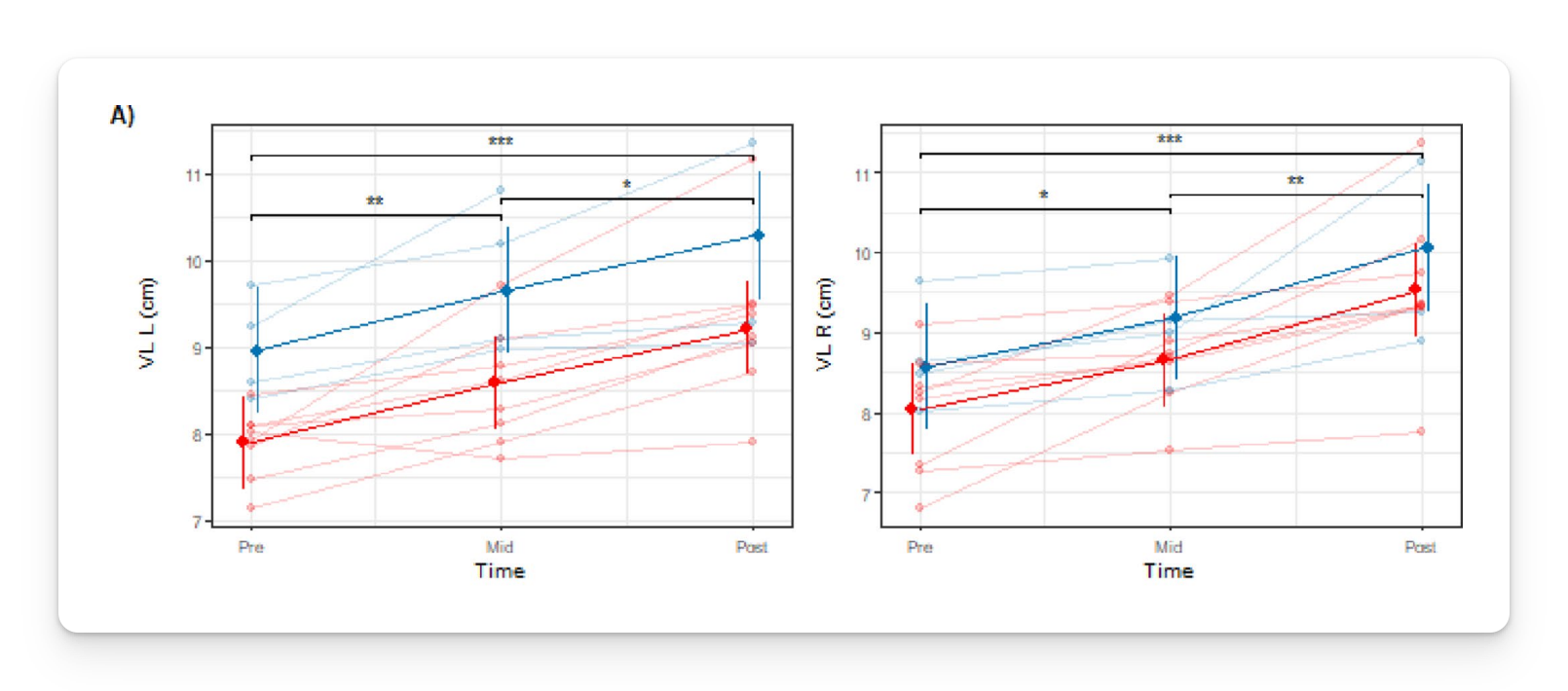
- VL left: +14.5%
- VL right: +16.8%
Muscle thickness also increased approximately 5 to 10% in several measures, while pennation angles generally decreased.
The individual trajectories show a clear upward shift in estimated fascicle length across the intervention.
Sprint Performance Changes
There were no statistically significant improvements in sprint, jump, or strength performance.
The most notable sprint changes were:
- Flying 10 m: ~2.2% faster, small effect
- Max velocity: little meaningful change
- 5 m: actually slower at post-test
- Max acceleration: also decreased
CMJ height improved about 4.9%, but again there was no significant main effect.
Perhaps most interesting, athletes who increased fascicle length the most were not clearly the athletes who improved sprint performance the most. Relationships between fascicle-length changes and flying 10 m improvements were trivial to small and non-significant.

The Performance Academy: Gain access to the best performance and rehab minds in the world through premium masterclasses, live and recorded events, plus a network of coaches and therapist around the world. Education, community, and networking under one roof, all at your fingertips.
What Does This Mean?
The muscle appears capable of adapting substantially to sprint exposure even when measured sprint performance barely changes.
Which is a good reminder that structural adaptation and performance adaptation are not the same thing.
Longer fascicles may provide favorable architecture for high-speed contraction, but sprinting still requires coordination, neural output, tendon behavior, technique, force orientation, and the ability to express force during extremely short ground contacts.
Another possibility raised by the authors is timing.
Architectural remodeling may occur first, with performance improvements requiring additional exposure before the athlete can fully express those structural changes, a reasonable hypothesis based on previous research.
Limitations
- No control group making the findings observational rather than definitively causal.
- Fascicle length was estimated using 2-D ultrasound and linear extrapolation, rather than directly visualizing the entire fascicle.
- Only 14 participants over 8 weeks so larger and longer studies may have resulted in different results.
Coach's Takeaway
- Sprinting appears to be a legitimate architectural stimulus ⮕ Max velocity, acceleration, and resisted sprint exposure may substantially increase estimated BFlh and VL fascicle length.
- Do not confuse adaptation with performance ⮕ A muscle characteristic becoming more favorable does not guarantee an immediate improvement in sprint time.
- This supports sprinting as training, not simply testing ⮕ Sprint exposure creates meaningful biological adaptation even when the stopwatch does not immediately move.
- Performance emerges from multiple systems ⮕ Architecture may increase an athlete's potential, but coordination, neural qualities, force production, technique, and repeated sprint exposure still determine how that potential gets expressed.
I hope this helps,
Ramsey
Reference: Stutter LR, Duhig S, Carey DL, Driller MW, Davids CJ, James LP. (2026). Muscle architectural and performance adaptations following an 8-week sprint-focused training intervention. European Journal of Applied Physiology.


