

For years, endurance performance has been viewed primarily through a physiological lens. VO₂max, lactate threshold, and running economy dominate most conversations. Yet we also know that stronger runners tend to perform better, especially when resistance training is included alongside endurance training.
The challenge has been identifying which strength qualities matter most.
This study explored whether mechanical variables obtained from a simple velocity-based back squat assessment relate to running performance in highly trained trail runners. Rather than asking whether stronger runners run faster, the researchers asked whether specific neuromuscular qualities measured during squatting are associated with the mechanics that underpin efficient running.
Which strength qualities measured during a submaximal back squat are associated with better running mechanics in highly trained endurance runners?

What Did the Researchers Do?
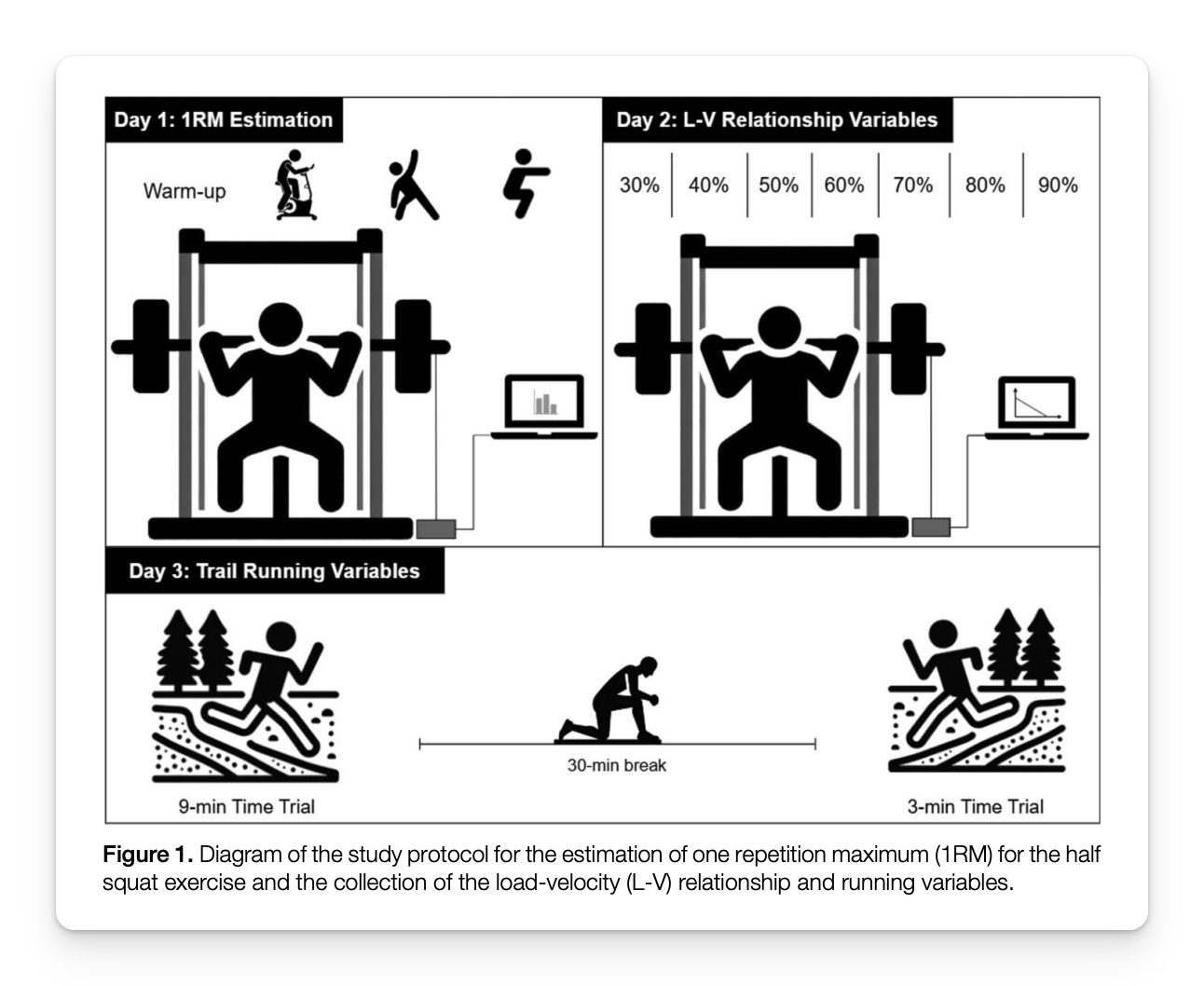
Fifteen highly trained male trail runners completed three testing sessions.
Session 1: Athletes established their half squat 1RM using velocity-based testing.
Session 2: Athletes performed squats with loads from 40 to 90% 1RM while bar velocity was measured with a linear position transducer.
From these data the researchers calculated:
- Theoretical maximal force (L₀), theoretical maximal velocity (V₀) and Aline, which is the area under the load-velocity relationship, used as a proxy for maximal power.
- Mean propulsive velocity (MPV) at each relative load: the speed at which an athlete moves a given percentage of their 1RM; higher MPV at the same relative load reflects a greater ability to express force rapidly.
Session 3: Athletes completed a 9-minute maximal trail time trial and a 3-minute maximal trail time trial with 30-minute recovery between trials.
During both runs the researchers measured:
- Running speed
- Ground contact time
- Cadence
- Leg stiffness estimated using a Stryd foot pod
What Were the Results?
Maximal squat power was related to leg stiffness
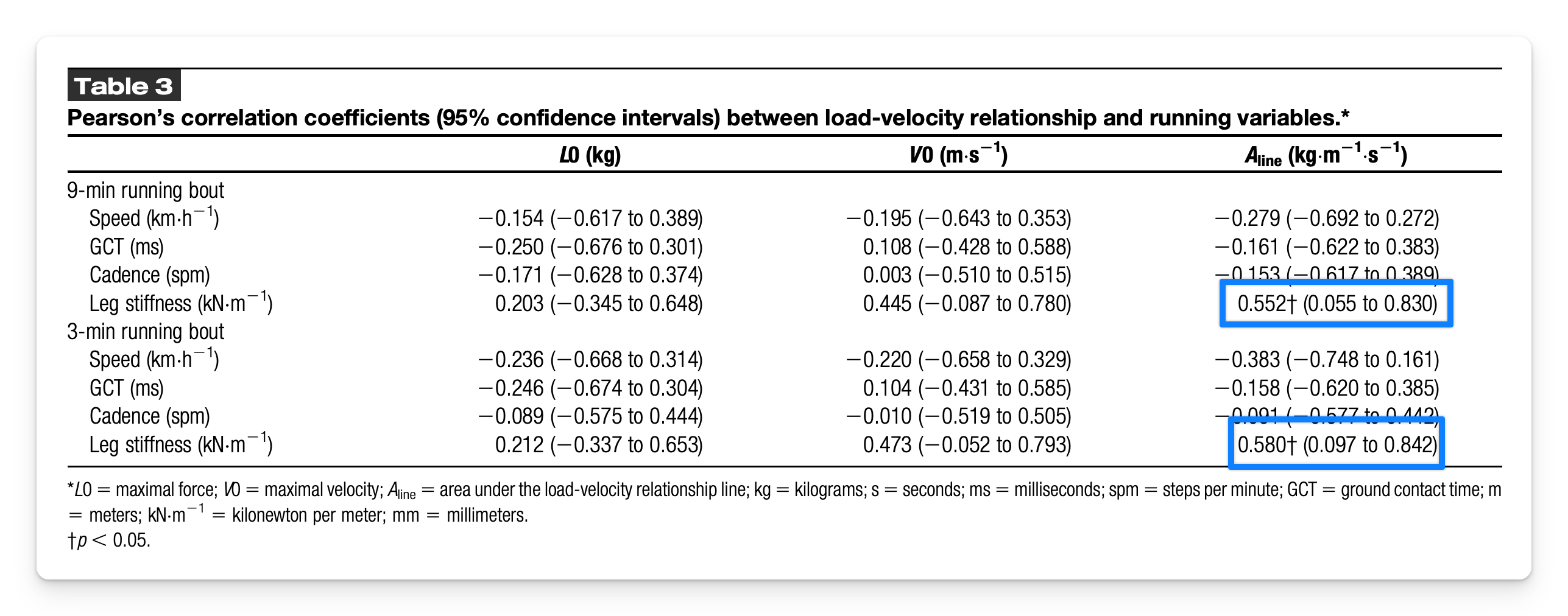
The strongest finding was that Aline, the measure representing maximal power from the load-velocity profile, showed moderate positive correlations with leg stiffness during both running trials.
- 9-minute run: r = 0.55
- 3-minute run: r = 0.58
Athletes capable of producing greater power in the squat tended to demonstrate greater leg stiffness while running.
Aline is a single metric that estimates an athlete's overall capacity to produce power across the force-velocity spectrum. Higher Aline values indicate a greater ability to generate force quickly over a range of loads.
Faster bar speeds at moderate loads also mattered
Mean propulsive velocity at moderate to heavy loads showed the strongest associations with running mechanics.
Significant relationships occurred between:
- 50%
- 60%
- 70%
- 80% 1RM
The strongest relationship occurred between 60% 1RM and the 3-minute trial (r = 0.69), which suggests the ability to move moderate loads explosively may be more relevant than maximal strength alone.
Maximal force was not related to running performance
Neither L₀ (maximal theoretical force) or V₀ (maximal theoretical velocity) showed meaningful relationships with:
- Running speed
- Ground contact time
- Cadence
- Leg stiffness
In other words, theoretical maximal force (L₀) and theoretical maximal velocity (V₀) were not associated with leg stiffness, whereas overall power output (Aline) was.
Running speed itself was not correlated
Interestingly, none of the squat variables correlated directly with running speed. Instead, they correlated with leg stiffness, which is believed to improve running economy by enhancing storage and return of elastic energy during ground contact.
The findings suggest that power-oriented strength training may support endurance performance, particularly during longer events where running economy becomes increasingly important.
What Does This Mean?
For endurance runners, producing force quickly at moderate loads may be more important than simply lifting heavier weights.
Leg stiffness is widely considered one of the key determinants of efficient running because it allows runners to:
- Store more elastic energy
- Reduce wasted motion
- Maintain shorter ground contact times
- Improve running economy
This study suggests that athletes capable of producing higher power outputs in the squat also possess better stiffness characteristics during running.
An interesting implication is that velocity-based training may provide coaches with a practical way to monitor qualities that transfer to endurance performance.
Rather than chasing bigger squat numbers, coaches may gain more by improving the velocity athletes can produce with moderate loads.
Limitations
Several important limitations should be considered.
- Only fifteen athletes participated.
- All participants were highly trained male trail runners.
- This was a correlational study, not an intervention.
- Leg stiffness was estimated using Stryd rather than measured directly with laboratory equipment, such as force plates.
Most importantly, the study demonstrates association, not causation. We cannot conclude that increasing squat power will automatically improve running performance.
Coach's Takeaway
- Develop explosive strength using moderate to heavy loads (roughly 50 to 80% 1RM), not just maximal strength.
- Velocity-based training may provide valuable insight into neuromuscular qualities linked to efficient running.
- Focus on improving power production and leg stiffness rather than simply increasing squat 1RM.
Collectively, these data suggests coaches may get more transfer by emphasizing rapid force production than by chasing ever-heavier squats.
I hope this helps,
Ramsey
Reference: Jaén-Carrillo D, Cartón-Llorente A, García-Ramos A, Santos L. (2026). Mechanical Variables Derived From Submaximal Back Squat Performance Are Positively Associated With Running Performance in Highly Trained Endurance Athletes. Journal of Strength and Conditioning Research, 40(7), 799-806.


