

High-intensity interval training has become one of the most popular ways to improve endurance performance.
But are all interval methods equally effective?
For coaches working with runners, field sport athletes, or anyone trying to improve aerobic fitness, understanding which interval format actually drives the biggest improvement in VO₂max has major programming implications.
This study directly compared three popular interval methods to determine which produced the greatest improvements in aerobic fitness, anaerobic capacity, and running performance.
If your goal is to maximize VO₂max, should you prescribe 4 × 4-minute intervals or all-out sprint intervals?

What Did the Researchers Do?
Researchers recruited 48 aerobically well-trained men (average VO₂max ≈63 ml/kg/min) and randomly assigned them to one of three training groups. All groups trained 3 sessions per week for 8 weeks.
Before we move on, two things are worth emphasizing. First, these subjects were already well conditioned, with an average VO₂max of approximately 63 mL·kg⁻¹·min⁻¹. Second, 4 × 4 is far from an easy workout.
Group 1: HIIT
- 4 × 4 minutes
- ~95% maximal aerobic speed
- 3-minute active recovery
Group 2: Sprint Intervals (Tabata style)
- 8 × 20 seconds
- ~150% maximal aerobic speed
- 10-second passive recovery
Group 3: Sprint Intervals
- 10 × 30 seconds
- ~175% maximal aerobic speed
- 3.5-minute active recovery
Before and after training the researchers measured:
- VO₂max
- Stroke volume (via oxygen pulse)
- Running economy
- Lactate threshold
- Anaerobic capacity (MAOD)
- 3000 m performance
- 300 m sprint performance
What Were the Results?
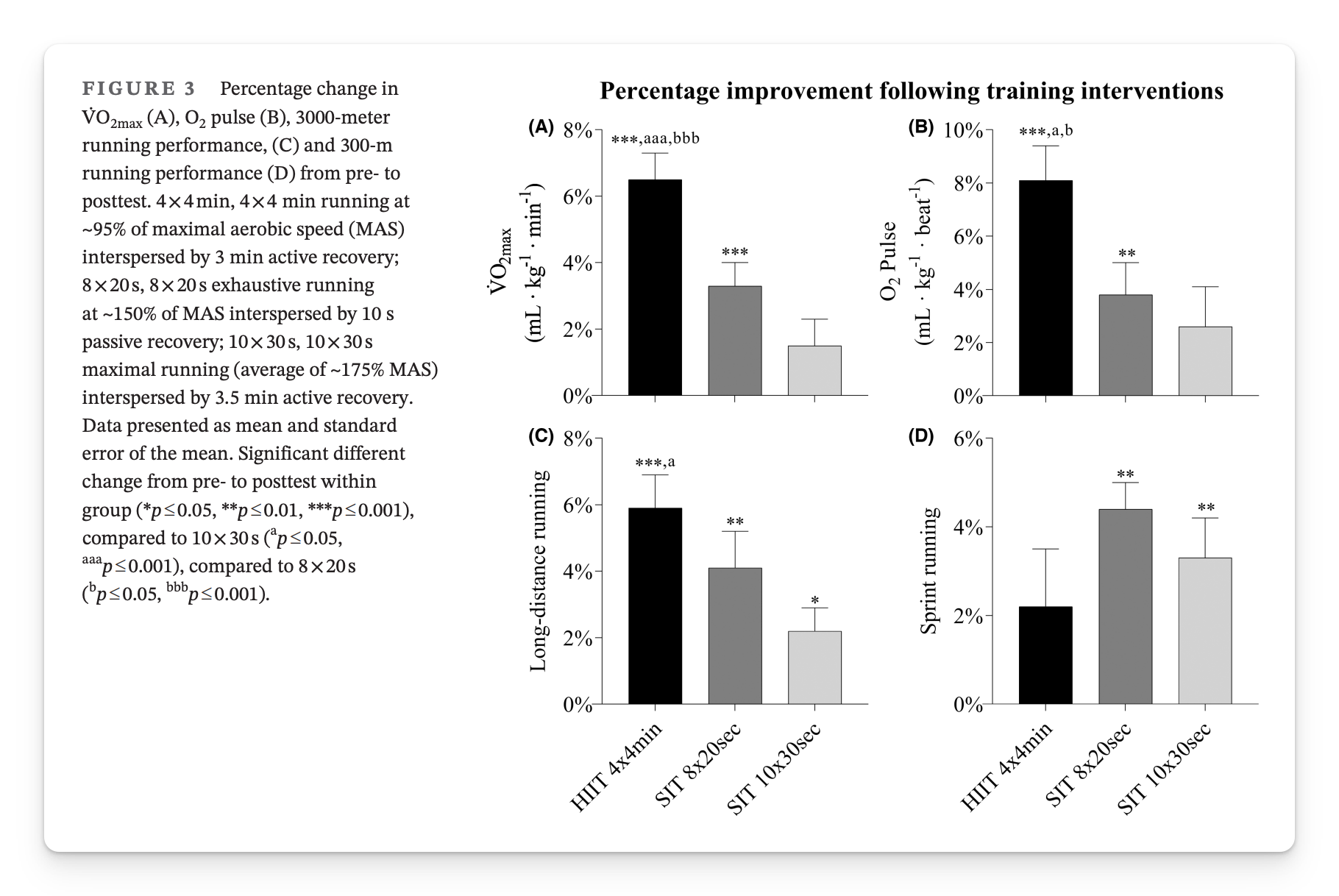
The classic 4 × 4 protocol produced the largest improvement in VO₂max.
The results gave us a clear podium:
- 4 × 4 HIIT: +6.5%
- 8 × 20 s: +3.3%
- 10 × 30 s: no significant improvement
Despite requiring a lower running speed than the sprint intervals, the longer aerobic intervals produced almost double the improvement in aerobic capacity.
HIIT also produced the largest cardiovascular adaptations.
The 4 × 4 group demonstrated the greatest increase in oxygen pulse, an indirect marker of stroke volume.
This suggests the heart itself adapted more following longer aerobic intervals than maximal sprint intervals.
Short sprint intervals improved anaerobic capacity.
The 8 × 20 protocol was the only group to significantly increase maximal accumulated oxygen deficit (MAOD).
In other words:
- Better anaerobic energy production
- Better ability to tolerate repeated high-intensity efforts
This makes physiological sense given the repeated exposure to very high power outputs, and limited rest of only 10s.
Running performance reflected the specificity of each protocol.
The 4 × 4 HIIT group produced the greatest improvement in 3000 m performance (+5.9%), followed by the 8 × 20 group (+4.1%) and the 10 × 30 group (+2.2%).
In contrast, 300 m sprint performance only improved following the sprint interval protocols, with gains of 4.4% for the 8 × 20 group and 3.3% for the 10 × 30 group, while the 4 × 4 group showed little change.
These findings reinforce a fundamental coaching principle: aerobic intervals are better for improving endurance performance, while sprint intervals are better for improving sprint performance.
What Does This Mean?
Training harder is not the same as creating a bigger aerobic stimulus.
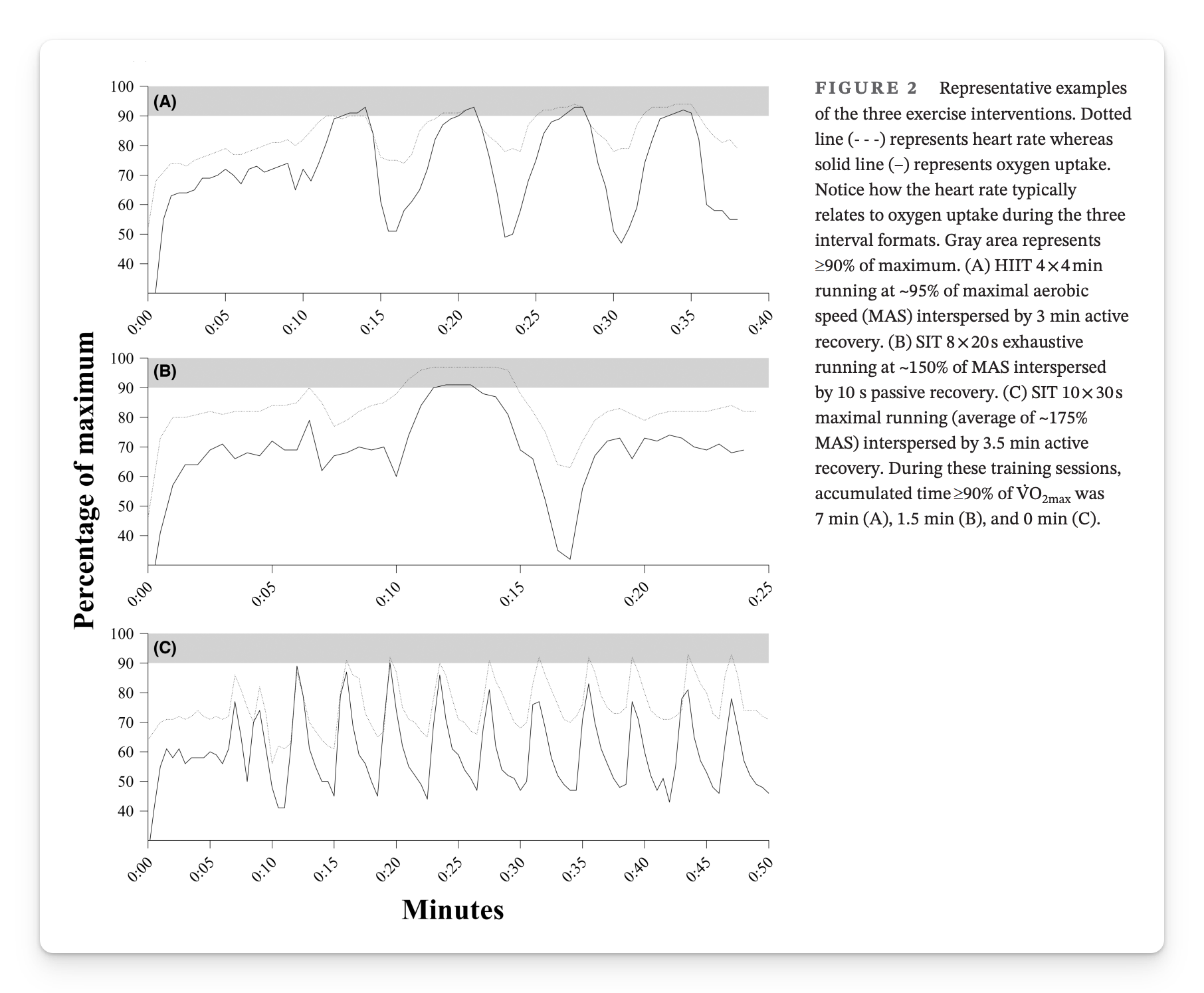
Although the sprint groups ran at much higher speeds, they simply didn't spend enough time operating near VO₂max.
The authors estimated accumulated time above approximately 90% VO₂max during each session:
- 4 × 4: ~7 minutes
- 8 × 20: ~1.5 minutes
- 10 × 30: essentially zero
The long recovery periods during the 10 × 30 protocol allowed oxygen consumption to fall too much between intervals. By the time athletes approached VO₂max again, the interval was already ending.
This explains why running at 175% of maximal aerobic speed produced virtually no improvement in VO₂max.
Instead, if your goal is improving aerobic fitness, the priority is accumulating meaningful time at a very high aerobic intensity, not simply maximizing running speed.
Limitations
- Results may differ in elite endurance athletes or beginners.
- Running-based protocols were investigated, so caution is needed when applying these findings directly to cycling or other sports.
- Total training volume differed between protocols, reflecting how these methods are typically performed in practice.
Coach's Takeaway
- Longer aerobic intervals remain one of the most effective methods for increasing VO₂max.
- Short sprint intervals can complement endurance training by improving anaerobic capacity and sprint performance.
- More intensity does not automatically produce better endurance adaptations. Time spent near VO₂max appears to matter far more than peak running speed.
I hope this helps,
Ramsey
Reference
Hov H, Wang E, Lim YR, et al. (2023). Aerobic high-intensity intervals are superior to improve VO₂max compared with sprint intervals in well-trained men. Scandinavian Journal of Medicine & Science in Sports, 33, 146-159.


