

We've previously discussed the evidence showing that regular cold water immersion after lifting can reduce anabolic signaling and slightly blunt muscle hypertrophy.
However, a new study asked something different.
Specifically, the researchers examined whether ice baths alter oxidative stress, redox signaling, mitochondrial adaptations, and muscle oxidative capacity after resistance training.
Does taking an ice bath after lifting blunt the cellular signaling and mitochondrial adaptations responsible for improving muscle metabolic function?
What Did the Researchers Do?
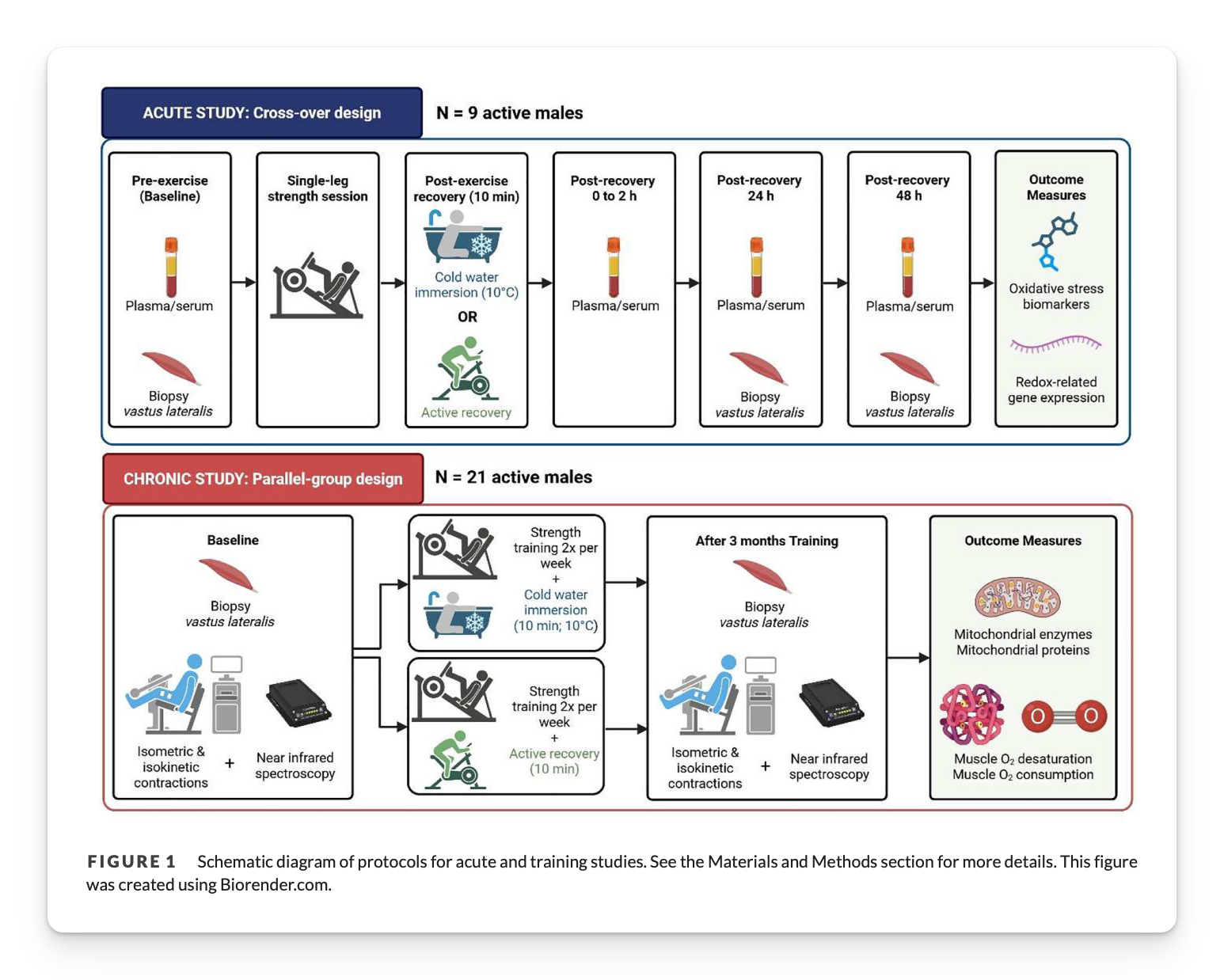
The researchers performed two studies.
Acute study
- Sample ⮕ 9 healthy young men
- Training ⮕ Two identical lower-body lifting sessions
- Recovery ⮕ Either 10 minutes of cold water immersion (10°C) or 10 minutes of active recovery (cycling)
- Measurements ⮕ Blood samples and muscle biopsies were collected over the following 48 hours to measure oxidative stress and redox-related gene expression.
Training study
- Sample ⮕ 21 healthy young men
- Training ⮕ Strength trained twice per week for 3 months
- Recovery ⮕ Either cold water immersion or active recovery after every session
- Measurements ⮕ Researchers measured Mitochondrial enzymes, Mitochondrial proteins, AMPK and PGC-1α, and Muscle oxygen utilization using near-infrared spectroscopy (NIRS)
What Were the Results?
Ice baths did not blunt redox signaling
Resistance exercise increased multiple redox-related genes involved in antioxidant defense, including NRF2, HMOX1, GCLM and TP53.
These responses were the same whether participants used cold water immersion or active recovery.
Mitochondrial adaptations were unchanged
After three months of training:
- Citrate synthase activity increased.
- Mitochondrial Complex I and IV activity increased.
- AMPK phosphorylation increased.
None of these adaptations differed between recovery groups.
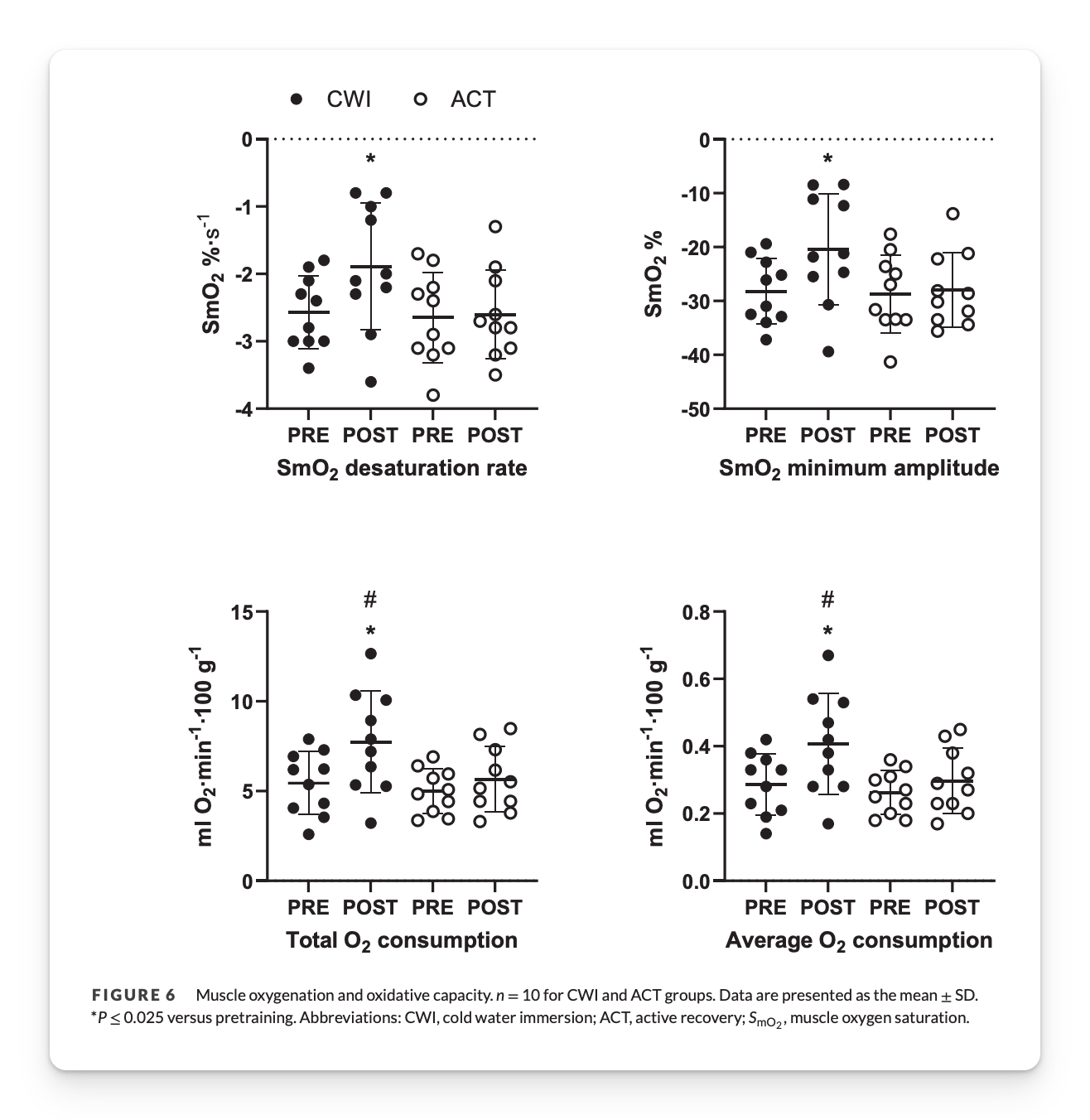
Muscle oxygen utilization improved with cold water immersion
The CWI group demonstrated:
- Greater total oxygen consumption during repeated contractions.
- Greater average oxygen consumption.
- Slower muscle oxygen desaturation.
These findings suggest improved muscle oxidative capacity, despite similar mitochondrial adaptations.
What Does This Mean?
While previous research suggests regular post-lifting cold water immersion may slightly reduce hypertrophy, this study found it did not impair:
- Redox-related gene expression
- Mitochondrial adaptations
- Cellular regulators of mitochondrial biogenesis
It may even improve muscle oxygen delivery and utilization during repeated contractions.
These findings reinforce that recovery strategies affect different adaptations differently, and that ice baths do not suppress every training adaptation.
Limitations
- Only healthy young men were studies and sample sizes were relatively small.
- Muscle oxygen utilization was measured indirectly with NIRS.
- The study did not measure muscle hypertrophy or strength gains.
Coach's Takeaway
- Not all bad ⮕ Ice baths do not appear to blunt mitochondrial or metabolic adaptations to strength training.
- Still not great for muscle ⮕ previous evidence that ice baths may reduce muscle hypertrophy still stands because this study examined different outcomes.
- Recovery should match the goal of the training goal ⮕ If hypertrophy is the priority, be selective with post-lifting ice baths. If recovery and repeated performance are the priority, cold water immersion remains a valuable tool.
I hope this helps,
Ramsey
Reference: Roberts LA, Pileggi CA, Zeng N, et al. (2026). Effects of cold water immersion versus active recovery on oxidative stress, redox gene expression and mitochondrial adaptations after strength training. Experimental Physiology.


