

In our last post, we detailed how different movement mechanics can influence excessive ACL loading and eventual failure in two different athletes.
But that discussion focused primarily on the load being placed on the ACL.
There is another side to the equation, which is:
What happens to the ACL when we repeatedly load it during training?
A recent narrative review by Staniucha and colleagues highlights an important concept: the ACL is a mechanoresponsive tissue capable of adapting to mechanical loading.
The ACL Responds to Mechanical Loading
Similar to muscle, tendon, and bone, ligament tissue responds to its mechanical environment.
Mechanical loading can stimulate:
- Type I and III collagen expression
- Extracellular matrix (ECM) remodeling
- Angiogenic signaling
- Changes in tissue structure and mechanical properties
Gene expression can change within hours of cyclic loading, while meaningful structural remodeling likely requires repeated exposure and recovery over much longer periods.
What Happens When We Repeatedly Load the ACL?
The strongest experimental evidence comes from animal models, where training has increased ACL stiffness, failure load, tensile strength, and CSA.
Human evidence points in a similar direction, with larger ACLs observed in weightlifters who began high-load training around puberty and in the dominant limbs of elite athletes.
This suggests both loading and its timing may matter.
Adolescence may be particularly important as body mass, strength, and sporting demands increase while ACL growth begins to plateau.
However, human evidence remains cross-sectional, so we cannot establish that training caused these differences or define adolescence as a specific window for ACL adaptation.
The Goal Is Not to Avoid ACL Loading
We often discuss ACL loading as something that should be minimized.
But loading is also the stimulus that may drive adaptation.
The authors represent this using an inverted U-shaped load-adaptation model with three general loading environments:
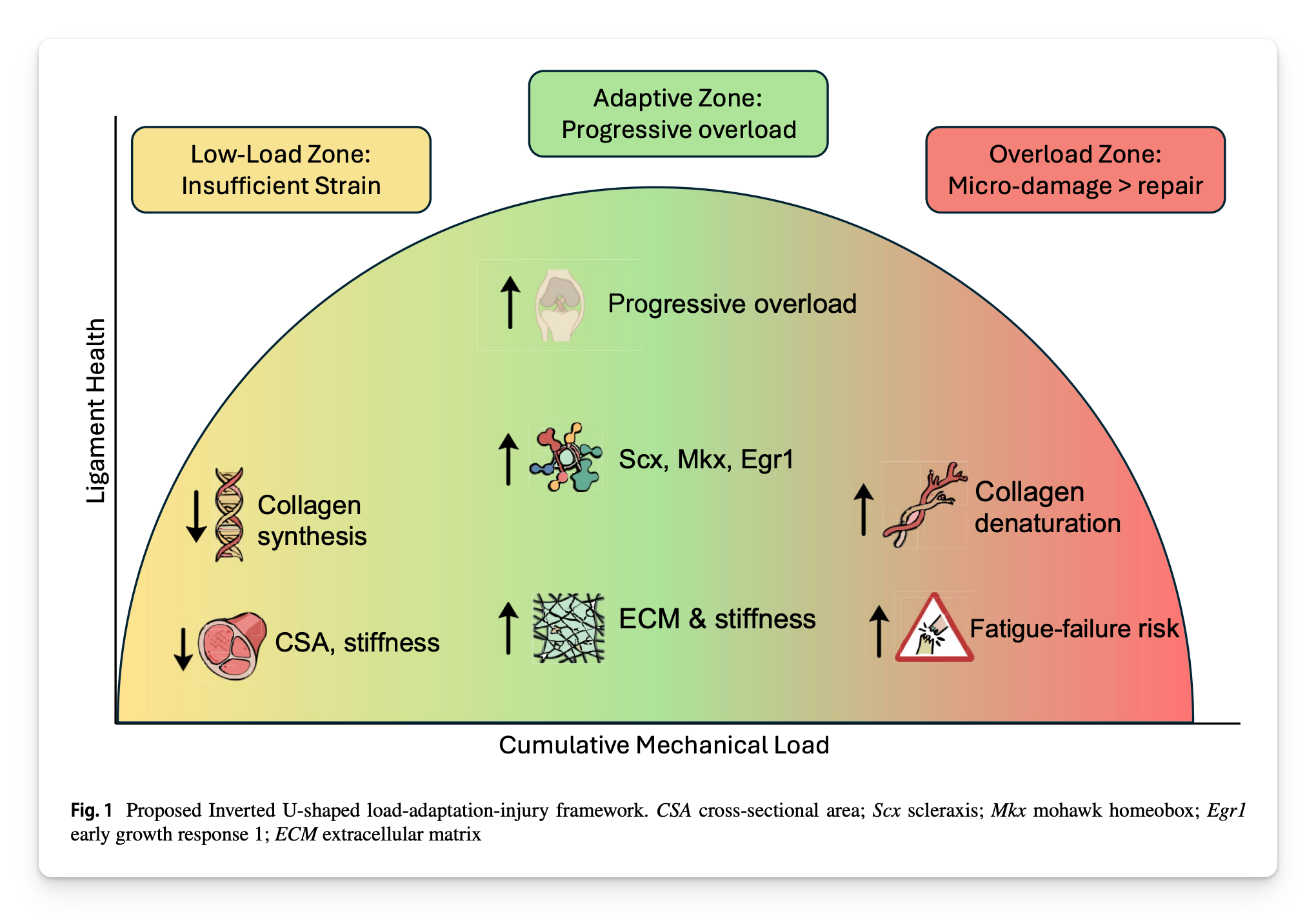
1. Low-Load Zone: Insufficient Stimulus
Too little mechanical loading may provide insufficient strain to stimulate meaningful collagen turnover, matrix remodeling, or structural development.
If the eventual demands of sport are high, chronically avoiding meaningful loading may leave the ACL underprepared.
2. Adaptive Zone: Progressive Overload
Appropriately dosed loading combined with sufficient recovery may stimulate favorable ligament adaptation.
Over time, this could contribute to:
- Increased CSA
- Improved ECM organization
- Increased stiffness
- Greater mechanical capacity
Importantly, we currently cannot define the optimal human ACL loading dose. Exact strain, volume, frequency, and recovery thresholds remain unknown.
3. Overload Zone: Damage Exceeds Repair
Repeated high-frequency or poorly controlled loading without sufficient recovery may cause micro-damage to accumulate faster than the ligament can repair.
Experimental models have demonstrated ACL fatigue failure following repeated submaximal loading.
So while rupture may occur during one identifiable movement, the state of the ligament entering that movement may partly reflect its previous loading history.
Not All ACL Loading Is the Same
Mechanical load also cannot be reduced to a single number.
The ACL experiences combinations of tensile, shear, rotational, and multiplanar loading influenced by:
- Joint position
- Muscle forces
- Movement strategy
- Load magnitude and frequency
- Movement velocity
- Recovery
For example, quadriceps contraction can increase anterior tibial shear at shallow knee flexion angles. Hamstrings and the soleus can generate posteriorly directed forces that may help oppose anterior tibial translation.
This brings us back to the mechanics discussed in our previous post. We cannot focus on the amount of load in isolation, but have to also consider how the load was distributed within the context of movement.
Coach's Takeaway
As always, we should be careful not to overstate the evidence.
We cannot currently prescribe a specific exercise, strain magnitude, set and rep scheme, or weekly frequency and confidently say it will hypertrophy the human ACL. Much of the direct adaptation evidence still comes from animal models, while human evidence is largely observational.
But the broader principle remains intact:
The goal of ACL preparation should not be to eliminate ACL loading.
Instead, progressively expose athletes to the mechanical demands they will eventually encounter through resistance training, jumping, landing, deceleration, cutting, and increasingly unplanned reactive movement.
Similar to all our training, we should apply enough mechanical stress to stimulate adaptation, provide enough recovery for adaptation to occur, and progressively build capacity for the loads sport will eventually demand.
And when we do that, we build resilient athletes.
I hope this helps,
Ramsey
Reference: Staniucha OK, Birse SM, Ferris DE, et al. (2026). Understanding Anterior Cruciate Ligament Adaptation: Structural, Mechanical, and Healing Considerations. Sports Medicine.


