

Patellofemoral pain (PFP) is one of the most common knee injuries in both athletes and recreationally active individuals.
While weakness of the quadriceps and hip muscles is frequently reported, it's less clear what that weakness is actually associated with.
Is strength related to pain? Function? Movement quality? Fear of movement?
This systematic review synthesized data from 57 studies involving more than 2,100 individuals with PFP to answer those questions.
How are hip and knee strength related to pain, function, movement mechanics, and fear of movement in athletes with patellofemoral pain?
What Did the Researchers Do?
The authors performed a systematic review and meta-analysis of correlational studies involving 2,191 participants with PFP.
They examined strength for the:
- Quadriceps
- Hamstrings
- Hip abductors
- Hip extensors
- Hip external rotators
- Hip posterolateral muscles
- Trunk lateral flexors
Then compared the strength measures with the following outcomes:
- Pain
- Function
- Pain duration
- Kinesiophobia
- Hip and knee kinematics
What Were the Results?
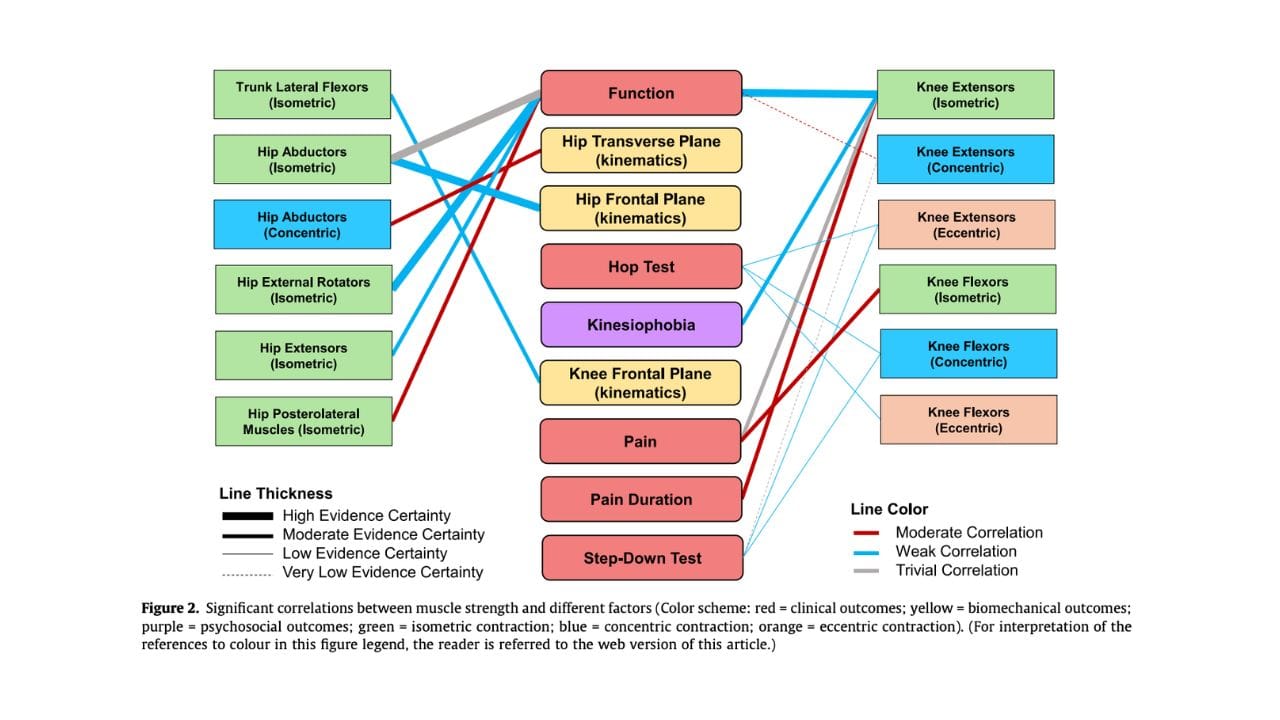
1. Knee Strength Was Most Closely Related to Pain
Quadriceps strength showed relationships with:
- Function
- Pain
- Pain duration
- Fear of movement
Hamstring strength was also associated with lower pain.
Athletes with longer symptom duration generally demonstrated lower quadriceps strength.
2. Hip Strength Was More Closely Related to Function
Hip abductors, extensors, external rotators, and posterolateral muscles all showed positive relationships with function.
The strongest functional relationship observed was for the posterolateral hip musculature.
Interestingly, hip strength showed little relationship with pain.
3. Strength Had Little Relationship With Movement Mechanics
One of the biggest findings was what wasn't associated.
High-certainty evidence showed:
- Hip abductor strength was not related to knee frontal plane mechanics.
- Hip abductor strength was not related to pain.
- Hip external rotator strength was not related to pain.
Only 3 of 21 biomechanical analyses found significant relationships, suggesting strength alone explains very little of how athletes move.
What Does This Mean?
This review reinforces that strength is important, but probably not for the reasons many of us have assumed.
Quadriceps and hamstring strength appear more closely related to pain and symptoms.
Hip strength appears more closely related to function and physical capacity.
At the same time, maximal strength does a poor job explaining movement quality or dynamic knee valgus, challenging one of the most common rehabilitation narratives.
The takeaway is that strength is one important piece of the puzzle, but not the entire explanation for pain or movement.
Limitations
- Cross-sectional correlations cannot establish cause and effect.
- Most relationships were weak to moderate.
- Studies varied considerably in testing methods and participant characteristics.
- Strength likely represents just one contributor to recovery.
Coach's Takeaways
- Knee strength is more closely associated with pain, symptom duration, and fear of movement.
- Hip strength is consistently associated with function, not pain.
- The evidence does not strongly support the idea that weak hip abductors directly cause dynamic knee valgus.
- Strength matters, but it explains only a small part of the clinical picture.
- Assess strength, but don't expect it alone to explain pain, movement quality, or rehabilitation outcomes.
I hope this helps,
Ramsey
Reference: Nunes GS, Pellenz MM, Piussi JB, et al. (2026). Which factors correlate with muscle strength capacity in people with patellofemoral pain? A systematic review with meta-analysis. The Knee, 60, 104358.


