

The best athletes don't just cut, they use deception to create separation. They fake one way and go the other.
So, what actually makes an athlete good at selling a fake?
And do the movement strategies that improve deception also increase ACL injury risk?
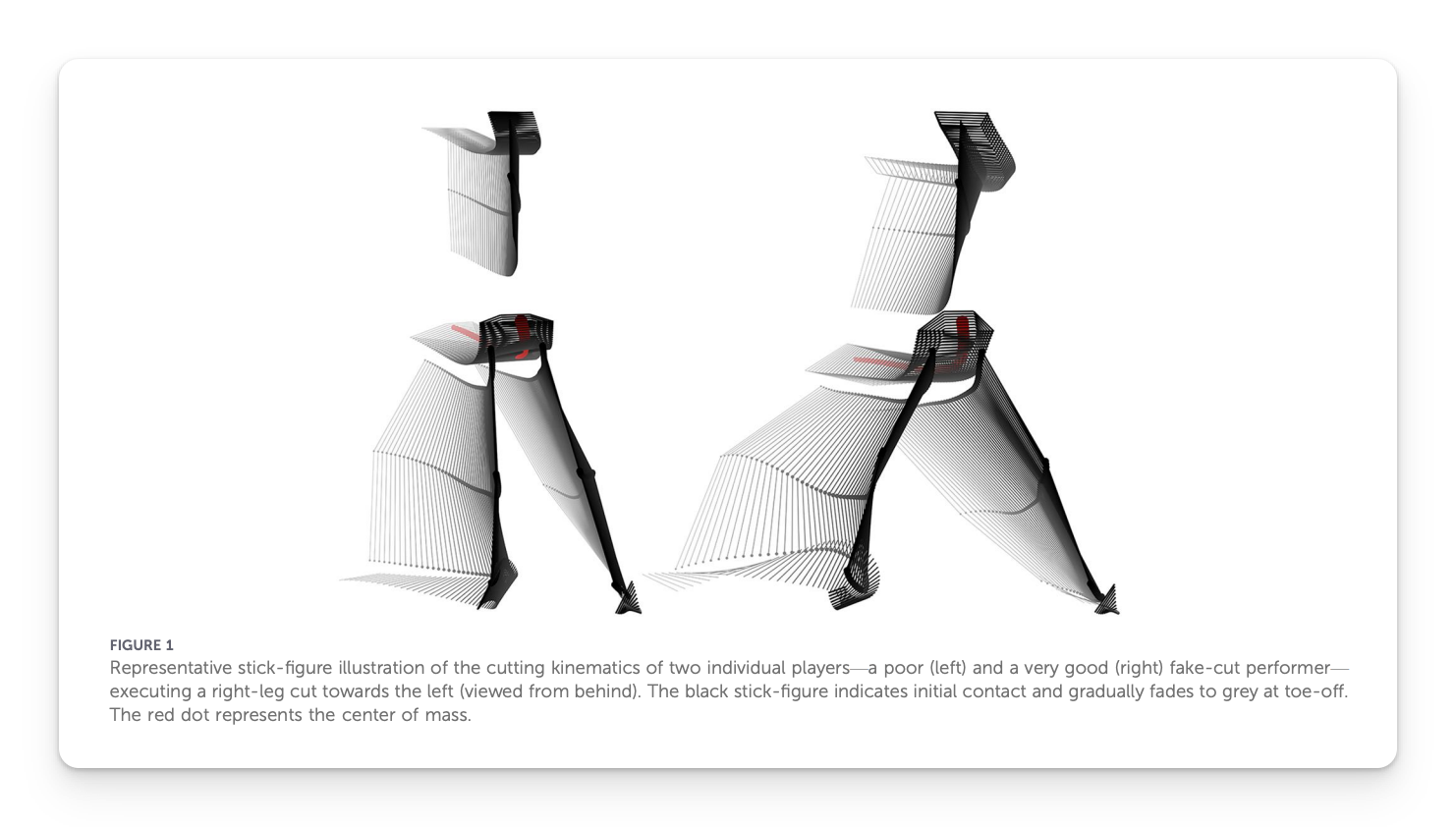
This study examined both questions by comparing athletes who were considered highly skilled fake-cut performers versus those who were less effective.
What movement characteristics separate great fake-cut athletes from average ones, and is there a tradeoff between performance and ACL injury risk?
What Did the Researchers Do?
Researchers recruited 96 competitive handball players including both males and females, with and without previous ACL reconstruction.
Testing Protocol
Athletes performed a sport-specific fake-cut maneuver:
- 6-meter approach run
- Catch a pass
- Attack a live defender
- Use deception to fake one direction
- Cut and accelerate the opposite direction
- Finish with a simulated shot
Athletes were not told how to perform the fake; instead they used their natural movement strategies.
Variables Measured
Researchers collected:
- 3D motion capture
- Ground reaction forces
- Joint angles
- Joint moments
- Head and torso movements
- Center of mass (COM) movement
- ACL injury-related knee loading metrics
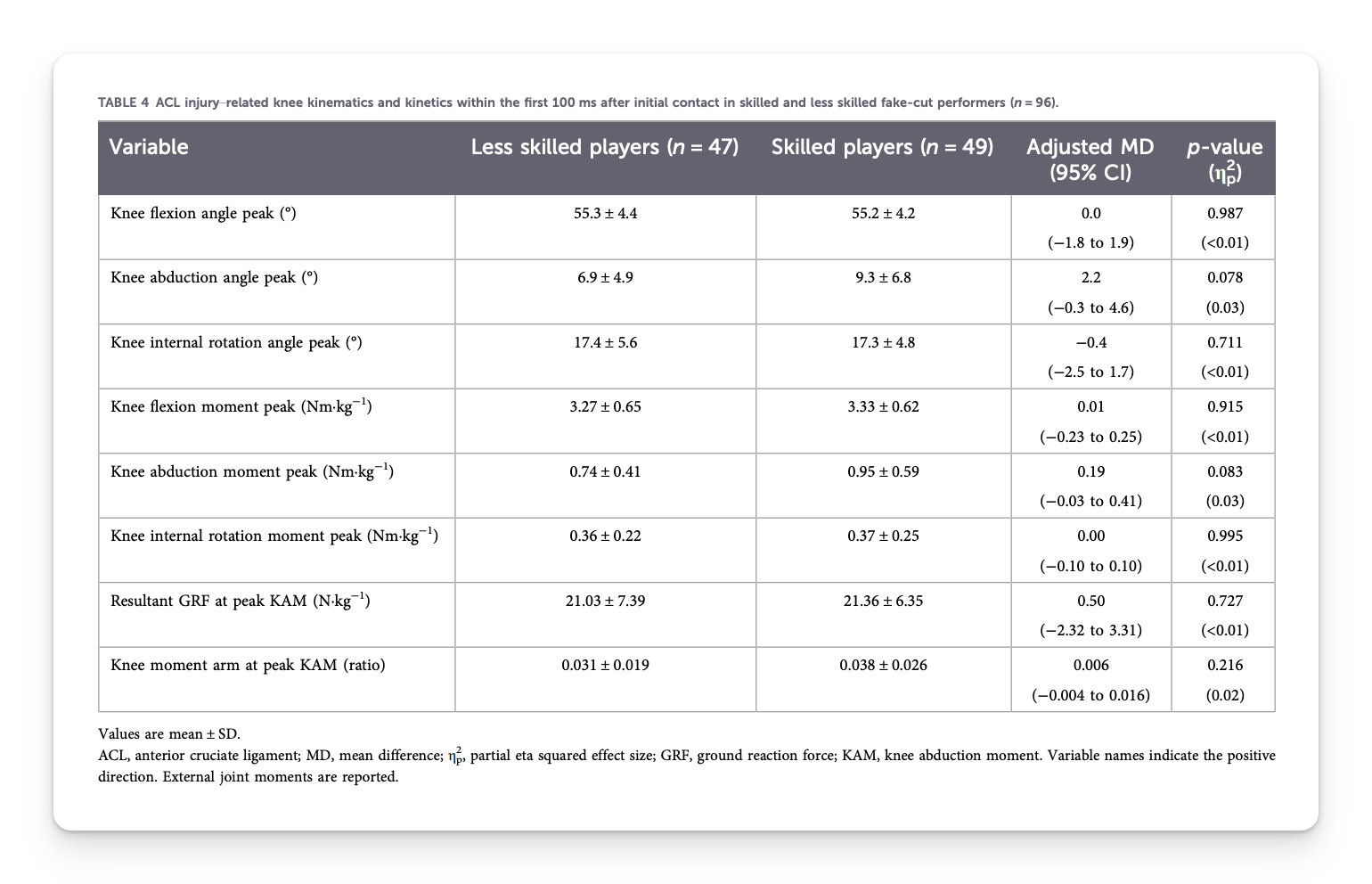
Particular attention was paid to knee loading during the first 100 ms after foot contact, the period when ACL injuries typically occur.
Performance Classification
The athletes were rated by their own primary handball coach. After testing, the researchers contacted each athlete's primary coach and asked them to evaluate the athlete's fake-cut ability. In total, ratings came from 65 different coaches across the 96 players.
"How good is this player at outmaneuvering and passing a defender using a fake-cut maneuver?"
Athletes were then grouped as:
- Skilled fake-cut performers
- Less skilled fake-cut performers
While subjective, this gave the study strong ecological validity because the ratings reflected how athletes actually perform in games, not just how they performed during one testing session.
What Were the Results?
Better Fake-Cut Athletes Were Faster Everywhere
Compared to less skilled athletes, skilled performers showed:
- 5% shorter ground contact times
- Higher approach speed
- Higher minimum speed during the cut
- Higher exit speed after the cut
The best athletes weren't necessarily making sharper cuts. They were maintaining speed during the cut.
Better Athletes Used Wider, Shallower Cuts
Skilled performers demonstrated:
- Greater cutting width
- Slightly shallower cutting angles
- More externally rotated foot positions
This suggests elite fakes may rely on creating enough lateral displacement to redirect the center of mass quickly without overcommitting to a deep plant.
The Head May Be the Secret Weapon
One of the most interesting findings involved upper-body deception.
Skilled performers showed:
- Greater head lean away from the true cutting direction
- Faster head movement away from the true direction
- More pronounced deceptive upper-body actions
The authors suggest that elite athletes rely heavily on upper-body deception while simultaneously preparing their lower body to move toward the actual destination.
In simple terms, athletes sell the fake with the head and torso, yet move their body where you actually want to go.
Poor Performers May Overcommit to the Fake
The analysis suggests that poor performers appeared to shift their center of mass toward the fake direction, while better performers were already beginning to direct their center of mass toward the real direction.
This may allow faster acceleration once the defender reacts.
Better Performance May Come With Higher Knee Loading
Now lets talking about the performance-injury conflict.
While ACL-risk variables within the first 100 ms weren't statistically different, skilled performers demonstrated:
- Higher peak knee abduction moments (KAM)
- Greater frontal plane knee loading
Many of the characteristics associated with better fake-cut performance have also been linked to increased ACL loading (e.g. higher speeds, greater hip abduction, more aggressive torso movement).
This creates a potential performance-injury conflict; risky mechanics are often the ones that set us up for better force and velocity outcomes.
What Does This Mean?
- Great fake-cuts are built on speed ⮕ Skilled performers maintained higher speeds before, during, and after the cut while spending less time on the ground, suggesting that successful fake-cuts rely more on preserving momentum than making larger directional changes.
- The upper body appears to drive deception ⮕ The best performers used greater and faster head movements away from the intended cutting direction, helping sell the fake while their center of mass was already beginning to move toward the true destination.
- Performance and injury risk may not always align ⮕ Several characteristics associated with better fake-cut performance, including higher speeds and wider cutting mechanics, have also been linked to greater ACL-related knee loading, highlighting a potential performance-injury tradeoff.
Limitations
- Performance classification was based on coach ratings rather than objective game statistics.
- Only handball athletes were included and the study was cross-sectional and cannot establish causation.
Coach's Takeaway
- Prioritize speed during fake-cut training ⮕ Faster approach speeds, faster exits, and shorter ground contact times consistently separated the most effective fake-cut performers from their peers.
- Coach deception through the head and torso ⮕ The best athletes appeared to fool defenders with upper-body movements while their lower body was already preparing to move toward the true destination.
- Recognize the potential performance-injury tradeoff ⮕ Some of the same movement qualities that help athletes create separation may also increase knee loading, making it important to find solutions that preserve performance while minimizing unnecessary ACL stress.
I hope this helps,
Ramsey
Continue Your Learning
For coaches looking for a deeper level of development, the Applied Performance Coach Certification (APC) provides industry-leading education, live mentorship, case discussions, and hands-on guidance to help you bridge the gap between research and real-world application.
You can continue trying to figure it out on your own, or you can learn alongside a community of professionals dedicated to becoming better coaches every day.
The Applied Performance Coach Certification and Mentorship is a
6-week live online course that will accelerate your understanding, application and confidence in performance science and coaching.


