

As coaches, we're often guilty of thinking adaptation requires more.
- More volume.
- More exercises.
- More sprint work.
- More time.
But sometimes the opposite is true.
A new study in professional rugby backs found meaningful improvements in sprint mechanical qualities during the season from just four resisted sprints per week.
Lets break it down.
What Did the Researchers Do?
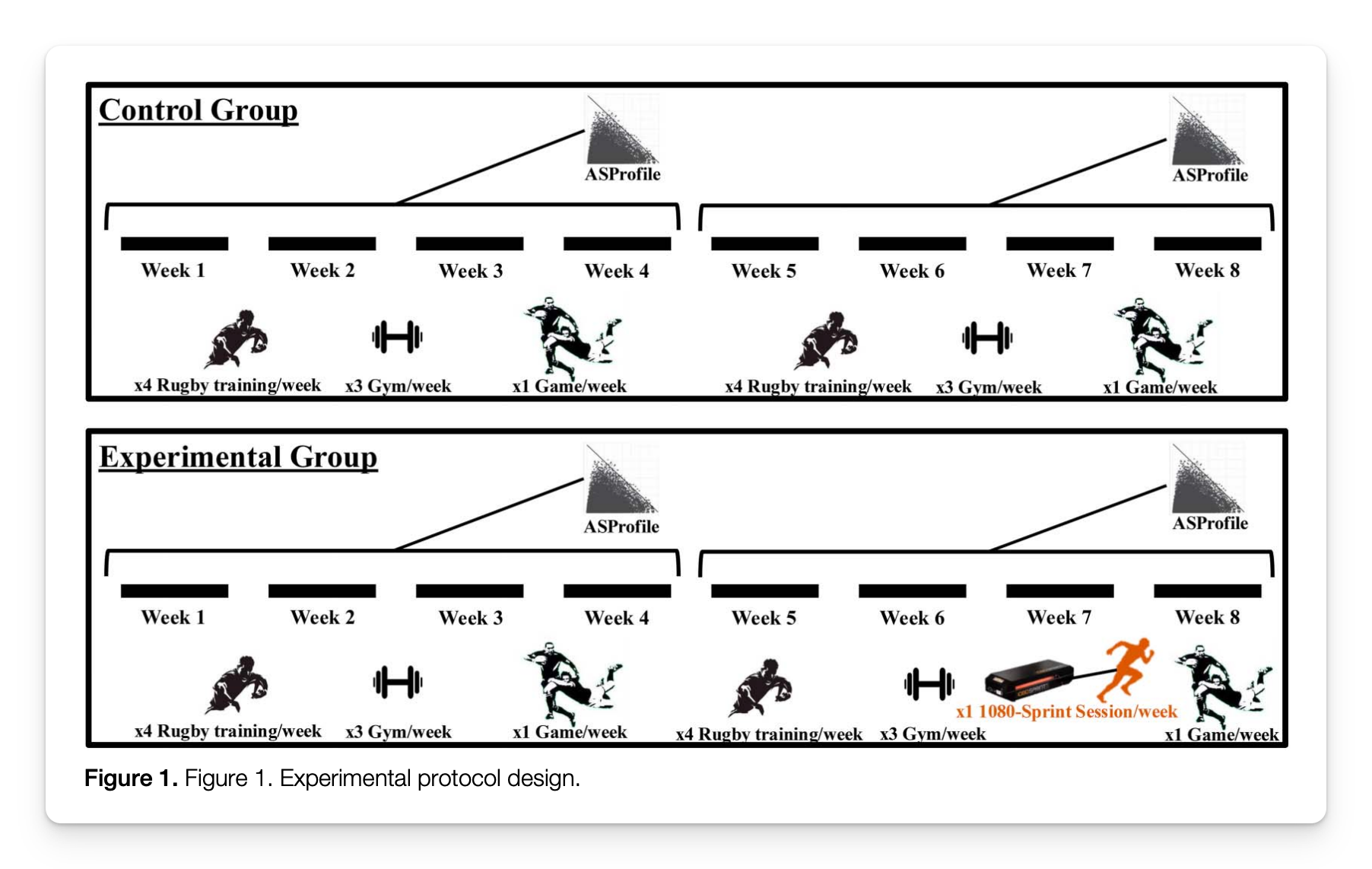
The researchers tracked professional rugby backs across an eight-week period.
For the first four weeks, everyone followed their normal schedule of:
- Rugby training
- Strength training
- Competition
GPS data collected during practices and matches were used to create an acceleration-speed profile for each athlete.
For the next four weeks, one group continued with their normal training.
The experimental group added a single weekly 1080 Sprint session consisting of:
- 4 × 15 m resisted sprints
- 4 minutes recovery between reps
- Individualized resistance prescription
The load wasn't based on body mass or a fixed sled weight. Instead, resistance was adjusted so each player sprinted at roughly 50% of their theoretical maximal velocity, a zone commonly associated with maximal horizontal power production.
Across the entire intervention, athletes accumulated just 240 meters of resisted sprinting.
What Were the Results?
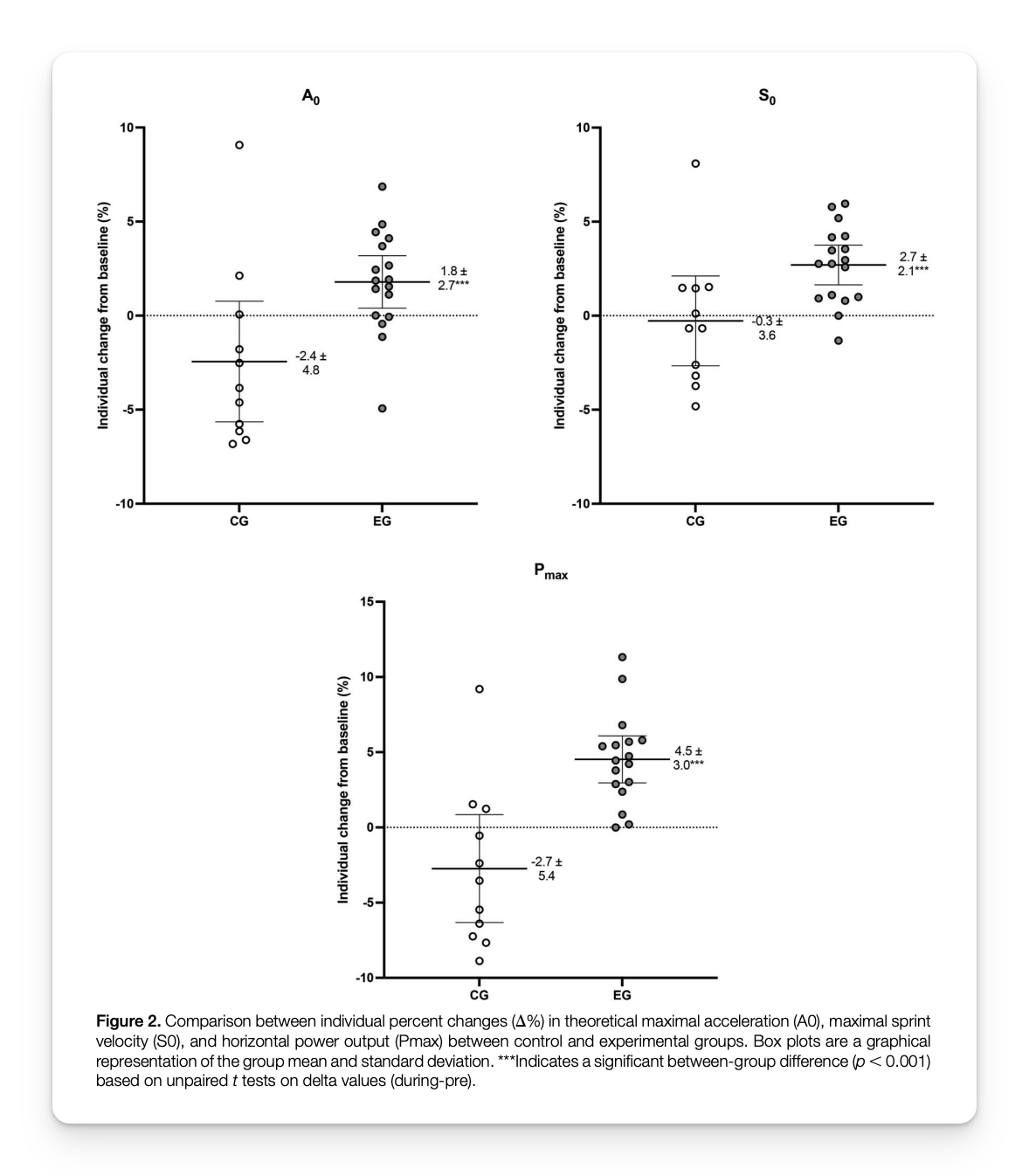
After four weeks, the resisted sprint group improved:
- Horizontal power (Pmax): +4.5%
- Sprint velocity (S₀): +2.7%
- Acceleration (A₀): +1.8%
The control group showed no meaningful changes.
The individual response plots tell the story better than the group averages. Most athletes improved, particularly for horizontal power.
What Does This Mean?
The dose is what caught my attention.
These weren't developmental athletes with unlimited room for improvement.
These were professional rugby players competing in one of the highest levels of rugby in the world.
And the training dose was minimal, yet effective:
- 1 session per week
- 4 resisted sprints
- 60 meters of weekly sprint volume
- 240 meters across the entire study
Studies like this are a useful reminder that speed qualities can be highly responsive to small doses of high-quality training.
As coaches, we often ask, "How much sprint work do we need?"
A better question may be, "What's the minimum effective dose?"
For many athletes, especially during the season, that answer may be lower than we think.
The Limitations
As promising as these findings are, a few important limitations should be considered:
- The researchers did not perform a true post-test. Sprint profiles were calculated using GPS data collected during the intervention period itself, making it difficult to separate long-term training adaptations from short-term performance enhancements.
- Potentiation may have influenced the results. Following the resisted sprint work, athletes performed high-speed sprinting as part of training. Some of the improvements in sprint velocity may therefore reflect repeated potentiation effects rather than purely chronic adaptations.
- The intervention was added on top of normal rugby training. While the results suggest the resisted sprint sessions contributed to the improvements, the study cannot fully isolate the contribution of the sprint intervention from the rest of the training environment.
That said, the practical takeaway remains compelling:
A relatively small amount of well-targeted sprint work, just four resisted sprints per week, was associated with meaningful improvements in sprint mechanical outputs during the competitive season.
Coaching Takeaways
- Meaningful speed improvements don't always require large training volumes ⮕ These athletes improved sprint mechanical outputs during the season from just four resisted sprints per week.
- Sprint development can fit into a busy in-season schedule ⮕ The intervention didn't replace rugby training, require a dedicated speed phase, or significantly increase overall training volume.
- Look for the minimum effective dose ⮕ Coaches often focus on how much sprint work they can add. This study suggests that a small amount of high-quality, targeted work may be enough to move performance.
- Individualize the stimulus, not just the exercise ⮕ Every athlete trained at approximately the same relative velocity loss (~50% Vdec), ensuring a similar mechanical stimulus despite differences in speed and physical capacity.
I hope this helps,
Ramsey
The Applied Performance Coach Certification and Mentorship is a
6-week live online course that will accelerate your understanding, application and confidence in performance science and coaching.
Reference: Maviel C, Vercruyssen F, Duché P, Bourdin S, Morin JB, Couderc A. (2026). In-Season Individualized Resisted Sprint Session Improves In-Situ Acceleration-Speed Profile in Professional Rugby Backs. Journal of Strength and Conditioning Research.


