

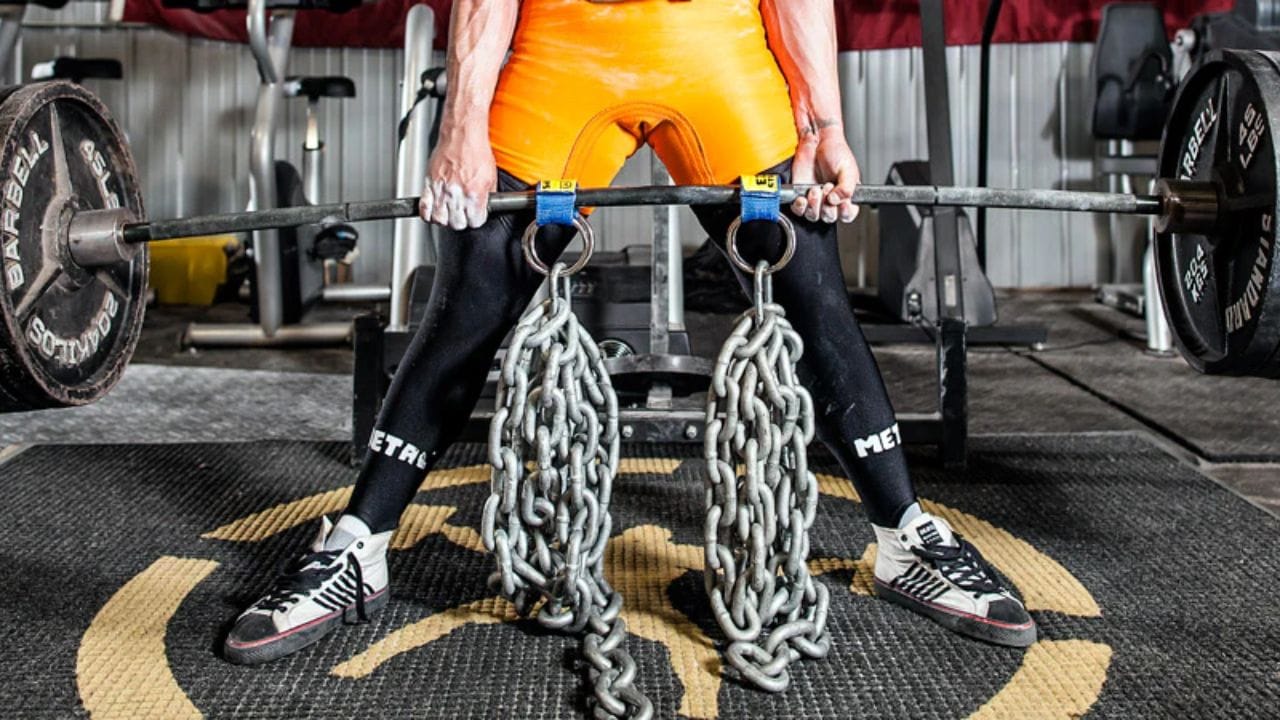
Chains are one of the most popular forms of accommodating resistance in strength training. Coaches often use them with the belief that they enhance strength through the full ROM.
The theory makes sense mechanically. As the bar rises, more chain lifts off the floor, increasing the load where leverage improves.
But despite how commonly chains are used, there was very little research at the time on how chains actually change muscle activation, ground reaction forces, and rate of force development. Especially during the deadlift.
So we asked:
Does adding chains to the deadlift make athletes more explosive and increase force production?
What Did the Researchers Do?
Subjects
- 13 resistance-trained men
- Average age: 24 years
- Average deadlift 1RM: ~176 kg (388 lbs)
Study Design
After a 1RM deadlift session, participants completed two experimental deadlift conditions:
- Deadlift without chains (NC)
- Deadlift with chains (CH)
Both conditions used 85% 1RM, 3 repetitions and maximal concentric intent (“move as fast as possible”).
Important Detail About Loading
In the chain condition:
- Chains made up ~20% of the total load
- Load was “matched at the top” of the lift
That meant that the top position had equal load between conditions and the bottom position was lighter with chains.
What Was Measured?
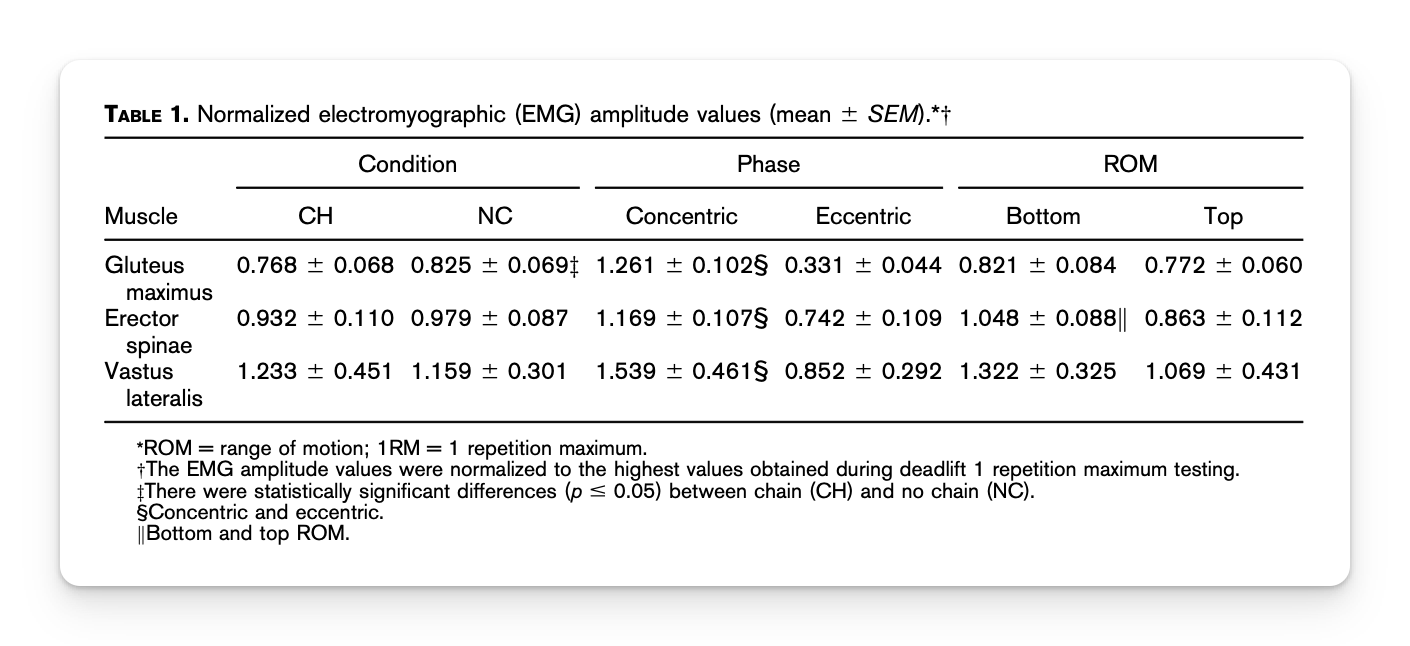
Muscle Activation (EMG)
- Glute max
- Erector spinae
- Vastus lateralis
Force Plate Data
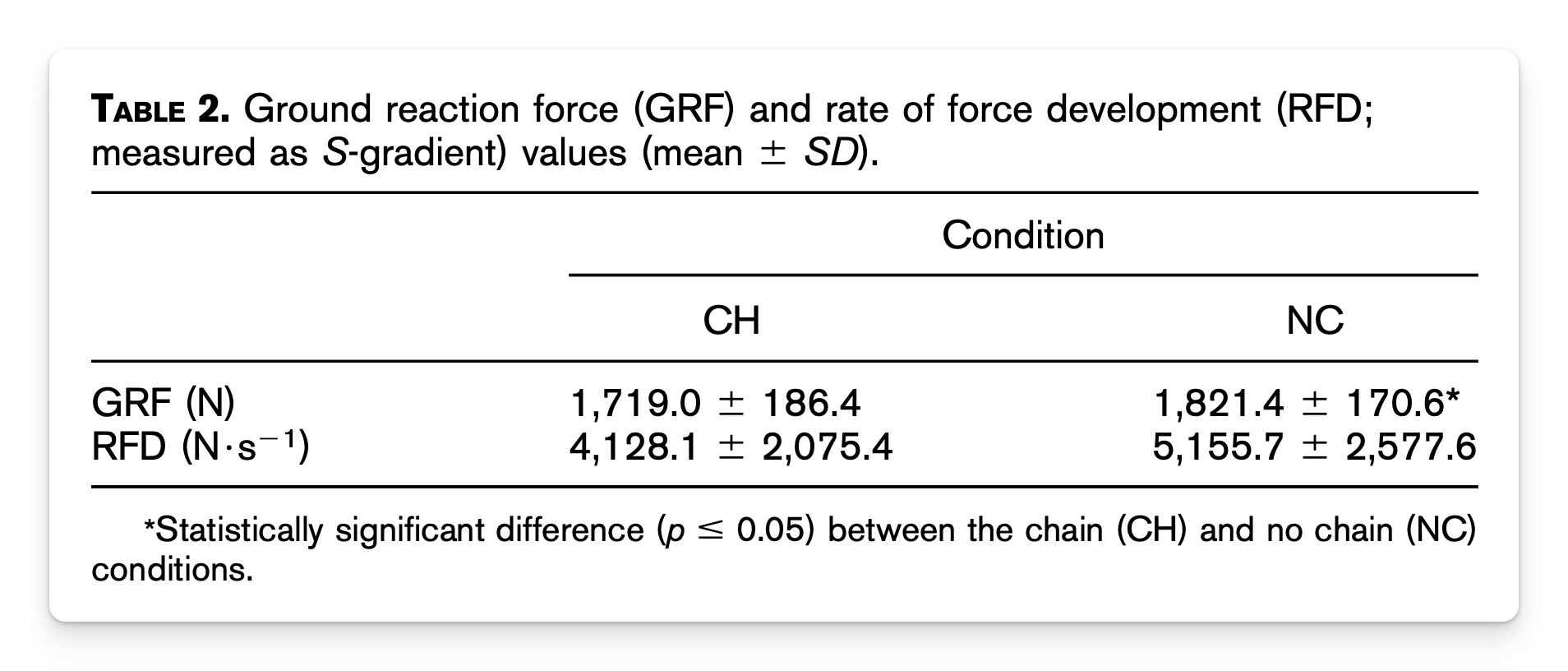
- Ground reaction force (GRF)
- Rate of force development (RFD)
What Were the Results?
The findings suggest chains primarily redistribute load across the ROM rather than automatically increasing force production, explosiveness, or muscle activation.
- Glute max activation was significantly higher without chains ⮕ likely because the bottom position was heavier and required greater hip extensor demand off the floor.
- Erector spinae activity was greatest at the bottom of the lift and during the concentric phase ⮕ likely due to greater trunk inclination and lumbar flexion torque demands.
- Ground reaction forces were lower with chains ⮕ likely because the lighter bottom position reduced the amount of force needed to initiate the lift.
- Rate of force development (RFD) did not improve with chains ⮕ despite accommodating resistance often being promoted as a more “explosive” training method.
Limitations
- The study only examined one chain setup, so other loading parameters may result in different results
- Researchers did not measure kinematics, making it difficult to fully explain why force and muscle activation changed.
- The sample size was small and consisted of recreationally trained men, so findings may not fully generalize to elite lifters or athletes
Coach’s Takeaway
- Chains are best viewed as a way to redistribute load across the deadlift ROM rather than a guaranteed method for increasing explosiveness or force production.
- Matching loads at the top makes the bottom position easier, which may reduce glute activation and peak force demands while potentially improving training tolerance and reducing stress at weaker joint positions.
- Coaches should choose chain loading strategies based on the goal of the session, whether that is maximizing force off the floor, overloading lockout, managing fatigue, or varying the stimulus.
I hope this helps,
Ramsey
Reference
Nijem RM, Coburn JW, Brown LE, Lynn SK, Ciccone AB. (2016). Electromyographic and force plate analysis of the deadlift performed with and without chains. Journal of Strength and Conditioning Research, 30(5), 1177–1182.


