

Marijuana use among athletes is increasingly common.
Most conversations center around whether an athlete is currently impaired or whether THC creates an issue with drug testing.
But a new study in NCAA Division I football players asked an important and relevant question for our athletes:
Does chronic marijuana use make an athlete slower at processing information and making decisions?

What Did They Do?
Researchers studied NCAA Division I football players who tested positive for THC and reported daily or near-daily marijuana use.
The Methods
- Eighteen players completed cognitive testing at baseline and again after approximately 12 months of program-verified abstinence.
- The athletes completed the S2 Cognition Football Battery, which measures what the researchers call "game-speed cognition."
The Assessments
The assessment included measures of:
- Reaction speed
- Decision complexity
- Impulse and distraction control
- Multiple-object tracking
- Visual processing
- Decision accuracy

The Performance Academy: Gain access to the best performance and rehab minds in the world through premium masterclasses, live and recorded events, plus a network of coaches and therapist around the world. Education, community, and networking under one roof, all at your fingertips.
What Were the Results?
Reaction Speed Improved
When the athletes were chronic marijuana users, reaction speed was approximately 20% slower compared with their performance after one year of abstinence.
The researchers estimated that difference at roughly 80 to 100 milliseconds.
That doesn't sound like much until you consider the timescale of sport. A quarterback identifying pressure, a defender responding to play action, or a receiver reading coverage has fractions of a second to perceive information and act.
An additional 80 to 100 milliseconds could matter.
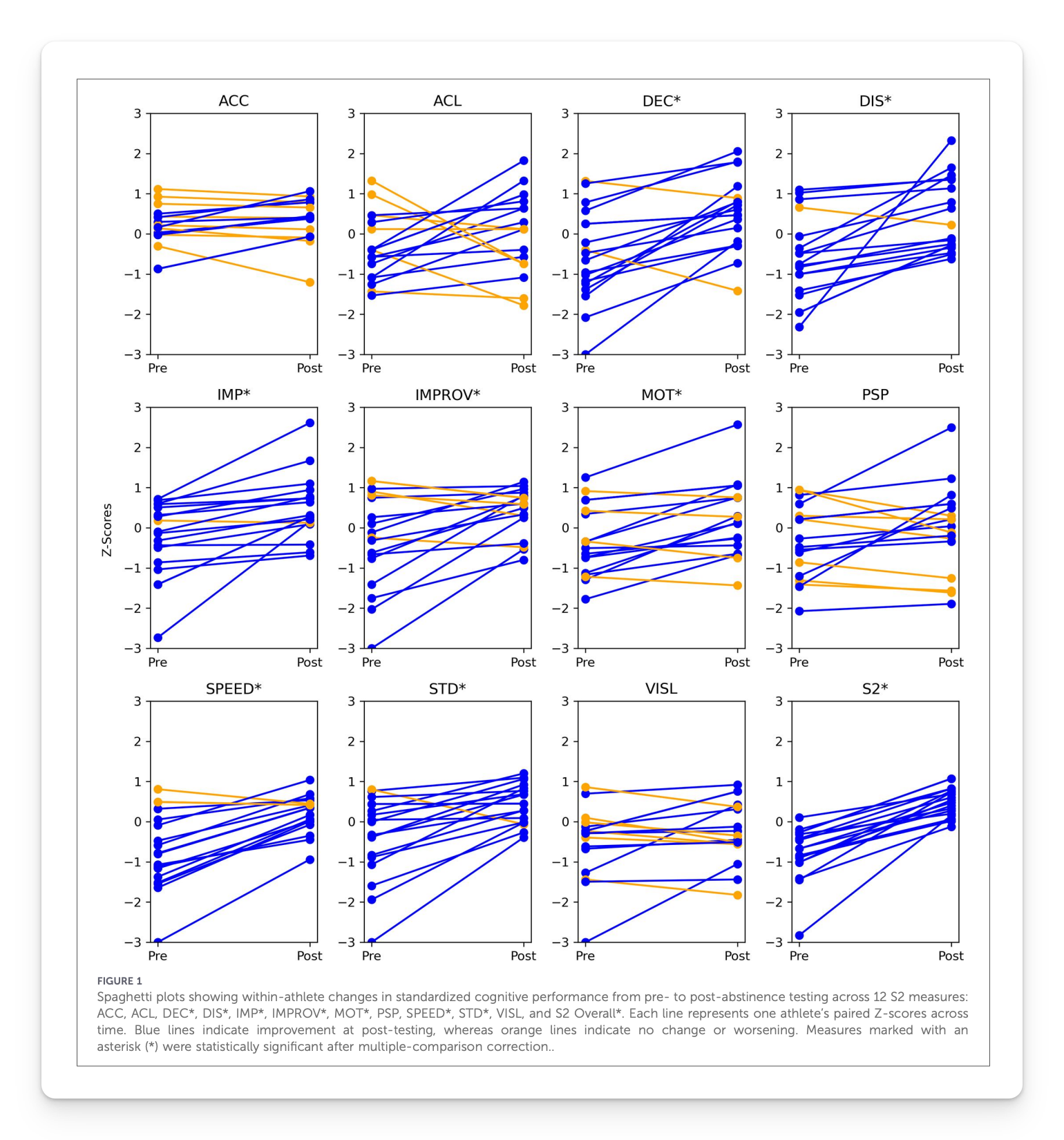
After abstinence, athletes also significantly improved:
- Decision Complexity ⮕ selecting the correct response when multiple options are available.
- Impulse Control ⮕ preventing premature responses.
- Distraction Control ⮕ preventing irrelevant information from interfering with the response.
- Multiple-Object Tracking ⮕ simultaneously tracking several moving objects.
- Speeded Target Detection ⮕ rapidly finding relevant information within visual clutter.
Most impressively, all 18 athletes improved their overall S2 cognitive score after abstinence for marijuana use.
The Limitations
- There was no matched control group ⮕ These athletes had another year of training, football experience, coaching, and maturation, all of which could have contributed to improvement.
- The authors compared the findings to an independent sample of 146 football players tested one year apart ⮕ Their S2 score improved only +0.14 z-score, compared with approximately +1.27 in the marijuana group.
- The athletes clearly performed better after 12 months of abstinence ⮕ but we cannot conclude that marijuana cessation caused the entire improvement.
Coach's Takeaway
- Reaction speed improved roughly 20%, or an estimated 80 to 100 milliseconds.
- Decision-making, impulse control, distraction control, tracking, and target detection also improved.
- All 18 athletes improved their overall cognitive score.
While there was no matched control group, so we can't attribute all of the improvement directly to marijuana cessation, the main takeaway is simple:
Chronic marijuana use likely slows reaction speed, while cessation and sustained abstinence appear to improve it.
I hope this helps,
Ramsey
Reference: Ally, B. A., Mentele, P. A., & Wylie, S. A. (2026). Cognitive performance recovery following marijuana cessation in NCAA Division I athletes. Frontiers in Sports and Active Living, 8, 1821656.


