

Achilles tendon rupture (ATR) is one of the most serious injuries in professional basketball. Recovery averages around 10 months, and previous research has shown reductions in performance and career longevity following injury.
After a record number of Achilles ruptures during the 2024-25 NBA season, with all-star caliber players going down in the playoffs, workload became an obvious area of interest.
The researchers of this study wanted to know whether players who ruptured their Achilles experienced unusual increases in workload leading into the injury.
Did NBA players who ruptured their Achilles experience an increase in workload shortly before injury?
What Did the Researchers Do?
Researchers retrospectively analyzed publicly available NBA data from the 2014-15 through 2024-25 seasons.
The final sample included:
- 19 NBA players who sustained a basketball-related Achilles rupture
- Mean age of 27.8 years
- Average NBA experience of 7.4 years
Researchers examined minutes played over the 5, 10, and 15 games before rupture, season and career minutes, distance covered, games played in the previous 30 days, back-to-backs, rest days, age, position, playing role, and early sport specialization.
The key comparison was within each athlete. Their workload immediately before injury was compared with their own workload during that season, rather than with healthy teammates or other uninjured NBA players. That distinction becomes important when interpreting the findings.
What Were the Results?
The clearest finding was a small increase in playing time before injury.
Compared with each player's season average:
- 5 games: 28.2 vs 26.8 min/game, P = .07
- 10 games: 29.0 vs 27.4 min/game, P = .01
- 15 games: 28.6 vs 27.4 min/game, P = .03
So, players were playing roughly 1 to 2 additional minutes per game during the 10 to 15 games preceding rupture.
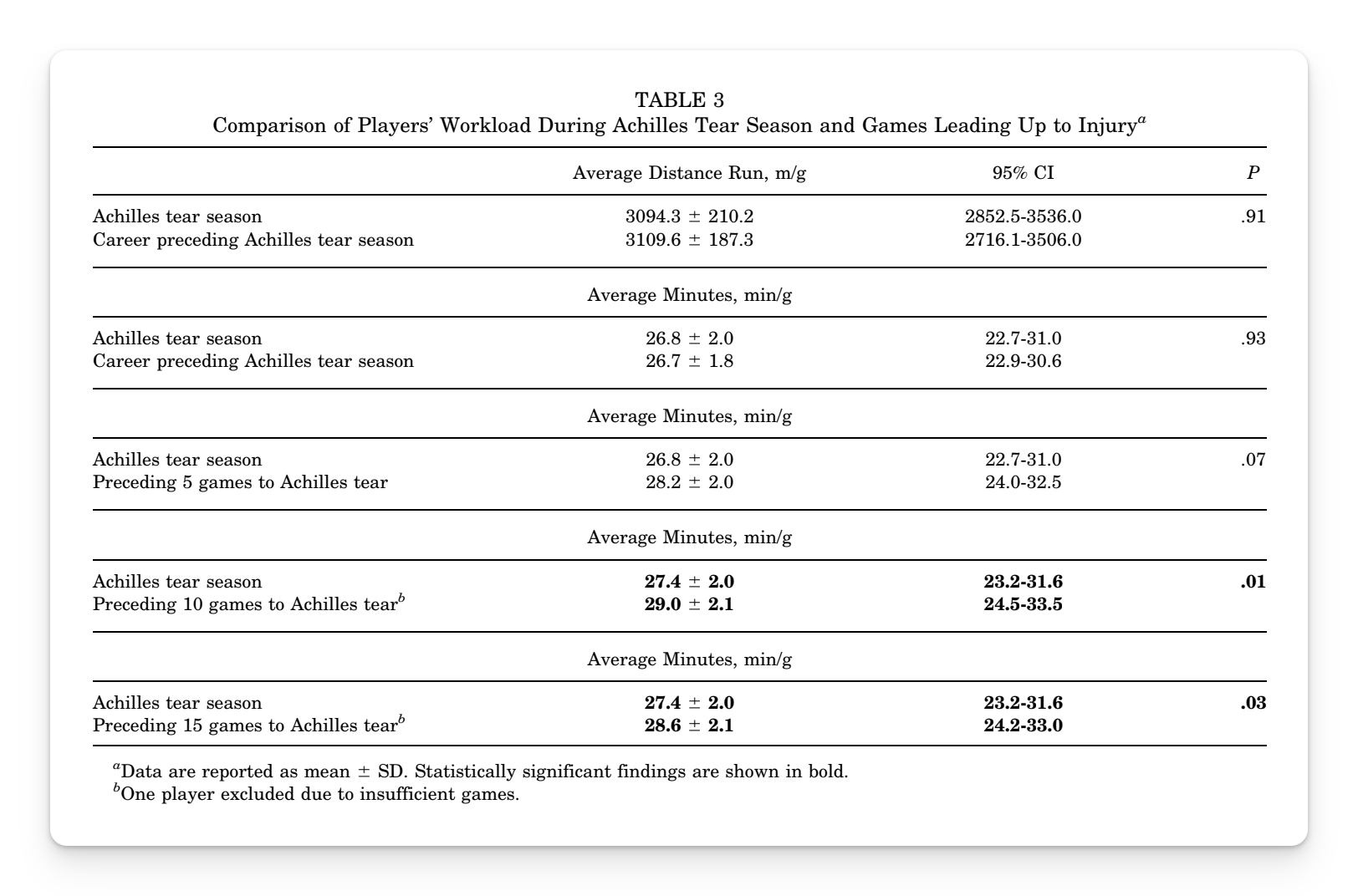
Interestingly, overall workload during the injury season was not unusually high compared with previous seasons. Average distance covered and minutes played were almost identical to career averages.
Veteran players generally accumulated greater workloads. Years of NBA experience correlated with season minutes and minutes played during the five games before injury. However, younger players also ruptured their Achilles despite comparatively lower workloads.
There were also no significant differences related to back-to-backs, games played in the previous 30 days, position, starter status, or early sport specialization.
What Does This Mean?
NBA players who ruptured their Achilles tended to be playing slightly more than usual during the weeks leading into injury.
Workload is a plausible contributor to injury. Greater exposure means more opportunities for high-force movements, while changes in workload may alter the relationship between the demands placed on an athlete and their current capacity.
However, we need to be cautious about moving from that observation to conclusions about injury risk.
The study did not compare these workload increases with healthy teammates or other NBA players who remained uninjured. We therefore don't know how common similar increases were across the league.
Imagine two players both increase from 27 to 30 minutes per game over several weeks. One ruptures his Achilles. The other finishes the season healthy.
Looking backward at the injured athlete makes the workload increase appear important. To determine whether it actually differentiates higher-risk athletes, we also need to know what happened to athletes exposed to similar workloads who didn't get injured.
This highlights why sports injury risk is so difficult to understand.
Injury rarely comes down to one variable. The same workload can represent a very different stress depending on the athlete's tendon capacity, previous injuries, training history, strength, age, recovery, fatigue, biomechanics, and countless other interacting factors.
Workload is certainly one part of that picture, but exposure alone cannot explain why one athlete gets injured while another does not.
Limitations
Several limitations are particularly important:
- Only 19 Achilles ruptures were included.
- There was no healthy control group.
- Practice and training loads were unavailable.
- Tendinopathy history and tendon characteristics were unknown.
These limitations do not make the findings unimportant. They mean that this analyses is exploratory and hypothesis-generating.
Coach's Takeaway
- Changes in workload deserve attention ⮕ Players who ruptured their Achilles were playing slightly more minutes than usual over the preceding 10 to 15 games.
- Workload should be viewed as one piece of injury risk ⮕ Exposure interacts with the athlete's capacity, history, recovery, and many other factors.
- Association and prediction are different ⮕ Without knowing how frequently similar workload increases occurred in healthy players, we cannot determine whether this pattern meaningfully differentiated athletes who were at greater risk.
The practical message isn't that an extra 1 to 2 minutes per game causes Achilles ruptures.
It's that injury emerges from the interaction between the demands imposed on an athlete and the athlete who is being exposed to those demands.
Monitoring workload remains useful. The challenge is interpreting that workload within the much larger, multifactorial picture of injury risk.
I hope this helps,
Ramsey
Reference: Kumar V, Sang L, David W, Pandya N. (2026). Short-Term Workload Patterns Before Achilles Tendon Rupture in National Basketball Association Players: A Descriptive Epidemiology Study. Orthopaedic Journal of Sports Medicine, 14(7).

The Performance Academy: Gain access to the best performance and rehab minds in the world through premium masterclasses, live and recorded events, plus a network of coaches and therapist around the world. Education, community, and networking under one roof, all at your fingertips.


