

Seventy-two hours to recover from a game feels like wishful thinking.
For example, 72 hours after a Saturday game puts you at Tuesday. But by then, you’ve probably practiced, lifted, traveled, or played another game.
But that number comes from Pedro Cosio’s recent paper on hamstring recovery. Some measures were still down three days after a soccer match.
If that’s the timeline after one match, how often are our athletes actually getting back to baseline during a season? And how much should we care if they don’t?
Lets dive in.
Fatigue Three Days Later
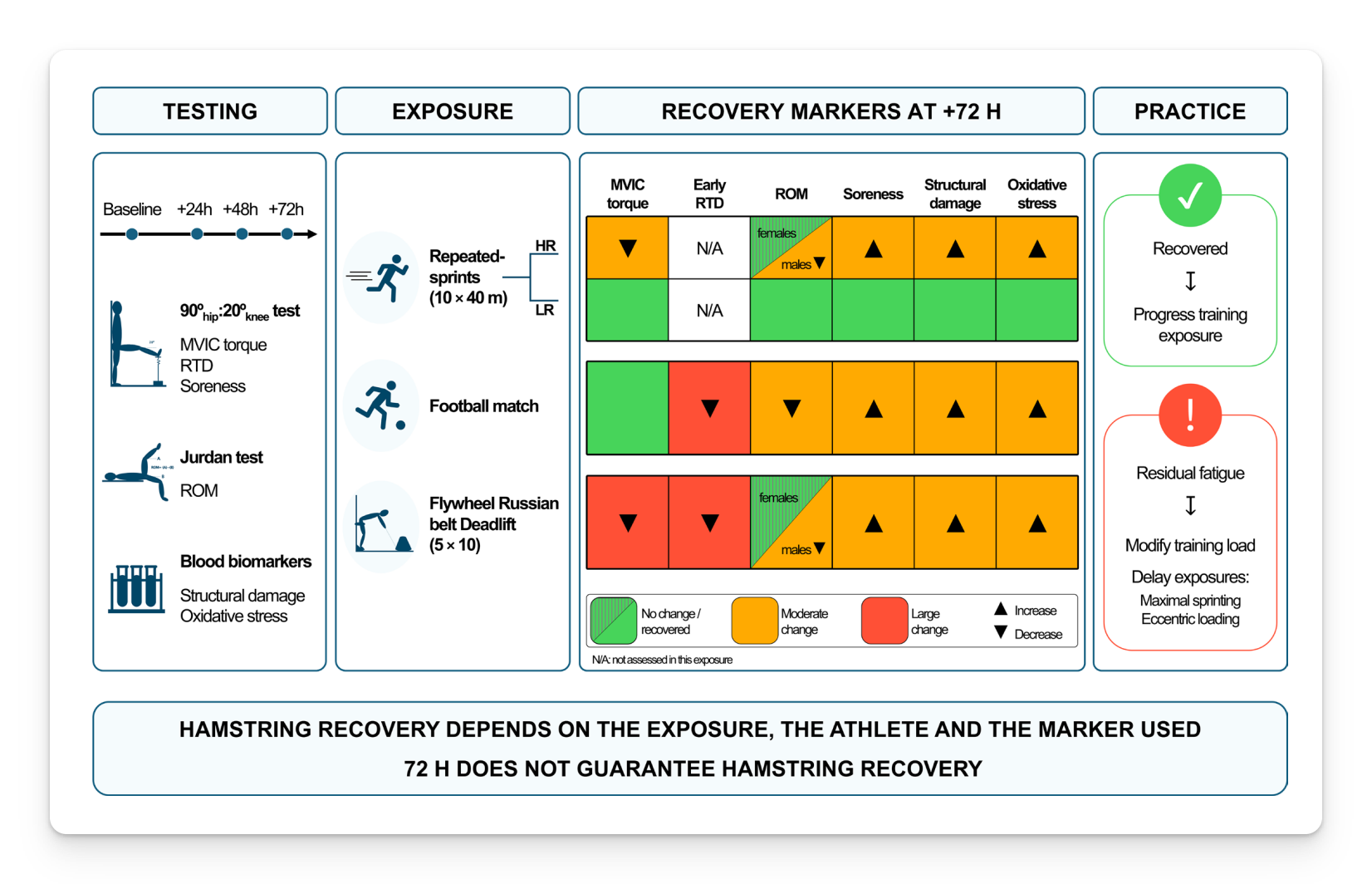
Cosio and colleagues tested 19 male soccer players before a match and again at 24, 48, and 72 hours. They looked at how much torque could the players produce at their peak, and how quickly could they build it?
By day three, the difference in peak torque from baseline was statistically unclear.
But torque was still building more slowly in the first 50 and 100 milliseconds. If you pulled only the peak number from the test, you could miss a change in how the athlete produced it.
The other studies in Cosio referenced showed how much the response depends on the session and the athlete.
- After 10 × 40 m sprints, some participants still had lower peak torque at 72 hours, while others showed no clear difference from baseline.
- After a five-set, 50-rep flywheel deadlift session, both peak torque and early torque development were still down three days later in a group of physically active, untrained adults. Testing stopped at 72 hours, so we don’t know how much longer those deficits lasted.
Readiness and Recovery Are Not the Same
An athlete can feel good at warm-ups, hit a familiar number on a strength or jump test, and still have some residual fatigue you’d only see if you measured something else. hat’s one reason I’m careful about treating any single score as a verdict on whether they’re fully recovered.
Think about a starter who played big minutes Saturday and has to play again Tuesday.
If an isometric metric is still down in the morning of the next game, what decision does that change? They’re probably still playing.
And importantly, the study measured changes in a test; not how much those changes matter for Tuesday’s performance or injury risk.
An athlete can be ready for the job you need them to do and still have room to recover.
Accommodating Game Demands
If the schedule regularly asks athletes to play on short turnarounds, that’s part of the demand we’re preparing them for.
I want them to have enough exposure to the speed, intensity, and volume their sport requires, built up over time.
I also want to be deliberate about what we add between games. The competition schedule already supplies plenty of hard work during some weeks.
For me, the question before a session is:
“What do we need from this athlete today, and what dose makes sense given what they’ve already done and what they need to do tomorrow?”
Sometimes the answer is to keep the session as planned. Sometimes it’s to keep the work that matters and cut the extra reps.
Over a season, athletes are going to practice, lift, and compete with some degree of residual fatigue, whether they feel it or we pick it up in testing.
I’d spend more time preparing them for that reality than trying to get every number back to baseline before they go again. In our pursuit of recovery and readiness, lets be sure we don't lose the plot.
I hope this helps,
Ramsey
Reference
Cosio, P. L. (2026). Hamstring recovery after repeated-sprints, football match play and flywheel eccentric loading: 72 hours may not be enough (PhD Academy Award). British Journal of Sports Medicine.


