

Walk into almost any high-performance environment today and you'll find dashboards.
Force plates. Wellness questionnaires. HRV. Sleep scores. Recovery metrics.
Monitoring has become a central part of modern sport.
And that's not necessarily a bad thing. Better information can lead to better decisions.
But somewhere along the way, I think many of us may have lost the plot.
We've become incredibly good at measuring readiness. Yet I'm not sure we've become equally focused on building preparedness.
We monitor fatigue. We track recovery. We react to daily fluctuations.
But are we spending enough time developing the physical capacities that actually determine performance?
The qualities athletes need when the lights come on and competition begins.
Because competition doesn't reward readiness. Competition rewards capacity.
And that raises an important question:
Have we become so focused on measuring today's readiness that we've lost sight of developing tomorrow's preparedness?
Let's get into it.
The Problem With Chasing Readiness
While readiness is what we want, its not always the priority.
Lets walk through an example.
Imagine two athletes.
Athlete A is perfectly recovered. Their force plate numbers look great. Their wellness scores are high. They feel fantastic.
But they're weak and slow.
And they lack the physical capacities required to compete at a high level.
Athlete B is carrying some fatigue from a productive training block. Their jump performance is slightly down. Their legs feel heavy.
But they're strong and fast.
And capable of handling the demands of competition.
Which athlete would you rather have?
Most coaches would choose Athlete B.
Yet many training decisions today prioritize short-term readiness over long-term preparedness.
We have become increasingly concerned with managing fatigue and increasingly less concerned with developing capacity.
Fresh Doesn't Mean Prepared
Athletes don't get rewarded for being fresh. They get rewarded for being prepared.
Basketball players are rewarded for producing force repeatedly over a long season.
Soccer players are rewarded for tolerating high-speed running.
Football players are rewarded for expressing strength, power, and durability over months of competition.
The goal of training is not simply to arrive fresh. Its to arrive prepared.
Freshness is only valuable when it allows an athlete to express a level of capacity that has already been developed.
If the capacity doesn't exist, freshness doesn't solve the problem.
The Simplest and Fastest Way to Learn Jump Analysis with Force Plates
The Athlete Monitoring Trap
One of the unintended consequences of modern monitoring is that it can encourage coaches to react to every small fluctuation.
- Force plate down 3%? Reduce the load.
- Wellness score slightly lower? Pull back the session.
- Jump height down? Change the program.
The issue is that biological systems fluctuate naturally.
And many monitoring variables contain measurement error.
So a small change often means nothing.
Yet coaches frequently treat every fluctuation as a meaningful signal.
Over time this creates a dangerous pattern:
- Every sign of fatigue becomes something to eliminate.
- Every drop in performance becomes something to fix.
- Every difficult training response becomes something to avoid.
And while this may lead to better readiness, its not without consequence.
An overemphasis on readiness can prevent athletes from accumulating the training exposures required for adaptation.
Adaptation Requires Exposure
The strongest athletes in the world didn't become strong because they perfectly managed every fatigue signal.
The fastest athletes didn't become fast because they avoided difficult training days.
They accumulated years of high-quality exposure.
This doesn't mean coaches should ignore fatigue.
It means fatigue must be interpreted within context.
Sometimes fatigue is a warning sign. Sometimes fatigue is evidence that training is doing exactly what it is supposed to do.
The art of coaching is knowing the difference.
Readiness Matters More When Preparedness Exists
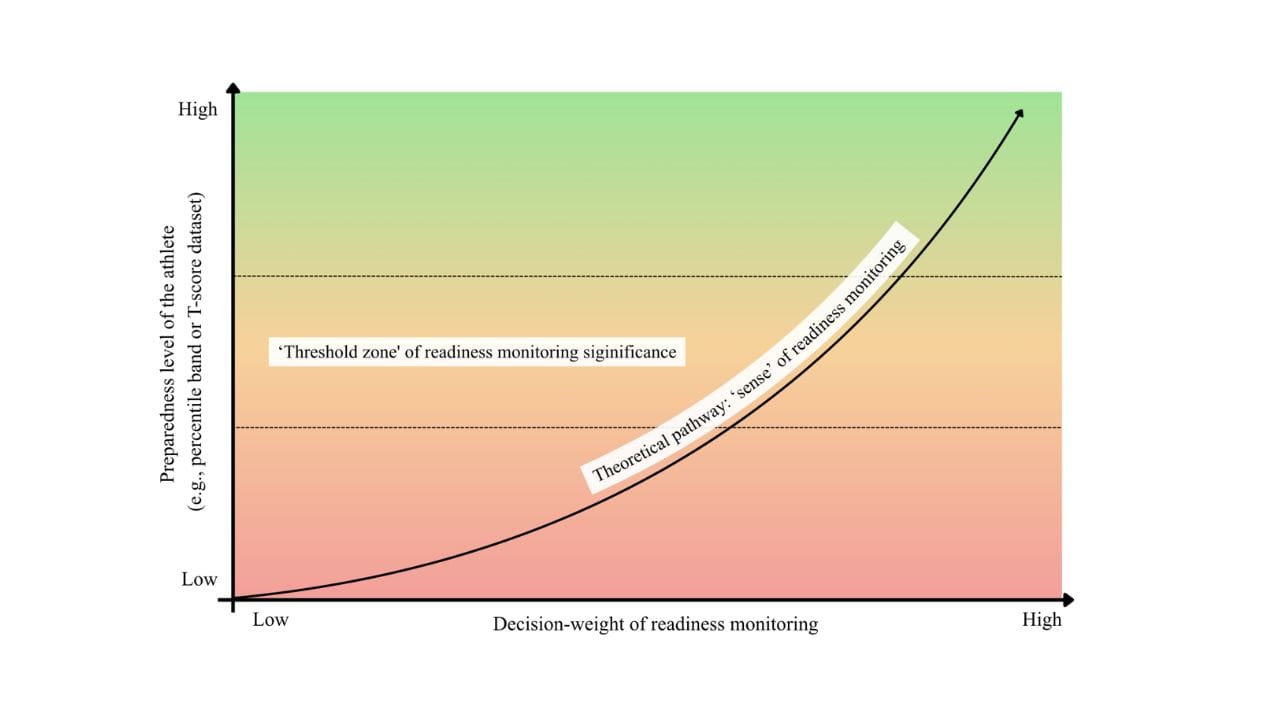
The more prepared an athlete is, the more valuable monitoring becomes.
The closer an athlete gets to their physical ceiling, the more important small fluctuations become.
If an NBA player has already developed elite physical capacities, monitoring can help optimize performance around dense schedules and travel.
If an Olympic sprinter is already operating near world-class standards, a small drop in readiness may have significant implications.
But if a developing athlete still lacks foundational strength, speed, power, or work capacity, the biggest opportunity isn't finding perfect readiness.
Its building preparedness.
Monitoring should support that process.
Not replace it.
A Better Decision Hierarchy
Before modifying training, ask yourself:
1. What is the athlete's biggest limitation? Is recovery actually the problem, or is it strength, speed, power, conditioning, robustness, or skill?
2. Is this a meaningful change? Does today's monitoring result reflect a real change, or simply normal day-to-day variation?
3. Will modifying training solve the problem? Will reducing load address the athlete's biggest limitation, or delay the adaptation we're trying to create?
4. Are we building capacity or protecting comfort? Is this decision moving the athlete closer to the demands of competition, or simply making today's session easier?
The goal isn't to ignore monitoring. The goal is to make sure monitoring serves development rather than replacing it.
Coaching Takeaways
Monitoring is a tool. It is not the objective.
The objective is building athletes capable of performing at the highest level possible.
Sometimes that means reducing load.
Sometimes that means modifying exposure.
But often it means continuing to build capacity despite normal fluctuations in readiness or true fatigue.
The best coaches understand that readiness and preparedness are not the same thing.
One reflects the athlete's current status. The other reflects years of accumulated adaptation.
And when forced to choose between the two, capacity almost always wins.
Before asking how ready your athlete is today, ask whether they're prepared for the demands of competition.
Because an athlete can score perfectly on every readiness test, and still be physically underprepared for the demands of their sport.
And that has consequences.
I hope this helps,
Ramsey
The Applied Performance Coach Certification and Mentorship is a
6-week live online course that will accelerate your understanding, application and confidence in performance science and coaching.


