

Basketball players rarely jump at one consistent intensity; a jump shot, rebound, block, and maximal CMJ can require very different outputs. Yet much of the research examining jumping mechanics focuses on maximal-effort jumps.
Previous group-level research suggests that increasing jump height involves greater mechanical work across the hip, knee, and ankle. The problem is that averaging athletes together can hide the strategies individual athletes actually use.
This study asked a more practical questions:
What do individual athletes change mechanically as they progressively jump higher?
What Did the Researchers Do?
Jumps
Eleven male NCAA Division I basketball players performed approximately 8 to 10 CMJs with arm swing, including 2 to 3 jumps at perceived:
- 25% effort
- 50% effort
- 75% effort
- 100% effort
Importantly, the researchers did not force athletes to hit an exact percentage of their maximal jump height. They were simply instructed to scale their effort.
Measurements
The researchers collected:
- 3D motion capture at 100 Hz
- Force plate data at 1,000 Hz
- Hip, knee, and ankle joint power
- Eccentric joint work
- Concentric joint work
- Total lower-extremity work
- CMJ height
They then examined the relationship between jump height and joint work both across the entire group and within each individual athlete.
What Were the Results?
Group Athlete Level
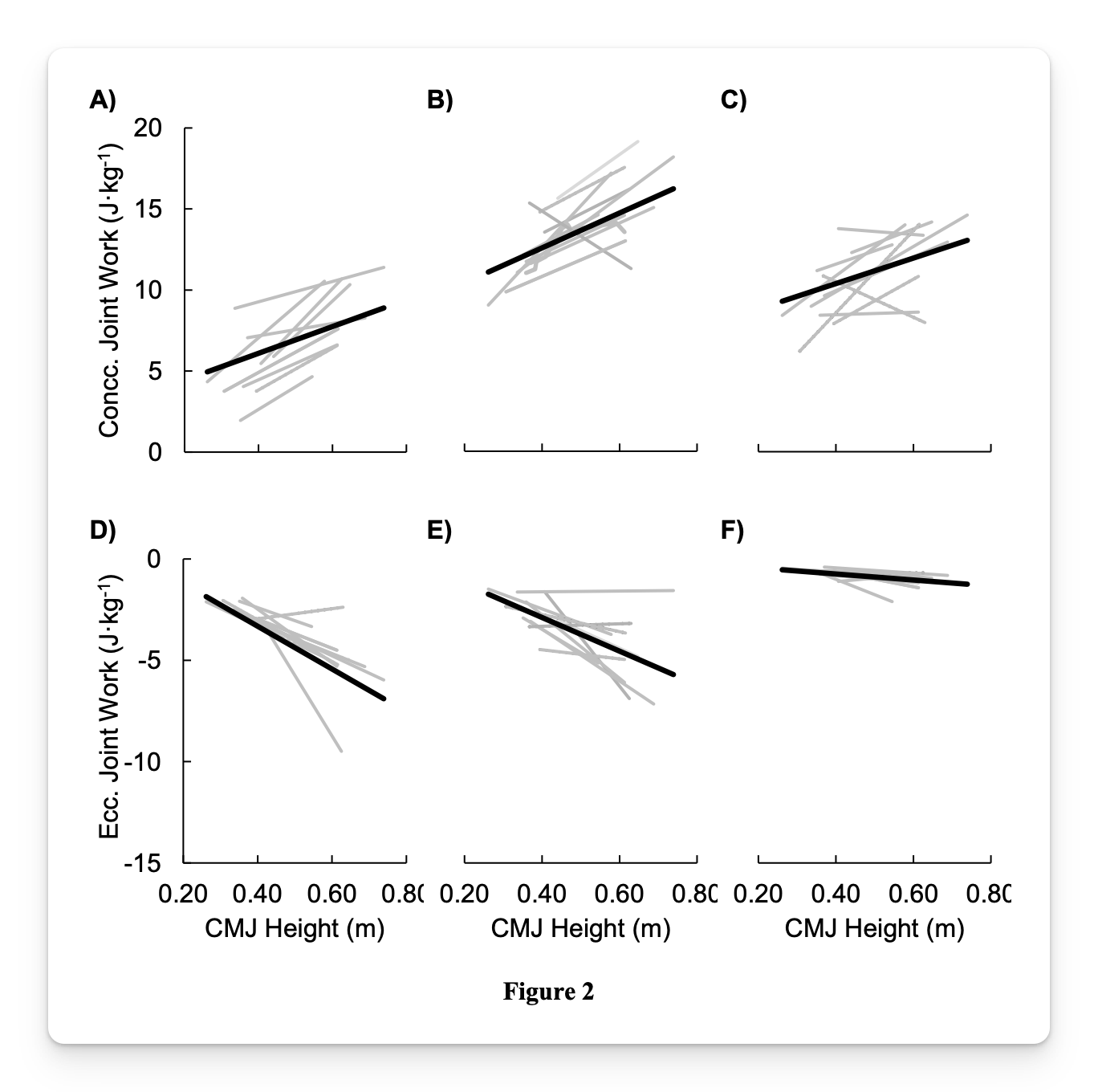
At the group level, the story looked simple. As jump height increased, athletes generally performed more eccentric and concentric work at the:
- Hip
- Knee
- Ankle
All group-average relationships between joint work and jump height were statistically significant.
But the individual analysis told a very different story.
Individual Athlete Level
Athletes selectively scaled work at:
- 2 athletes: no clear joint-specific scaling strategy
- 2 athletes: scaled work primarily at 1 joint
- 5 athletes: scaled work across 2 joints
- 2 athletes: scaled work across all 3 joints
Concentric work also appeared to be the more consistent mechanism for increasing jump height. 9 of 11 players showed significant relationships between total concentric work and jump height, compared with only 5 of 11 for total eccentric work.
What Does This Mean?
The key conclusion is that there may not be one universal strategy for scaling jump performance
The group analysis suggests that jumping higher requires athletes to increase work across the lower extremity.
But it doesn't tell us how a specific athlete accomplishes it.
One athlete may scale primarily through the hip. Another may increase knee and ankle work. Another may distribute additional work across all three joints.
Importantly, the data also don't tell us that one strategy is inherently superior.
Limitations
- Prescribed effort levels were subjective rather than standardized to exact jump heights.
- The study was cross-sectional, so it cannot tell us whether changing an athlete's joint strategy improves performance.
- Tendon behavior, stiffness, fascicle behavior, and muscle-level mechanics were not measured. We therefore should not label one athlete more "elastic" or "tendon dominant" from these data.
Coach's Takeaway
- Athletes scale jumping effort differently ⮕ As athletes jump higher, they don’t simply increase the same mechanical strategy by the same amount.
- Group averages can hide individual strategies ⮕ Across the group, hip, knee, and ankle work increased with jump height, but individual athletes used different combinations to get there.
- Don’t confuse description with prescription ⮕ Identifying an athlete’s jump strategy does not tell us how they should jump or what they should train.
I hope this helps,
Ramsey
Reference: Kipp K, Kiely M, Giordanelli M, Malloy P, Geiser C. Joint- and Subject-Specific Strategies in Male Basketball Players across a Range of Countermovement Jump Heights.

The Performance Academy: Gain access to the best performance and rehab minds in the world through premium masterclasses, live and recorded events, plus a network of coaches and therapist around the world. Education, community, and networking under one roof, all at your fingertips.


