

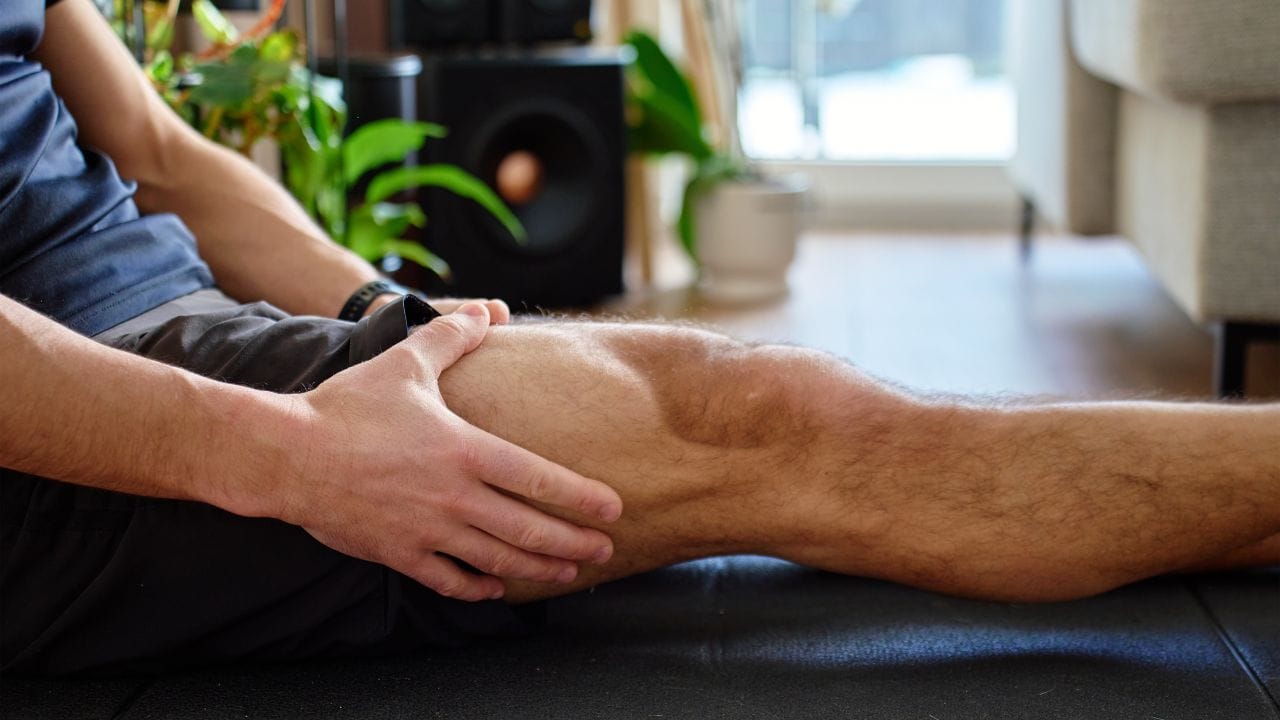
Delayed-onset muscle soreness, or DOMS, is commonly treated as evidence of muscle damage.
An athlete completes a demanding training session, wakes up sore the next day, and assumes the workout caused considerable structural disruption.
But the relationship is not that simple, and soreness alone is a poor indicator for quality.
A recent systematic review by Jemni and colleagues presents DOMS as a multifactorial neurophysiological response shaped by tissue stress, inflammation, sensory processing, motor control, and previous training exposure.
Lets unpack it.
What Actually Causes DOMS?
DOMS usually develops several hours after unfamiliar or demanding exercise, peaks between 24 and 72 hours, and resolves within approximately five to seven days.
Eccentric contractions are often involved, but the resulting soreness cannot be explained by structural muscle damage alone.
Several interacting processes contribute:
- Mechanical stress to muscle and connective tissue
- Inflammatory signaling
- Peripheral nociceptor sensitization
- Changes in proprioception and motor control
- Altered central pain processing
- Individual differences in training history and pain sensitivity
This helps explain why soreness, creatine kinase, strength loss, and structural muscle damage do not always follow the same pattern.
An athlete can experience considerable soreness without detectable microscopic muscle-fiber disruption. Another athlete may report little soreness while strength, coordination, or performance remains impaired.
Soreness is a perception. It provides useful information, but it does not directly quantify tissue damage or readiness.
What Did the Review Examine?
The authors reviewed research investigating DOMS following endurance, resistance, and plyometric exercise.
The search identified 1,183 records, with 68 studies meeting the stated full-text eligibility criteria. Outcomes included:
- Perceived soreness
- Pressure-pain threshold
- Maximal voluntary contraction
- Creatine kinase and inflammatory markers
- Electromyography
- Reflex and neurological measures
Most studies did not report enough comparable statistical information to conduct a full meta-analysis. The authors therefore used a narrative synthesis to integrate the findings.
Does the Type of Exercise Matter?
The review proposed that different training modalities may emphasize different contributors to DOMS.
Endurance exercise
Endurance-related soreness may be influenced by prolonged metabolic stress, oxidative stress, and cumulative inflammatory signaling. These responses appear to become more moderate with repeated exposure.
Resistance exercise
High-tension eccentric contractions may create greater localized mechanical stress, strength loss, and activation of Group III and IV sensory afferents. Athletes often describe the resulting sensation as deeper soreness or stiffness.
Plyometric exercise
Rapid stretch-shortening-cycle actions place substantial demands on sensory feedback and neuromuscular coordination. The authors proposed that plyometric DOMS may involve greater temporary disruption of proprioception and motor control.
These distinctions are theoretically interesting, but the evidence is not strong enough to divide DOMS into three cleanly separated categories.
Exercise intensity, volume, novelty, muscle groups involved, and the athlete’s training history may influence soreness as much as the exercise label itself.
Do Recovery Interventions Work?
Several recovery methods produced small-to-moderate reductions in soreness:
- Compression garments: standardized mean difference of approximately −0.44
- Foam rolling: approximately −0.34
- Acupuncture: effects as large as −0.89 in some analyses
- Massage: potentially greater benefits around 72 hours
- Photobiomodulation: possible improvements in soreness and biochemical markers
These numbers require caution. The interventions were generally evaluated in different studies with different participants, exercise protocols, treatment doses, and outcome measures. Most were not directly compared in head-to-head trials.
A recovery method may still be useful when it improves comfort, perceived readiness, or the athlete’s ability to complete the next session. That does not mean the method accelerated tissue repair or fully restored performance.
Important Limitations
- Study populations and DOMS protocols varied considerably.
- Many studies relied heavily on subjective soreness ratings.
- Most studies lacked extractable effect sizes.
What Does This Mean for Coaches?
We need to stop treating soreness as a direct measure of damage, training effectiveness, or readiness.
Instead, combine the athlete’s soreness rating with:
- Strength or power
- Jump performance
- Range of motion
- Movement quality
- Training history
- The demands of the next session
Progressive exposure is critical because the repeated-bout effect allows athletes to adapt to familiar loading and experience less soreness after subsequent sessions.
Good programming may therefore offer more protection than any recovery tool applied afterward. And if your athlete are always sore, take a good look at your programming progression.
The takeaway is that DOMS is one signal within a much larger recovery picture; consider it but dont let it drive all decision making.
I hope this was helpful,
Ramsey
Reference: Jemni M, Quodling N, Hammami N, et al. (2026). Rethinking neurophysiology of delayed onset muscle soreness: updated concepts and mechanisms for mitigation across endurance, resistance, and plyometric exercise. Frontiers in Sports and Active Living, 8:1709704.


