Jump Testing for Return to Play: What Metrics Really Matter After ACL Reconstruction?
ACL injuries are common in basketball and re-injury rates remain high, especially among youth athletes. Force plate jump testing can
Science-Backed Testing Articles to Enhance Your Performance and Rehab Assessments.
ACL injuries are common in basketball and re-injury rates remain high, especially among youth athletes. Force plate jump testing can
The countermovement jump (CMJ) is a popular neuromuscular monitoring tool, but its long-term utility in sprinters hasn’t been clearly
Sprinting and acceleration are crucial in field sports like soccer, hurling, and rugby, where plays often hinge on short bursts
Drop jumps (DJs) are a core plyometric tool used to develop explosive strength and improve jump performance, critical qualities in
Coaches often use the isometric mid-shin pull (MSP) and countermovement jumps (CMJs) to assess and train strength and power. CMJs
In professional football, the season is long, dense, and physically taxing. Players in the English Championship average more than a
The countermovement jump (CMJ) is a go-to tool for monitoring neuromuscular status in athletes. Recently, more emphasis has been placed
The countermovement jump (CMJ) is widely used to evaluate lower-body power, coordination, and rapid force development. Ground reaction force (GRF)
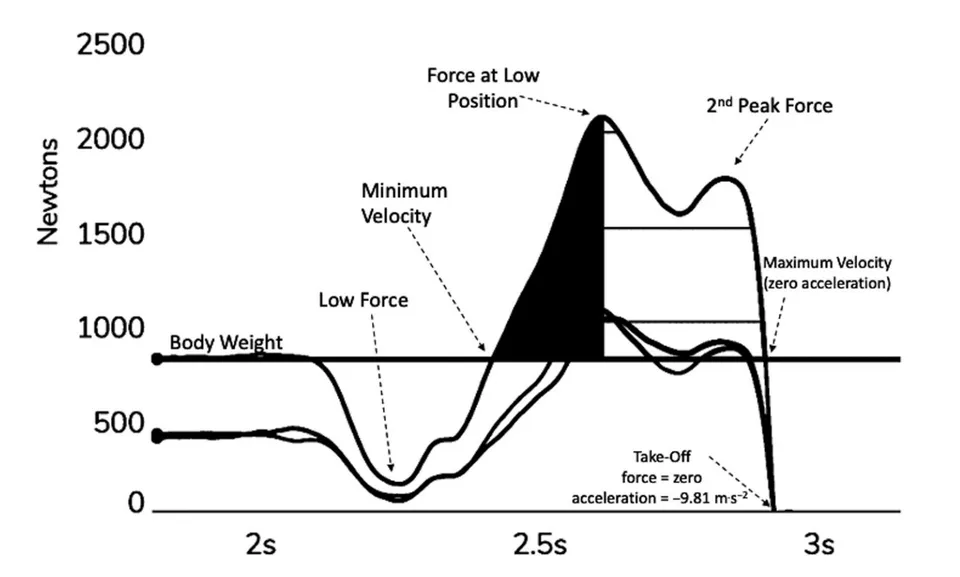
Vertical ground reaction force (GRF) profiles from countermovement jumps (CMJs) provide insights into the athlete's jump strategy. Beyond
Coaches often use verbal cues to drive movement changes, but more exploration is needed to understand how these cues impact
Coaches often examine countermovement jump height but overlook how the athlete jumps, specifically their force-time curve. This study explored whether
Athletes often struggle to regain full function after ACL reconstruction (ACLR), even when strength returns. Traditional strength tests may overlook