

Basketball is built on short, explosive movements in multiple directions. A large portion of those movements involves stopping, not just accelerating. Players spend a significant amount of time shuffling on defense, and many lower body injuries occur during rapid deceleration tasks.
Despite this, most training programs still prioritize acceleration and top speed, with much less attention given to how well an athlete can brake.
The purpose of this study was to examine whether an athlete’s linear deceleration ability relates to their ability to move laterally.
Does an athlete who can stop faster in a straight line also perform better in lateral shuffle and change of direction tasks?
What Did the Researchers Do?
The study included 124 male NCAA Division I basketball players from 10 programs. Athletes were grouped by position (guards and bigs) and then split into high and low deceleration groups based on their performance in a linear deceleration test.
Primary Tests
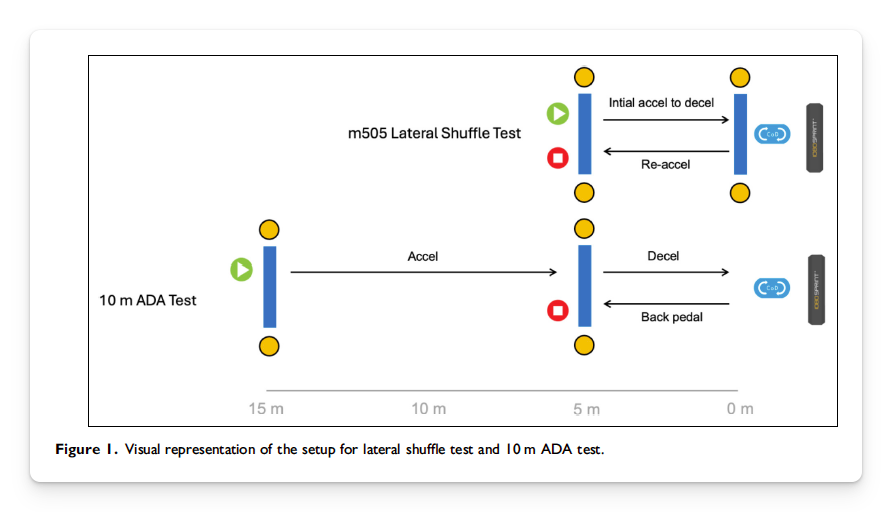
1. 10-meter Acceleration-Deceleration Ability Test (ADA)
Athletes sprinted 10 meters and then decelerated as quickly as possible. This measured:
- Maximum deceleration
- Deceleration time
- Acceleration and top speed
2. 5-5 Lateral Shuffle Test
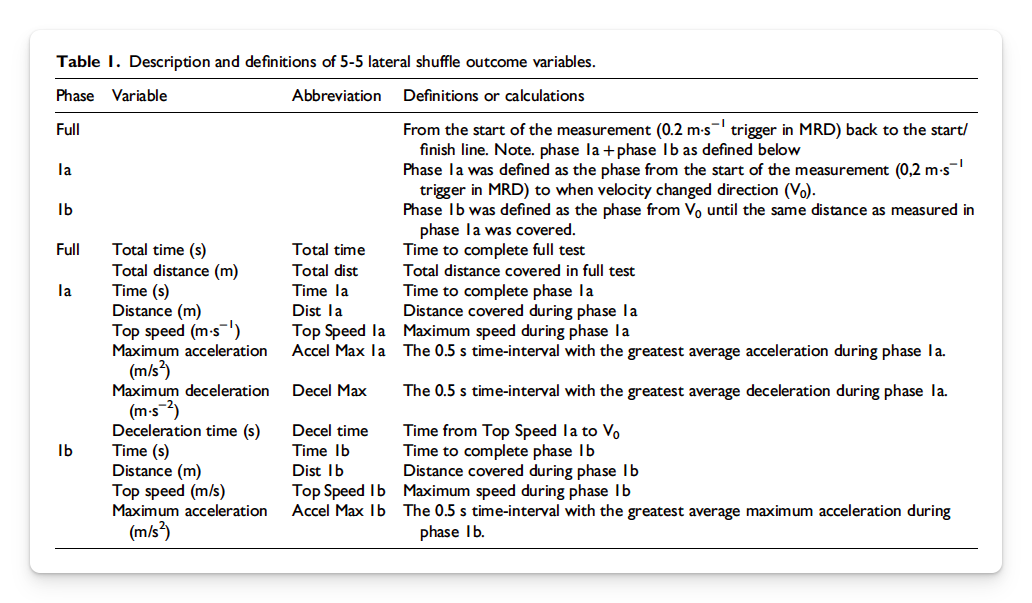
Athletes shuffled 5 meters, changed direction, and shuffled back. This measured:
- Total time
- Deceleration
- Re-acceleration
- Top speed
All testing was done using a motorized resistance device that captured velocity, force, and distance in real time.
What Were the Results?
Athletes with better linear deceleration were faster laterally
- Players in the high deceleration group completed the lateral shuffle faster than those in the low deceleration group.
- This was true for both guards and bigs.
Deceleration was the main performance separator
- Differences in acceleration were small.
- Differences in top speed were moderate.
- The largest differences were seen in deceleration ability.
Faster deceleration meant better efficiency
Athletes with higher deceleration capacity were able to:
- Stop in less time
- Stop over a shorter distance
- Transition more effectively into the next movement
Re-acceleration improved as well
- The high deceleration group showed better performance during the re-acceleration phase after the change of direction.
- This suggests that braking ability directly influences the quality of the next movement.
Guards demonstrated higher deceleration ability than bigs
- This likely reflects positional demands, as guards perform more high-frequency lateral movements and changes of direction.
What Does This Mean?
- Deceleration is a transferable quality ⮕ The ability to brake effectively in a linear sprint carries over to lateral movement, suggesting shared underlying physical qualities
- Braking is a key limiter in change of direction ⮕ Many athletes can produce speed, but fewer can control it, the ability to absorb and redirect force separates performance levels
- Movement performance depends on transitions ⮕ The most important phase is not acceleration or top speed, it is the transition where athletes decelerate and re-accelerate
- Better deceleration improves movement efficiency ⮕ Athletes who stop faster maintain better positioning, react quicker, and change direction with less wasted motion
Limitations
- The study is cross-sectional, so it shows relationships but does not prove causation
- A fixed resistance load was used, which may affect athletes differently based on body mass
Coach’s Takeaway
- Deceleration is a primary driver of lateral movement performance
- Training should include dedicated work on braking and force absorption
- The transition from deceleration to re-acceleration is critical and should be trained directly
- Speed alone is not enough, athletes must be able to control and redirect it
If you want athletes to move better, especially on defense, you need to train deceleration.
I hope this helps,
Ramsey
Reference
Petway AJ, Harper D, Cohen D, Eriksrud O (2026). Influence of maximal linear deceleration on lateral deceleration and shuffle performance in NCAA Power 4 basketball athletes. International Journal of Sports Science & Coaching.


