

One of the biggest mistakes we make as coaches is assuming that more strength always equals better performance.
It doesn’t.
Strength is a tool. A powerful one.
But like any tool, its value depends on context, timing, and how much of it you already have.
The Strength–Transfer Curve describes how increases in maximal strength relate to improvements in sport performance over time.
It explains why strength gains are highly effective early in development, moderately effective in intermediate athletes, minimally effective in advanced athletes, and potentially harmful if overemphasized.
The Strength–Transfer Curve has four stages: Capacity → Conversion → Saturation → Interference
Let’s walk through each phase and what it means for your programming.
The Capacity Phase
[When More Strength Helps Most]
When an athlete is weak and untrained, strength has linear returns on performance because force production is the limiting factor.
Add 20 pounds to a squat and:
- They sprint faster
- They jump higher
- They change direction better
- They tolerate more practice load
If an athlete cannot produce sufficient force relative to their body mass, everything downstream suffers:
- Acceleration
- Deceleration
- Re-acceleration
- Propulsion
- Tissue tolerance
At this stage, increases in force capacity meaningfully improves performance.
Coaching implication:
Push progressive overload hard. Build the engine.
The Conversion Phase
[When More Strength Helps Less]
Eventually, the slope flattens. We call this diminishing returns.
The athlete is no longer weak. They meet basic force thresholds for their sport. Now, when you add 10–20 pounds to their lift, you don’t see the same jump in sprint time or vertical height.
Strength still matters. It just matters less per unit gained.
At this stage:
- Rate of force development becomes more important
- Force orientation matters more
- Timing and coordination begin to dominate
- Technical skill limits performance
You are no longer just building horsepower. You’re refining how it’s expressed.
This is where many coaches get stuck. They continue chasing max strength because it’s measurable and controllable. Meanwhile, performance plateaus.
Coaching implication:
Maintain and slightly improve strength, but begin shifting emphasis toward power, speed, and skill.
The Saturation Phase
[When More Strength Stops Helping]
Now you’re working with a strong, well-trained athlete. They are:
- Meeting normative population standards
- Strong relative to positional demands
- Physically robust
Adding more maximal strength produces almost no improvement in sprinting or jumping.
Why?
Because strength is no longer the limiting factor. Performance is now constrained by:
- Neural coordination
- Elastic qualities
- Technical efficiency
- Sport-specific skill
- Decision-making speed
At this point, the system has enough force capacity. Adding more does not meaningfully improve sport performance.
The transfer coefficient is near zero.
Coaching implication:
Shift toward power, elastic work, sport-specific speed, and integrated skill exposure. Strength becomes supportive, not central.
The Interference Phase
[When More Strength Hurts Performance]
This is the uncomfortable yet true part. Strength can actually have negative returns.
There is a point where chasing strength can reduce sport performance.
How?
- Increased body mass: If strength gains come with unnecessary mass, relative force may not improve.
- Interference with speed qualities: Excessive heavy lifting can blunt high-velocity adaptations if poorly balanced.
- Fatigue cost: Heavy maximal training carries a recovery tax. In-season athletes especially can pay for it.
- Movement stiffness or altered coordination: Overemphasis on slow, heavy strength without speed integration can shift movement strategy in ways that don’t transfer.
The athlete becomes stronger in the weight room but is no faster on the field. Sometimes even slower.
This is not because strength is bad. It’s because the marginal utility of additional strength has turned negative relative to sport demands.
Coaching implication:
Know when to stop pushing maximal strength. Protect speed, rhythm, and readiness.
A Simple Way to Visualize It
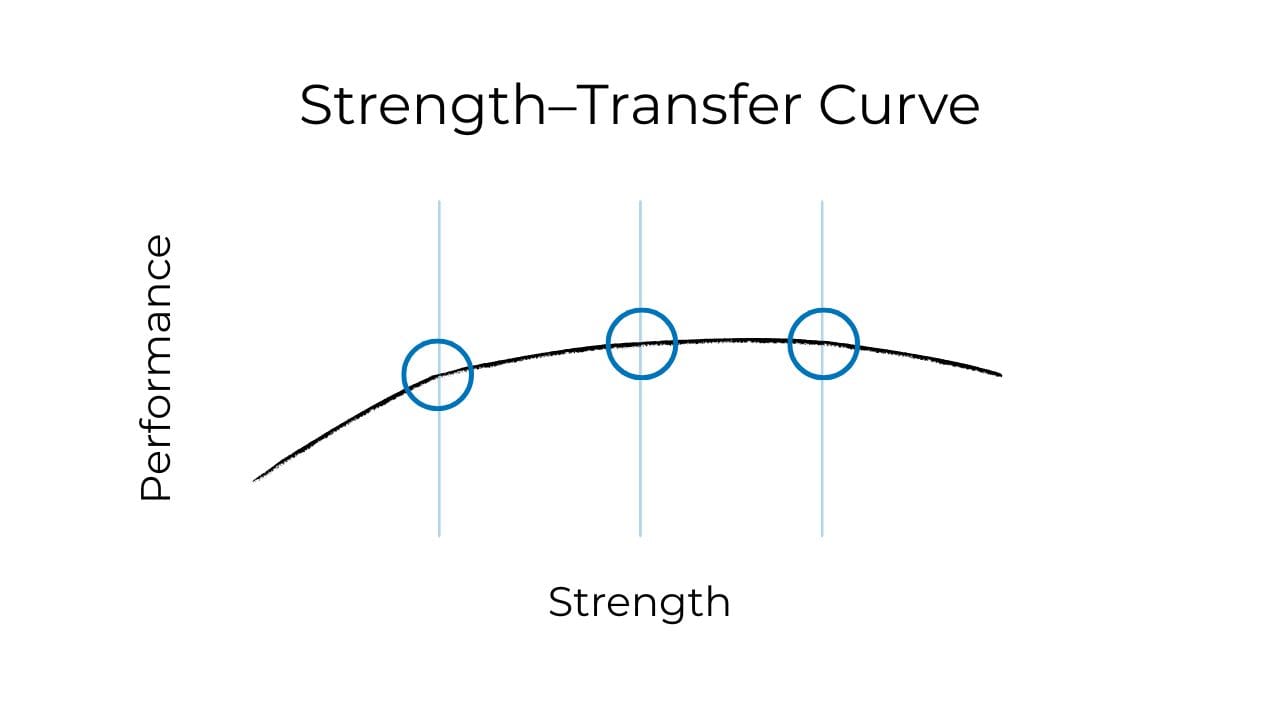
The curve above shows what happens as strength increases:
- Early on, strength and performance rise together.
- Then the curve flattens.
- Then it plateaus.
- Eventually, if mismanaged, it dips.
Your job as a coach is to identify where your athlete sits on that curve.
Not every athlete needs more strength. Some need better use of the strength they already have, while others need less fatigue and more exposure to real sport speed.
Practical Framework for Coaches
Strength is foundational. But it is not the finish line.

While we priortize strength early, eventually our priorities shift:
- Early in development, strength drives performance.
- Later, strength supports performance.
- Eventually, excessive focus on strength can interfere with performance.
The best coaches know when to build it, when to maintain it, and when to get out of its way. Ask yourself these questions:
- Is strength currently the limiting factor?
- Has the athlete met reasonable relative strength standards for their sport?
- Are we seeing actual improvements in sprint, jump, or change-of-direction times?
- Is the cost of gaining more strength worth the return?
If the answer to the first question is yes, push strength. If the answer to the second and third questions is yes, shift your focus. If performance metrics are stagnant or declining despite strength gains, you may be in the saturation or interference phase.
I hope this helps,
Ramsey
P.S. If you want to learn how to think deeper about performance and apply science-backed, proven methods, then consider the Applied Performance Coach.
The Applied Performance Coach Certification and Mentorship is a
6-week live online course that will accelerate your understanding, application and confidence in performance science and coaching.