

Inside our Force Plate Practitioner course, we spend time discussing the difference between the bilateral countermovement jump (CMJ) and the single-leg countermovement jump (SL-CMJ).
At first glance, they seem like very similar tests.
- Both involve a countermovement.
- Both assess jumping performance.
- Both are commonly used in sport performance and rehab settings.
But mechanically, they are very different tasks, and that matters when interpreting force plate data.
Bilateral vs Single-Leg CMJ
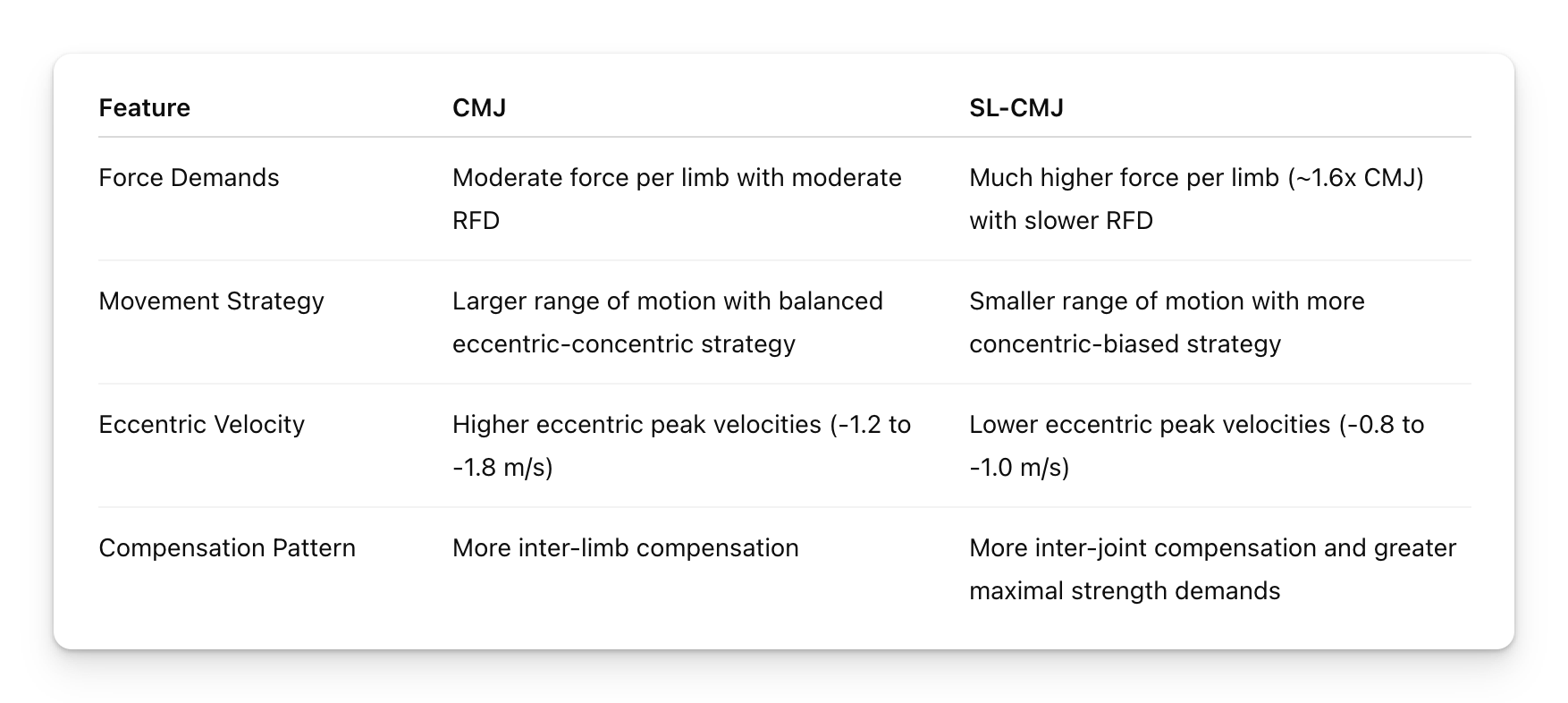
The traditional bilateral CMJ allows athletes to distribute force across two limbs, use a deeper countermovement, and move through higher eccentric velocities. The movement tends to look smoother and more balanced from an eccentric-concentric standpoint.
The SL-CMJ changes the equation immediately.
Once athletes jump from one leg, force demands per limb rise substantially. To handle these demands, athletes often reduce countermovement depth, slow eccentric velocity, and rely more heavily on concentric force production.
In many ways, the SL-CMJ begins to shift away from a slow stretch-shortening cycle dominant task and trends toward a higher-force strength challenge.
Why This Matters for Coaches
This distinction is important because these tests may provide very different information.
The bilateral CMJ may be more useful for understanding:
- Global neuromuscular performance
- Fatigue-related changes
- Inter-limb asymmetries
- General fast dynamic strength qualities
The SL-CMJ may expose:
- Single-leg force production limitations
- Coordination and stability deficits
- Inter-joint compensation strategies
- Higher maximal force-strength demands
This also helps explain why some athletes can look explosive in bilateral jumps but struggle to express force efficiently on one leg. The task constraints change the movement solution.
Limb Biases vs Capacity
A bilateral CMJ allows athletes to bias toward a preferred side, redistribute load, and use compensation strategies to complete the task. In many ways, bilateral testing may reflect how the system solves the movement globally, not necessarily what each limb can truly do independently.
The SL-CMJ removes many of those options.
Once isolated to one limb, that leg must accept force, produce force, stabilize, and coordinate the movement on its own. As a result, the SL-CMJ may be a more direct reflection of true single-leg capacity, while the bilateral CMJ may reveal movement preferences and compensation strategies.
Different Tests, Different Stores
As coaches, practitioners, and sport scientists, we should avoid treating these tests as interchangeable.
Instead, the better question becomes:
“What quality am I actually trying to assess?”
Because ultimately, the test shapes the strategy, and the strategy shapes the data.
While both jumping task, the two are more apple to orange comparison and should be treated as different tests.
If you want to learn how to interpret these tests beyond just jump height, including force-time metrics, asymmetries, contraction strategies, and practical athlete profiling, check out the Certified Force Plate Practitioner course.
It was built to help coaches, PTs, ATCs, and sport scientists turn force plate data into meaningful coaching decisions.
I hope this helps,
Ramsey

The Simplest and Fastest Way to Learn Jump Analysis with Force Plates