

Walk into almost any high-performance environment today and you'll find data everywhere.
Force plates. GPS metrics. Wellness questionnaires. Sleep scores. Load monitoring. And more.
None of this is a bad thing.
In fact, these tools have helped coaches make better decisions, improve performance, and better manage athlete health.
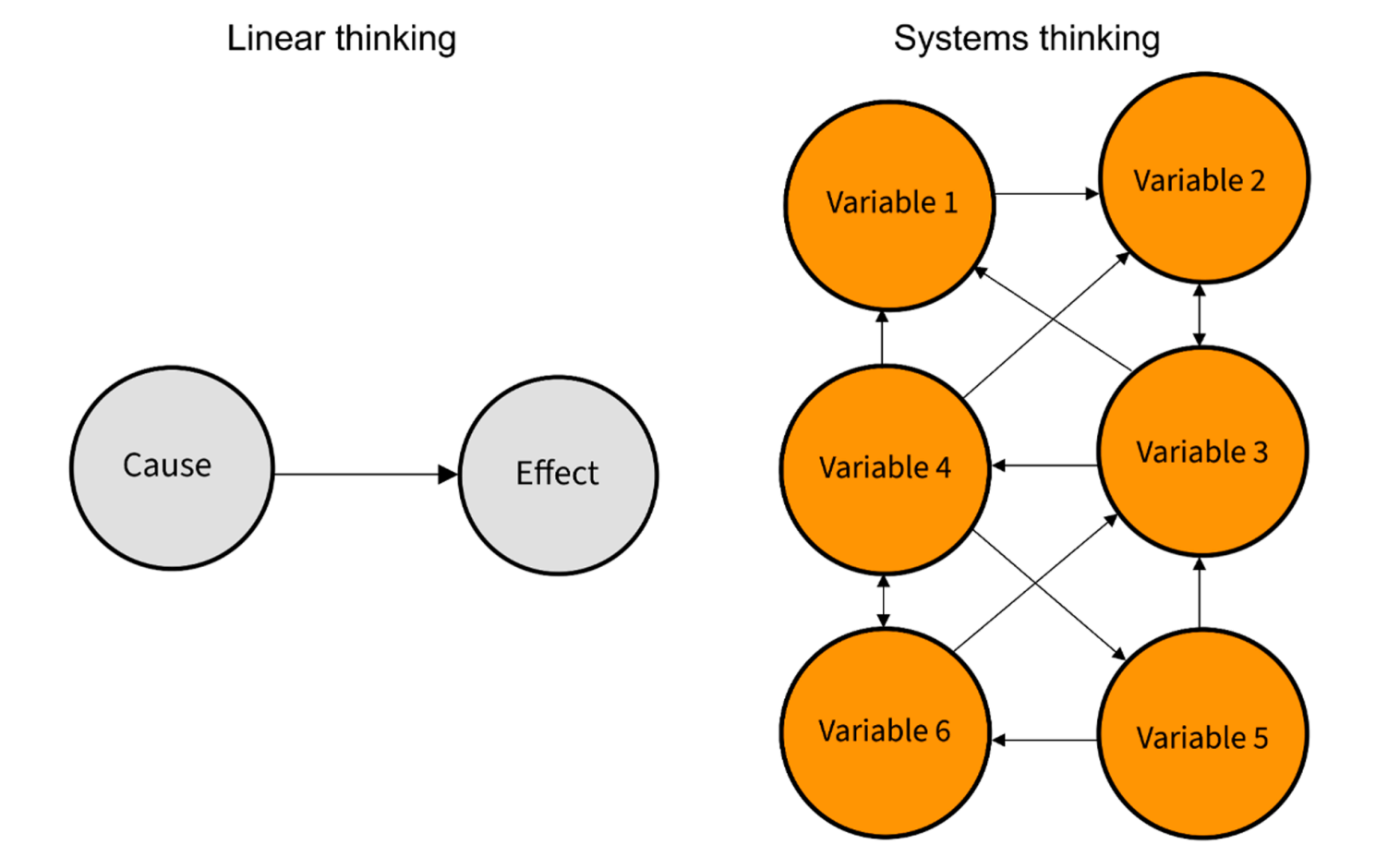
The challenge is that sport performance is often treated like a machine. We identify individual variables, measure them, and attempt to optimize them one at a time.
The assumption is that if enough individual pieces improve, performance improves.
Sometimes that's true. But often it isn't.
Because sport is not a machine.
It's a system.
The Problem with Linear Thinking
As coaches, we're naturally drawn toward simple explanations.
- An athlete is underperforming? Maybe they're fatigued.
- The team is losing? Maybe conditioning is poor.
- Injury rates are increasing? Maybe workloads are too high.
These explanations are appealing because they are easy to understand and easy to act on.
The problem is that real-world performance rarely works this way.
An athlete's performance may be influenced by:
- Sleep quality
- Travel demands
- Schedule congestion
- Team role
- Coaching decisions
- Confidence
- Tactical changes
- Recovery practices
- Personal life stressors
All at the same time.
Trying to isolate a single cause often misses the bigger picture.
Sport Performance Emerges From Interactions
Lets consider an example from the sport I have worked in for 15+ years.
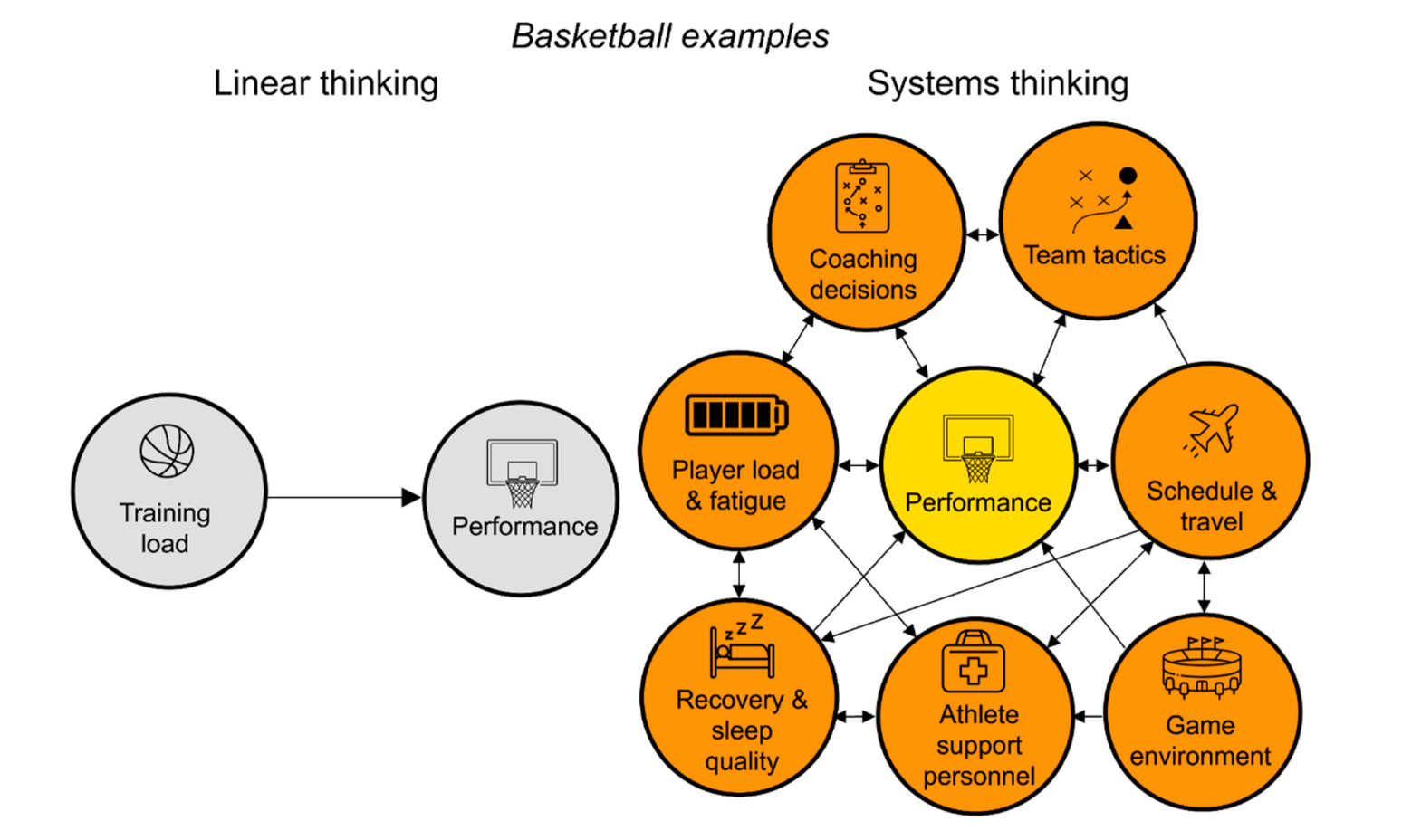
Basketball should be viewed as a complex sociotechnical system rather than a collection of isolated variables.
That's a fancy way of saying that performance emerges from the interaction of many moving parts.
- Players interact with teammates.
- Coaches influence tactics.
- Scheduling influences recovery.
- Travel influences sleep.
- Fatigue influences decision-making.
- Technology influences coaching decisions.
Each component affects the others.
As a result, performance becomes an emergent property of the entire system rather than the product of any single variable.
Basketball is particularly useful for understanding complexity because the game is fast, dynamic, and full of constant interaction.
Think about a simple example.
A player shoots poorly during a road trip.
A reductionist approach might conclude that poor shooting means the athlete is fatigued.
A systems approach asks additional questions:
- How much travel occurred?
- Was sleep disrupted?
- Did the player's role change?
- Were defensive matchups different?
- Did tactical adjustments affect shot quality?
- Was team communication affected?
- Were there organizational pressures surrounding the game?
Suddenly, what appeared to be a simple performance problem becomes a network of interacting influences.
This doesn't mean fatigue is unimportant.
It means fatigue is rarely acting alone.
The Same Principle Applies to Injury
This concept extends beyond performance.
Many injury discussions focus on a single risk factor.
- Training load.
- Strength deficits.
- Mobility restrictions.
- Movement quality.
Each may matter, and likely does.
But injuries typically emerge from interactions among many factors including:
- Workload
- Recovery
- Scheduling
- Travel
- Stress
- Communication
- Previous injury history
- Team resources
When we focus exclusively on one variable, we risk overlooking the conditions that allow problems to emerge in the first place.
More Data Isn't Always the Answer
While complexity must be appreciated, collecting more data doesn't automatically create more understanding.
Modern sport has become incredibly good at measuring things.
What remains difficult is understanding how those measurements interact.
- A readiness score might tell us an athlete feels tired.
- A jump test might show a decrease in performance.
- GPS data might reveal increased workload.
Those metrics are useful.
But none explain why the athlete is responding the way they are.
The answer often exists in the relationships between variables rather than the variables themselves.
What This Means for Coaches
I am not suggesting we abandon sport science, monitoring, or performance analytics.
My dissertation was done on workload monitoring in the NBA and I have helped hundreds of coaches understand force plates, so its safe to say I am a believer in the data approach.
but I am suggesting we zoom out.
Instead of asking, "What variable is driving performance?"
We may need to ask, "How are the variables interacting?"
That shift changes moves the conversation from optimization to integration.
From individual metrics to system behavior. And from isolated interventions to understanding consequences across the entire environment.
Coach's Takeaway
The best coaches don't simply manage training. They manage systems.
Training, recovery, travel, communication, staffing, scheduling, and decision-making all influence one another.
Performance is not explained by a single variable. Rather, it emerges from the interaction of many.
The sooner we stop looking for simple answers to complex problems, the better positioned we'll be to understand what drives performance, injury risk, and athlete wellbeing in the real world.
I hope this helps,
Ramsey

The Applied Performance Coach Certification and Mentorship is a
6-week live online course that will accelerate your understanding, application and confidence in performance science and coaching.
Reference: Morrison M, McLean S, Salmon PM. (2026). Rethinking basketball performance: A complex sociotechnical systems perspective. Basketball Studies, 1(2026), 100003.