

Introduction
Sprint technique is often coached as if there is one ideal model.
But when you watch elite athletes accelerate, you quickly realize that great athletes move differently.
Some athletes create speed through large, powerful projection mechanics. Others rely on rapid turnover and reactive contacts. Some look smooth and controlled, while others appear explosive and elastic.
And according to recent research in professional rugby players, those movement solutions may not only influence performance, but also how stress is distributed throughout the lower body.
That matters because Hamstring injuries remain one of the most common injuries in sport, Calf and Achilles injuries continue to rise and athletes often demonstrate similar sprint performances despite very different mechanics.
This guide breaks down:
- The Sprint Technique Quadrant
- The 4 acceleration archetypes
- The injury implications of each
- Practical training considerations for coaches
Most importantly, this guide aims to shift the sprint conversation away from “What is the perfect sprint technique?” and towards “How does this athlete solve the movement problem of acceleration?”
Lets get into it.
The Sprint Technique Quadrant
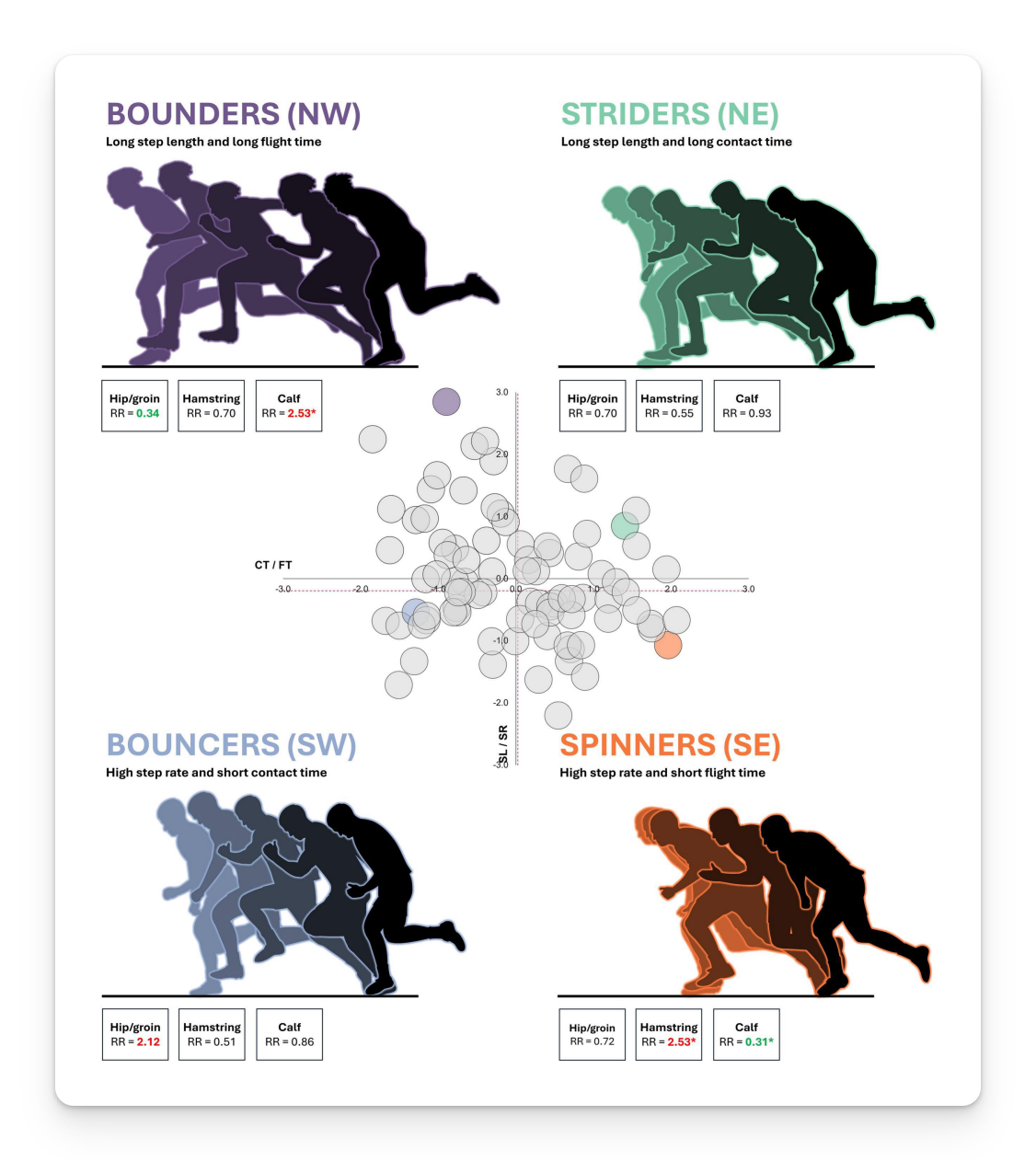
The Sprint Technique Quadrant is a framework for understanding how athletes organize movement during acceleration.
Rather than viewing sprint technique as one universal model, the quadrant describes four distinct movement solutions based on how athletes combine:
- Step length vs. step rate
- Contact time vs. flight time
Some athletes create speed through projection and longer steps. Others rely more on rapid turnover and reactive contacts.
Neither approach is inherently right or wrong.
They are simply different ways of solving the same movement task of accelerating the body forward as fast as possible.
One of the most important findings from the study was that athletes with very different sprint mechanics were still capable of producing similar sprint acceleration performances.
That is an important coaching point. Athletes do not all need to look identical to move fast.
Instead, athletes appear to self-organize around movement solutions that fit:
- Their structure
- Their force production capacities
- Their tendon behavior
- Their coordination tendencies
- Their neuromuscular strategies
The quadrant simply gives coaches a framework for understanding those tendencies.
The 4 Sprint Archetypes
1. The Bounder: Long Step Length + Long Flight Time
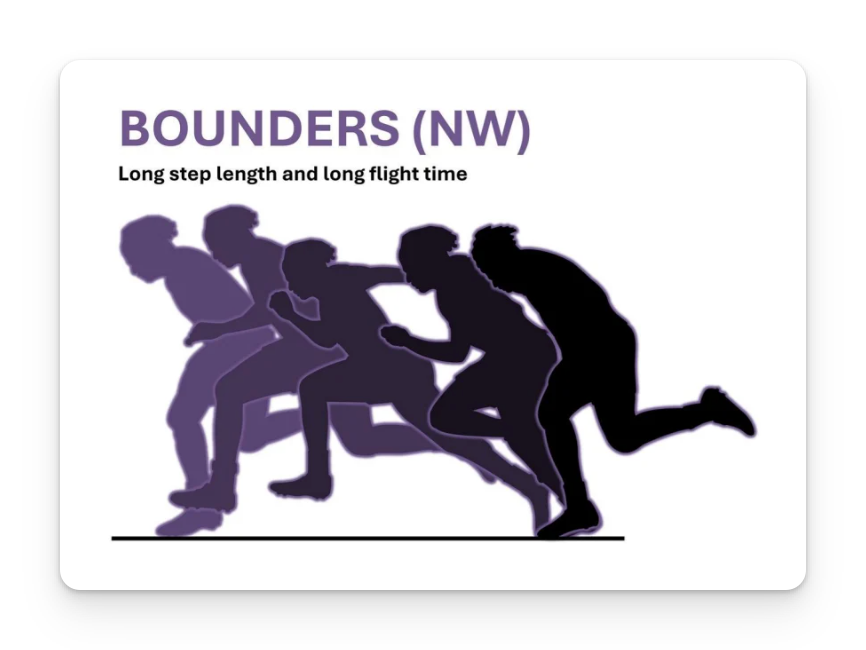
The Bounder creates speed through projection.
These athletes tend to cover large amounts of ground with each step and often appear explosive and elastic during acceleration. Their mechanics are characterized by noticeable displacement and greater airtime between contacts.
When coaches watch these athletes sprint, they often describe them as:
- Powerful
- Springy
- Explosive
Bounders typically generate larger vertical impulses and rely heavily on the plantarflexors to project the body forward. The result is an acceleration strategy that often looks aggressive and dynamic.
These athletes often excel at:
- Creating large displacement per step
- Producing strong projection mechanics
- Generating powerful early acceleration
However, those same mechanics may also come with larger landing demands and increased stress through the calf-Achilles complex, which becomes important later when discussing injury implications.
2. The Spinner: High Step Rate + Short Flight Time
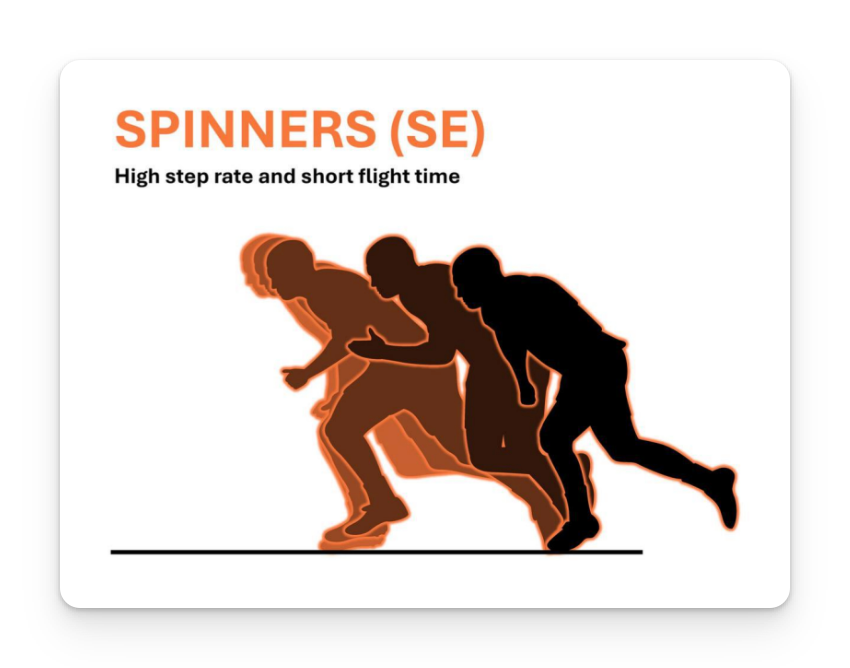
The Spinner solves acceleration very differently.
Rather than creating speed through large projection mechanics, these athletes generate acceleration through rapid limb repositioning and extremely high cadence mechanics.
Their acceleration often looks:
- Sharp
- Reactive
- Twitchy
- Fast-footed
These athletes spend very little time in the air and instead rely on rapid turnover to continually reposition the limbs underneath the body.
From a mechanical perspective, this strategy likely shifts more demand proximally toward the hip and hamstring musculature. Rapid repositioning requires aggressive hip flexion and extension mechanics, particularly during the transition from swing to ground contact.
Spinners often appear naturally fast because of how quickly the limbs cycle, even if they are not covering large amounts of ground per step.
3. The Strider: Long Step Length + Long Contact Time
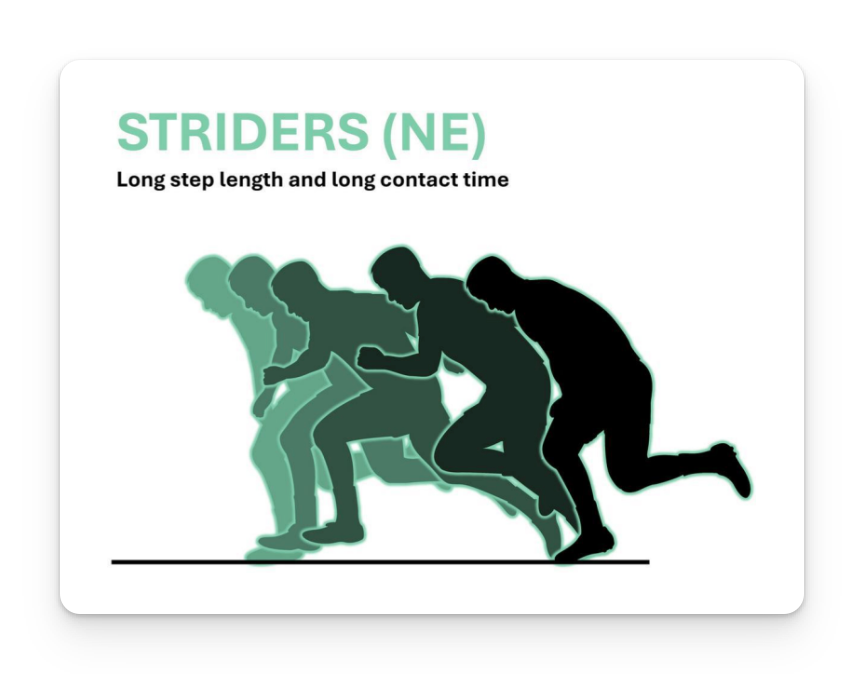
The Strider creates speed through smooth projection and longer force application.
Compared to the Bounder, these athletes still utilize relatively long steps, but do so with less airtime and more controlled ground interaction. Their acceleration often appears technically clean and rhythmical rather than highly explosive.
Coaches often describe these athletes as:
- Smooth
- Efficient
- Controlled
Rather than aggressively “bounding” through acceleration, the Strider tends to stay more connected to the ground while still producing effective displacement.
This may allow for:
- More controlled force application
- Efficient force orientation
- Reduced impact stress compared to more aggressive projection strategies
Importantly, despite producing relatively long step lengths similar to the Bounder, these athletes did not demonstrate the same elevated calf injury risk in the study. That distinction becomes highly important when considering how different sprint strategies distribute stress.
4. The Bouncer: High Step Rate + Short Contact Time
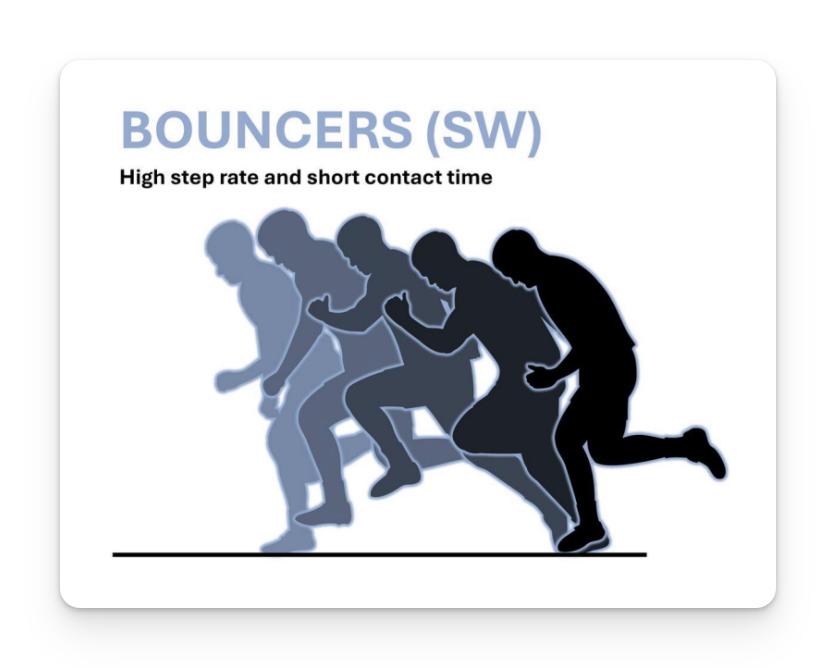
The Bouncer creates speed through reactivity and stiffness.
These athletes tend to stay compact during acceleration and produce very quick contacts with minimal wasted movement. Their acceleration often appears punchy and reactive, with fast rebounds off the ground.
Compared to the Spinner:
- The Bouncer tends to display shorter contact times
- Greater reactive stiffness
- Less airtime
- More compact mechanics
These athletes often look reactive, bouncy, and quick off the floor.
The Bouncer strategy may rely heavily on rapid force production and efficient stiffness behavior rather than large projection mechanics.
While the study did not show strong injury associations for this group, there was a possible trend toward greater hip and groin demands, likely due to the rapid repositioning and compact mechanics involved.
The Injury Implications
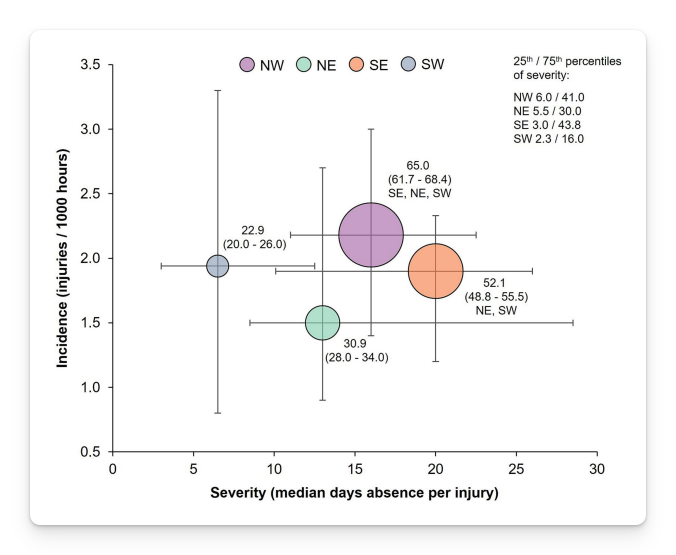
The most interesting part of this study may not have been performance.
It may have been injury distribution.
The researchers found that different acceleration strategies were associated with different site-specific injury profiles.
Importantly, this does not mean:
- One sprint strategy is “bad”
- One technique is universally superior
- Sprint mechanics directly cause injury
Instead, the findings suggest that sprint strategy may influence injury distribution more than injury occurrence, as overall injury rates were similar between groups but injury profiles differed substantially.
Bounders and Calf Loading
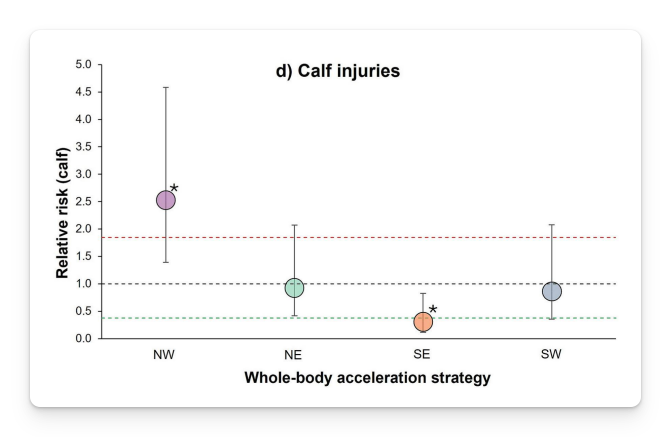
The Bounder strategy demonstrated the greatest calf injury risk.
These athletes combined long step lengths, longer flight times, and greater projection mechanics.
The authors suggest this likely increased:
- Vertical impulse demands
- Plantarflexor loading
- Achilles tendon stress
- Energy absorption demands during landing
An important nuance from the study was that long step length alone did not appear sufficient to increase calf injury risk.
The Strider group also used relatively long steps, but without the same elevated calf injury profile.
This suggests that flight time, landing dynamics, and impact demands may be just as important as stride length itself.
Spinners and Hamstring Loading
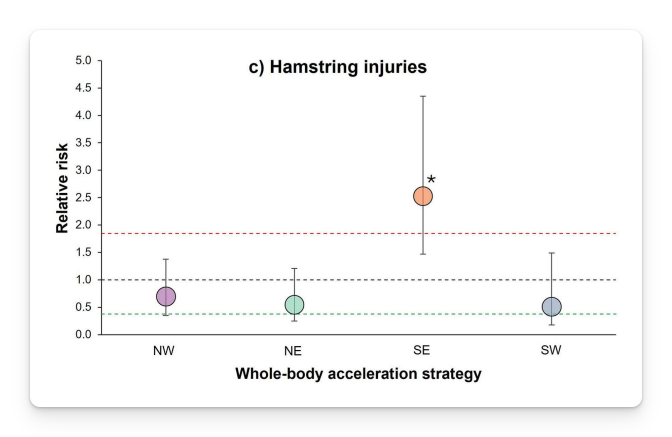
The Spinner strategy demonstrated the greatest hamstring injury risk.
These athletes relied heavily on rapid limb repositioning, high cadence mechanics and short flight times.
The authors propose that these mechanics may increase demand on the hamstrings during late swing, particularly the biceps femoris, due to the combination of:
- Fast limb cycling
- Greater trunk lean
- Rapid hip flexion and extension
This does not mean Spinners should stop using high cadence mechanics.
It simply means their movement solution may place greater stress on the hamstrings, and coaches should prepare tissues accordingly.
Bouncers and Hip/Groin Loading
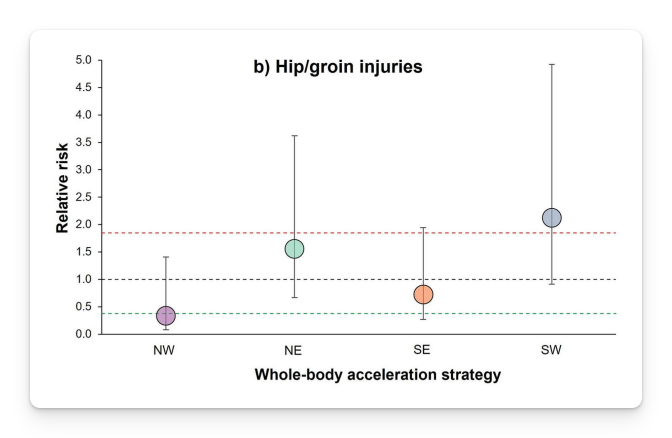
The Bouncer strategy showed a potential trend toward greater hip and groin injury risk, although the findings were not statistically significant.
These athletes rely heavily on rapid repositioning, short contact times, and reactive stiffness during acceleration.
The authors proposed that these compact and reactive mechanics may increase demand on the hip flexors and groin musculature, particularly during rapid limb exchange and force production in early acceleration.
While more research is needed, this may suggest that Bouncers accumulate more proximal stress around the hip and pelvis compared to other sprint archetypes.
Practical Training Implications
This study opens interesting discussions around individualized sprint preparation and injury management.
For athletes who naturally organize as Bounders, coaches may consider emphasizing:
- Calf robustness
- Achilles tendon capacity
- Plantarflexor strength
- Landing tolerance
- Running volume management
For athletes who naturally organize as Spinners, coaches may place greater emphasizing:
- Hamstring robustness
- Hip extensor strength
- High-speed running exposure
- Pelvic and trunk control
- Fatigue management during sprinting
For athletes who naturally organize as Bouncers, coaches may consider emphasizing:
- Hip flexor and groin robustness
- Reactive strength and stiffness tolerance
- Trunk and pelvic control
- High-velocity limb repositioning capacity
- Exposure to rapid acceleration and deceleration demands
Importantly, this does not necessarily mean coaches should attempt to completely change an athlete’s sprint strategy. In many cases, the better solution may be supporting the athlete’s natural movement solution rather than forcing a universal model.
When Might Technique Modification Matter?
For most athletes, the goal is probably not to completely change their natural sprint strategy. In many cases, building the tissue capacities needed to support their preferred movement solution may be the best approach.
However, chronic or recurrent injury cases may warrant exploration of alternative movement solutions that redistribute stress away from repeatedly overloaded tissues.
For example:
- A “Bounder” with persistent calf or Achilles issues may benefit from reducing excessive projection or airtime
- A “Spinner” with recurring hamstring problems may benefit from reducing excessive turnover demands or improving projection mechanics
Importantly, the goal is not to force a completely new sprint style, but rather to subtly shift loading demands while still preserving performance qualities.
The Coaching Takeaways
The Sprint Technique Quadrant and Archetypes provide coaches with a practical framework for understanding how athletes organize acceleration differently.
This reinforces something many experienced coaches already observe:
- Athletes self-organize differently
- Different structures create different mechanics
- Different mechanics create different tissue demands
The coaching challenge becomes:
- Understanding the athlete’s strategy
- Understanding where stress accumulates
- Building the physical qualities needed to tolerate that strategy
The final takeaway may be this: sprint mechanics are not simply about how athletes create performance, but also how they distribute stress throughout the body.
Want to Go Deeper?
If you enjoy this style of coaching education, Applied Performance Coach is our flagship mentorship and certification experience designed for strength coaches, physical therapists, and performance professionals who want to improve:
- Sport science application
- Athlete assessment
- Sprint and force plate interpretation
- Programming
- Rehab integration
- Critical thinking
Learn more about Applied Performance Coach
Ramsey
Reference: Wild JJ, Bezodis NE. (2026). Sprint acceleration technique is associated with lower-limb injury epidemiology in professional male Rugby Union players: a seven-season analysis. Journal of Science and Medicine in Sport.