

Two Different Meanings of Stiffness
“Stiffness” is one of the most misunderstood words in performance training.
Coaches throw it around as if it is one thing. It’s not.
And when we don’t separate what kind of stiffness we’re talking about, we end up with bad conclusions and worse programming decisions.
The short version is this: tendon stiffness and movement (system) stiffness are not the same thing. One is local and structural. The other is global and behavioral.
Once you understand that distinction, a lot of confusion disappears.
Let’s start by drawing a clear line.
Tendon stiffness is a local tissue property. System stiffness is a global movement outcome.
They interact, but they are not interchangeable.
Tendon Stiffness: The Local Property
Tendon stiffness refers to how much a tendon resists elongation when force is applied.
In simple terms, a stiff tendon stretches less for a given force while a compliant tendon stretches more for a given force.
This is what classic studies like Kubo et al. (1999) measured using ultrasound. They looked at force production and how much the tendon-aponeurosis complex physically elongated.
Key characteristics of tendon stiffness:
- Local, tissue-level behavior
- Specific to a muscle–tendon unit
- Relatively slow to adapt
- Influences elastic energy storage and recoil
A more compliant tendon can store more elastic energy when it is stretched. A stiffer tendon transmits force faster but stores less.
Neither is “good” or “bad” on its own.
System Stiffness: The Global Behavior
System stiffness is how the entire body responds to external forces. This is what we actually see in movement. A practical definition for coaches:
System stiffness is force produced relative to center of mass displacement.
If an athlete produces a lot of force with very little COM movement, system stiffness is high. If the same force is produced with large displacement, system stiffness is lower.
System stiffness emerges from:
- Joint angles and range of motion
- Muscle activation timing and magnitude
- Pre-activation and intent
- Coordination across joints
- Tendon behavior interacting with movement strategy
Importantly, system stiffness can change instantly based on task and intent. Tendon stiffness cannot.
The Distinction Matters
Here’s where coaches can get confused.
An athlete can have compliant tendons locally and high system stiffness globally or stiff tendons with low system stiffness due to large joint displacement.
These are not contradictions. They are different layers of the system.
The distinction is clear when we consider how these two qualities are measured.
Tendon stiffness:
- Ultrasound
- Force–elongation relationships
- Mostly research or clinical settings
System stiffness:
- Force plates
- COM displacement
- Force–time and force–displacement metrics
This is why force plates are so valuable. They tell you how the athlete organizes the entire system.
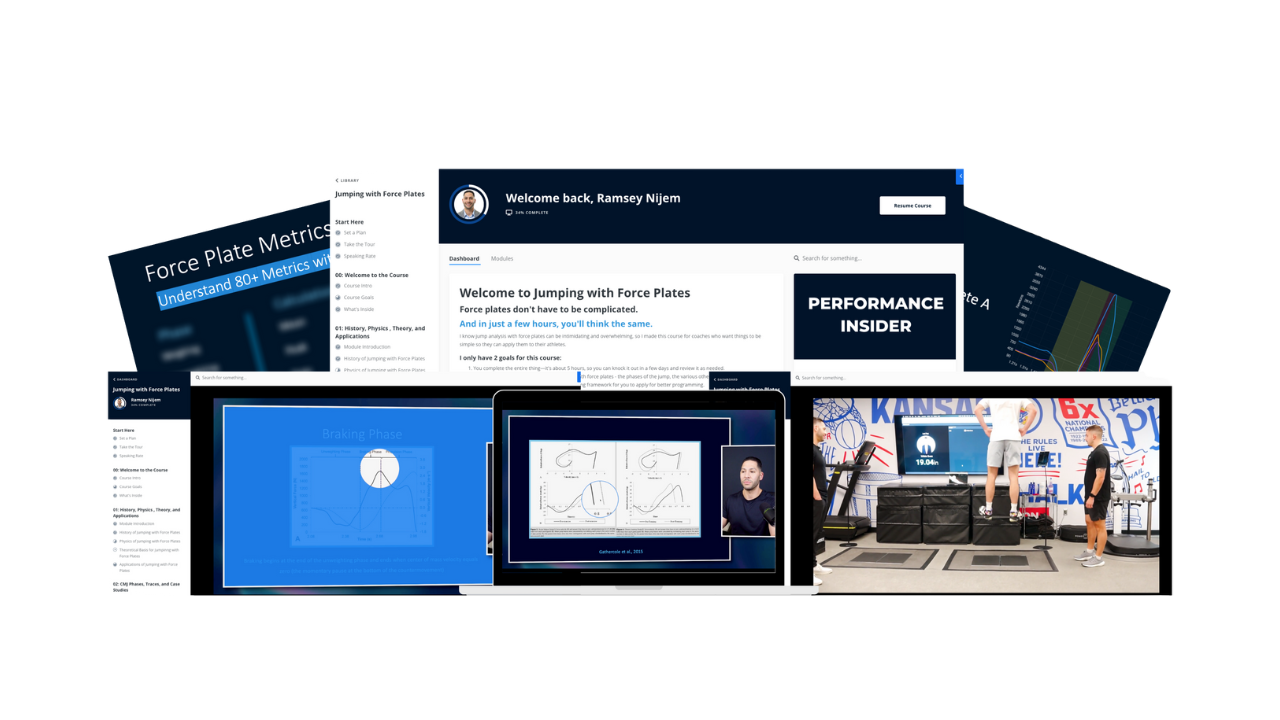
The Simplest and Fastest Way to Learn Jump Analysis with Force Plates
Practical Takeaway
The key takeaway is that stiffness is not a single quality or measure.
Tendon stiffness is a local tissue property. System stiffness is a global, task-dependent movement behavior.
If you don’t separate those two, stiffness conversations can be misguided. If you do, programming becomes much clearer.
I hope this helps,
Ramsey


