

Drop jumps and RSI are staples in performance testing. Coaches often chase shorter ground contact times or higher jumps, assuming improvements in either reflect better stretch-shortening cycle (SSC) function.
The problem is that RSI is a ratio, and ratios can hide meaningful changes.
How much does jump height actually change when ground contact time changes?

The Simplest and Fastest Way to Learn Jump Analysis with Force Plates
What Did the Researchers Do?
Participants
- 23 elite youth track & field athletes
- Jumpers and sprinters, national-level
- All were experienced with drop jumping
Task
- Drop jumps from a 40 cm box
- Hands on hips
- GCT < 250 ms (fast SSC zone)
Three instruction conditions
- Trade-off: “Jump high with as little ground time as possible”
- Short contact: “Get off the ground as fast as possible”
- Max height: “Jump as high as possible”
Measurements included ground contact time, jump height, and reactive strength index (RSI), while analysis examined how jump height scales with GCT
What Were the Results?
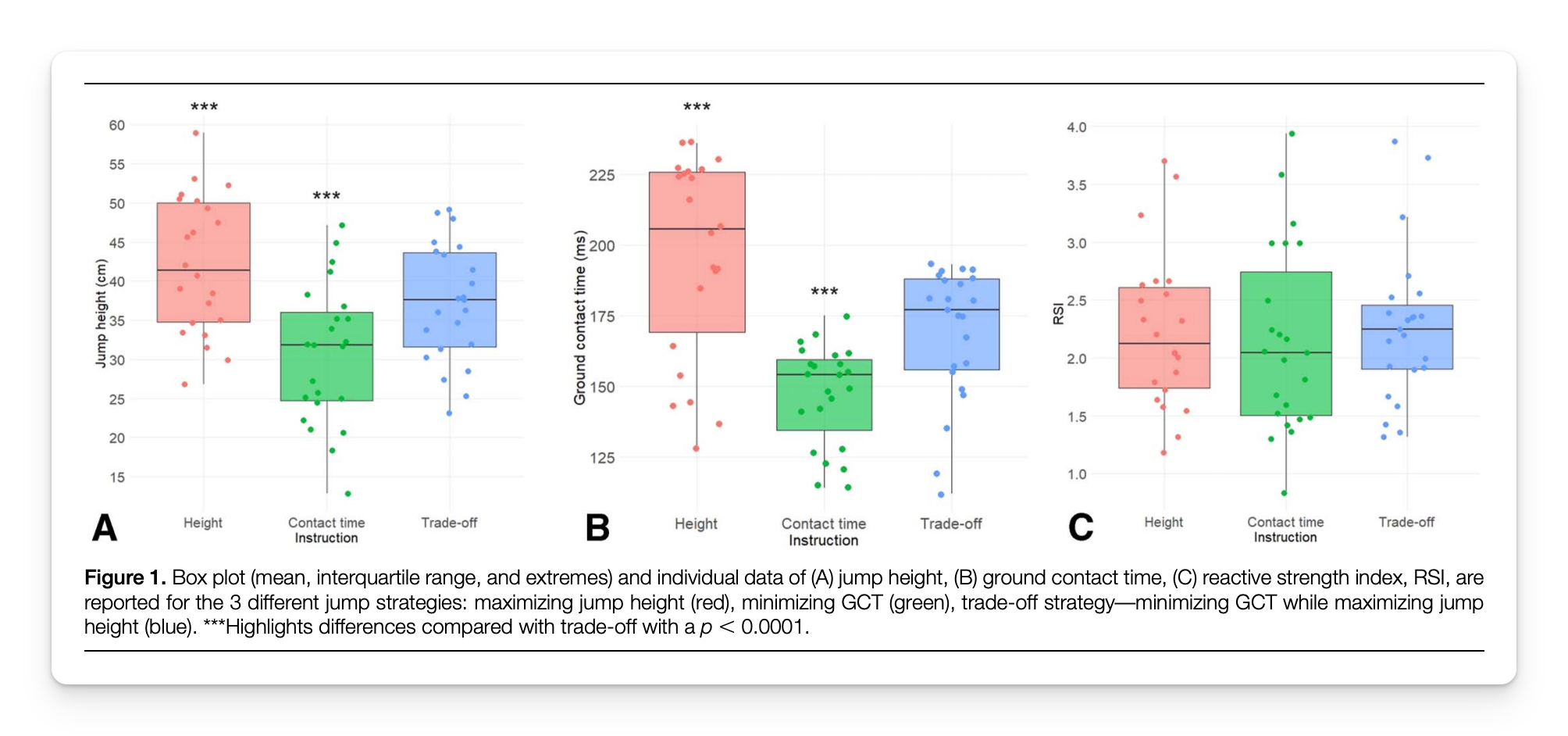
Athletes clearly changed strategy based on instruction
- Short-contact cue: ~21 ms shorter GCT and ~5.9 cm less jump height.
- Max-height cue: ~49 ms longer GCT and ~4.8 cm more jump height.
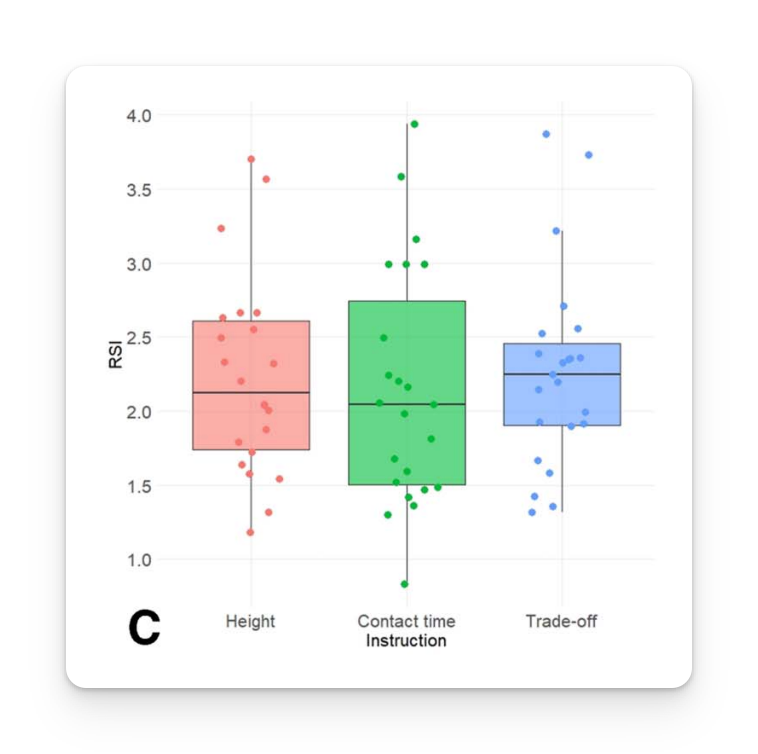
2. RSI did NOT change
- Despite large shifts in GCT and height
- Same RSI, very different jumps
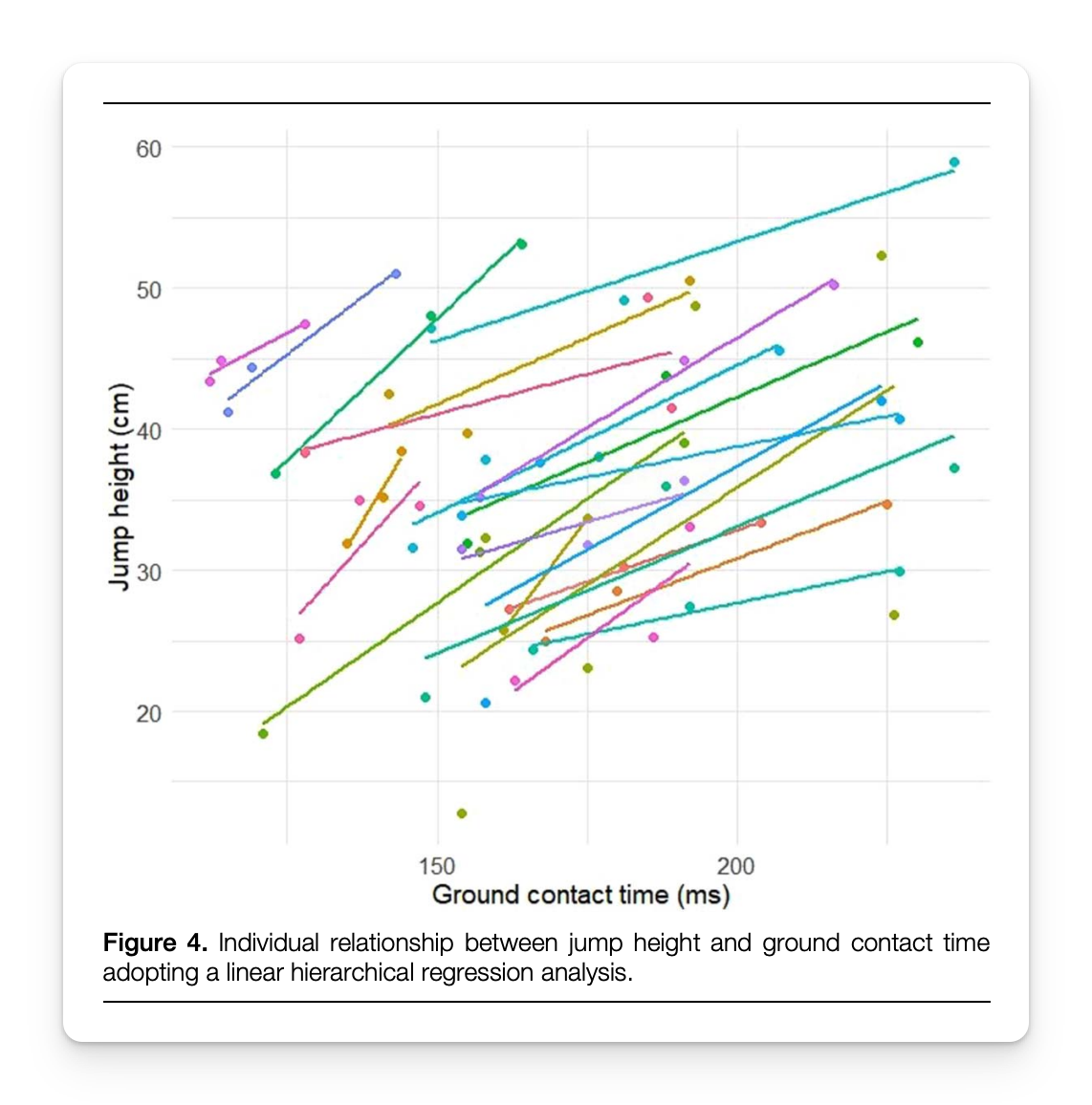
Jump height and GCT had a strong linear relationship
- At the individual level, jump height increased by approximately 0.154 cm for every 1 millisecond increase in ground contact time, meaning it took about 6 milliseconds of extra contact time to gain 1 cm of jump height.
- This relationship was extremely strong, with an R² of 0.94, indicating a near-linear trade-off within each athlete.
What Does This Mean?
Athletes don’t freely improve jump height without paying a time cost. Within an athlete, performance tends to move along a personal force-time line, not off it.
Shorter GCT strategies rely on:
- Higher stiffness
- Pre-activation
- Faster force transmission
Longer GCT strategies allow:
- More impulse
- More elastic energy storage
- Greater jump height
RSI stayed the same because height and time rise or fall together.
Why RSI Alone Is a Problem
RSI hides how performance is achieved.
Two jumps can have:
- Identical RSI
- Very different neuromechanical strategies
- Very different training implications
If you only track RSI, you can miss out on strategy changes.
Coach’s Takeaway
- More jump height often just means more time
- Track GCT and jump height together (not just RSI)
- The cue used will impact the strategy used
- Assess multiple strategies, not one “perfect” jump
I hope this helps,
Ramsey
Reference
Boccia G, Serrano S, Bonelli B, La Torre A, Pavei G. (2026). The scaling factor between jump height and ground contact time in drop jumps: A linear relationship at the individual level. Journal of Strength and Conditioning Research, 40(2), 152–157.


