

I think a sub-2 marathon will be one of the most impressive sporting achievements humans have ever witnessed.
Running 13.1 miles per hour for 30 seconds on a treadmill is difficult; now imagine holding that pace for two straight hours on the open road.
That is the reality of a sub-2 marathon. Running 13.1 miles per hour for 2 hours straight for an average pace of under 4:34 per mile.
Insane.
Yes, Nike’s Breaking2 and INEOS 1:59 projects already proved it is physiologically possible. Eliud Kipchoge showed the world that a human can run 26.2 miles in under two hours.
But those attempts were not official races. They used controlled pacing formations, lasers, rotating pacers, and race conditions that make the performance ineligible for record status.
Eliud Kipchoge proved what was possible with his fastest official marathon time of 2:01:09, but the world record now belongs to Kelvin Kiptum, who ran an astonishing 2:00:35 in the 2023 Chicago Marathon before tragically passing away in a car accident at just 24 years old.
The question now is simple: what would it take to break two hours in an official, record-legal marathon?
Two new 2025 studies give us the clearest answer yet.
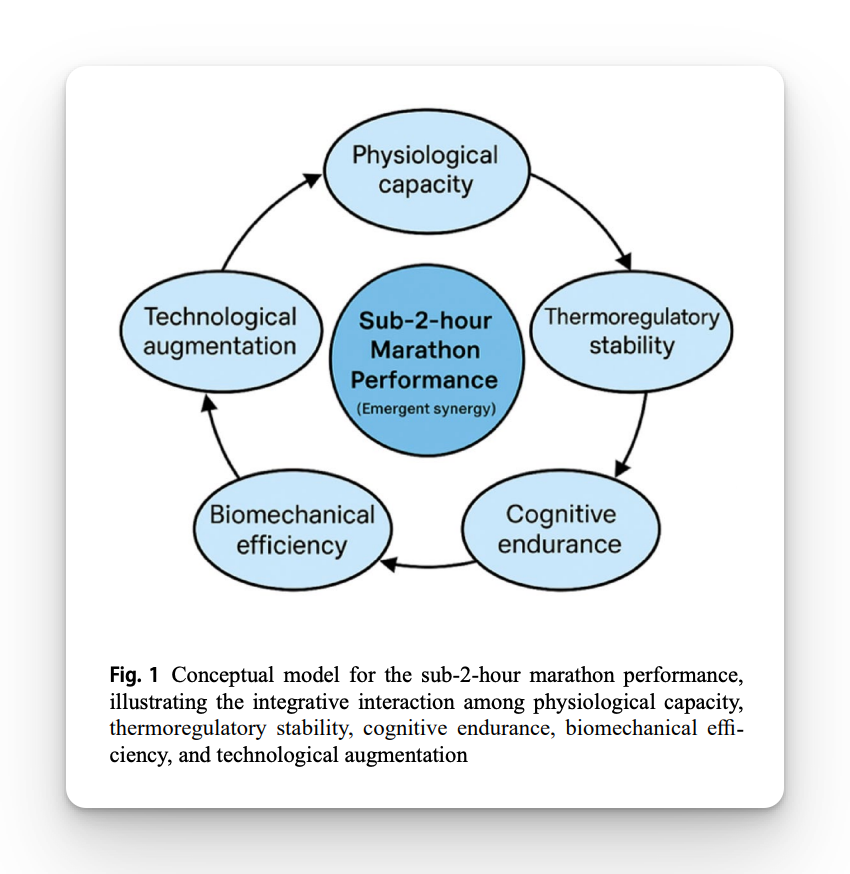
One outlines the physiological, technological, and cognitive determinants that set human limits. The other models the pacing and drafting strategy that could make a historic breakthrough possible.
When you blend these studies together, a complete blueprint emerges. Breaking two hours is not mythical. It is measurable, predictable, and completely dependent on the merging of human physiology, engineering, psychology, and strategy.
Let's break it down.
Physiological Requirements: The Human Engine
Grivas, G. (2025) provides an integrative framework that breaks sub-2 performance into three major pillars: aerobic capacity, running economy, and fatigue resistance.
Aerobic Capacity
You cannot run 4:34 per mile for 26.2 miles without:
- VO2max around 80 to 85+ ml/kg/min
- Extremely high fractional utilization
- Highly stable mechanics at world-record pace
Only a handful of runners in history check these boxes.
Running Economy
Economy determines oxygen cost. Key requirements include:
- Minimal vertical oscillation
- Efficient stride frequency
- High tendon stiffness for elastic return
- Ability to maintain technique under fatigue
Over 26 miles, tiny drops in economy can turn into major performance barriers.
Fatigue Resistance
Most elite runners can hit world-record pace through 20 miles. Few can avoid the late-race slowdown that destroys sub-2 attempts. Sub 2 requires:
- Outstanding glycogen conservation
- High heat tolerance
- Durable neuromuscular output
- Stable coordination despite rising metabolic stress
This is the hardest part of the problem.
Built to Run
Recent evidence adds another important layer. Berry and Gladden (2025) highlight data showing that elite Kenyan runners possess exceptionally slender lower legs, and this single morphological trait fully explains their superior running economy compared to equally elite Danish runners.
When researchers adjusted for lower-leg cross-sectional area and relative length, the economy advantage disappeared. Less distal mass reduces the energy required to swing the leg each stride, lowering oxygen cost at any given speed.
Technological Requirements: Extending Human Capacity
The paper highlights how footwear, environmental engineering, and course design shift performance ceilings.
Footwear
Next-level super shoes will be essential. Improvements likely include:
- Lighter yet more resilient foams
- More efficient carbon plate geometry
- Enhanced stability for late-race mechanics
Course & Environment
Conditions must be dialed in:
- 5 to 10 °C temperature
- Low humidity
- Low altitude
- Minimal wind
- Smooth elevation profile
Cognitive Requirements: The Hidden Limiter
Running at the physiological ceiling for two hours requires remarkable psychological control.
- Emotional regulation under extreme discomfort
- Ability to stay locked into rhythm
- Avoiding panic during physiological spikes
- Experience overriding the brain’s protective downshift mechanisms
Race Strategy: The Drafting Blueprint for a Legal Sub 2 Attempt
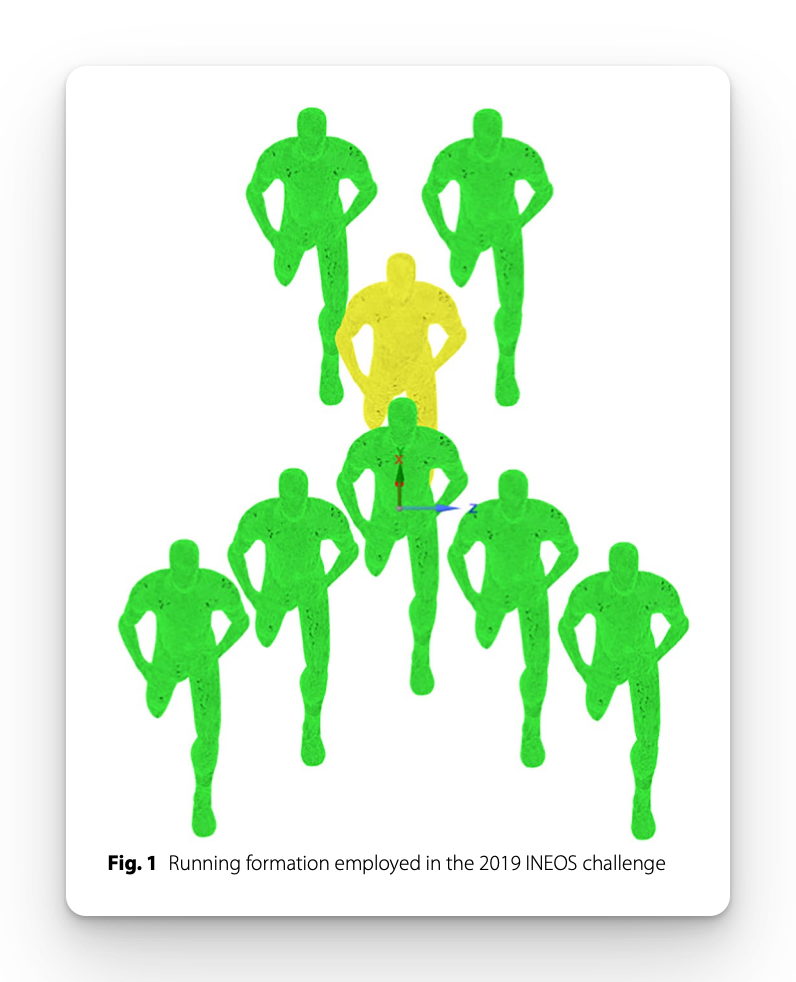
Fernandes et al. (2025) developed a comprehensive pacing and drafting plan compliant with World Athletics rules.
Even or Slightly Negative Splits
The model shows that the lowest physiological cost comes from:
- Starting slightly conservative
- Holding steady through 30 km
- Finishing with controlled acceleration
Pacers
Legal pacing is allowed as long as formations remain compliant. The optimal plan includes:
- 2 to 3 rotating pacers
- Pacers positioned slightly ahead and offset
- Pacers dropping out as fatigue builds
Pack Running
Multiple contenders working together through 30 km helps:
- Stabilize pace
- Reduce perceived effort
- Increase aerodynamic benefit within legal limits
A record-legal sub-2 will likely come from a race with genuine cooperation.
The Formula: What It Will Actually Take
When everything is mapped out, breaking two hours requires five major components.
- A generational athlete with elite VO2max, exceptional running economy, extreme durability, and high psychological resilience.
- Next generation super shoes that are light, stiff, stable, and able to preserve efficient mechanics late in the race.
- Near perfect environmental setup with cold, dry, calm, low-altitude conditions on an optimized course.
- Intelligent pacing and drafting that uses rotating pacers, even or slight negative splits, and zero panic miles.
- A race designed for history with the right course, the right weather window, and the right competitive field.
Sub 2 is not magic. It is math, physiology, engineering, and strategy.
And all signs point to this: It will happen. Probably sooner than most expect.
Kelvin Kiptum (December 2, 1999 - February 11, 2024)
I hope this helps,
Ramsey
References
- Geneau, N. E., Angell, G., Major, H., & Thomas, G. (2025). The sub 2-h official marathon is possible: An integrative framework of physiological, technological, and cognitive determinants. Sports Medicine Open.
- Pellegrini, B., & Pringle, J. (2025). Drafting strategy for a historic breakthrough in sports: The sub-two-hour marathon. European Journal of Applied Physiology.
- Berry, A. C., & Gladden, L. B. (2025). Skinny (lower) legs run fast marathons. Experimental Physiology.


