

In sports, we throw around the phrase "muscle damage" as if it means one thing. It doesn’t.
Muscle injuries fall on a broad spectrum, and once you understand that spectrum, you stop expecting DOMS to behave like a hamstring strain, and you stop treating a strain like a small trauma.
The biology is very different, the timelines are different, and your coaching decisions should be different, too.
The more the underlying muscle structure is preserved, the more complete the recovery. The more that structure is disrupted or removed, the more the athlete relies on scar tissue and compensations.
That simple concept will help you interpret symptoms, set better expectations, and build smarter progressions.
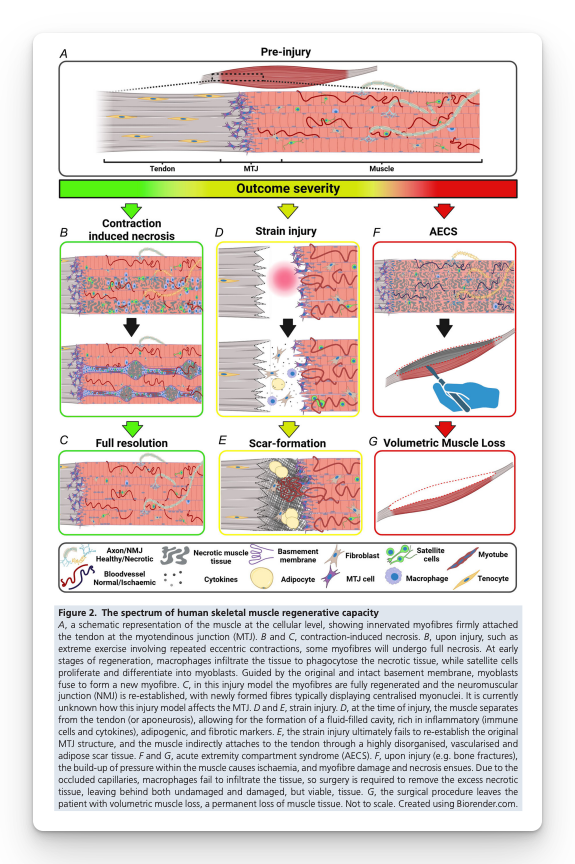
The Easy End: DOMS and Controlled Eccentric Damage
Think brutal eccentrics, high force eccentrics, sore athletes after a training block, or heavy game workloads. The fibers can get beat up, swollen, and even necrotic at a microscopic level, but the scaffolding around them stays intact.
When the basement membrane and extracellular matrix are preserved, the muscle has a roadmap to rebuild. Satellite cells know exactly where to go. The architecture realigns. The fiber repairs inside that original tube. Athletes bounce back. There is no long term deficit and you are not “using up” recovery capacity.
This explains why athletes tolerate repeated heavy eccentric exposure when you progress it correctly.
The structure stays intact so the biology does its job.
The Middle Ground: MTJ Strains and Aponeurotic Injuries
This is where most of our headaches live. Hamstring strains. Calf strains. Adductor tendon junction issues. They almost always occur at or near the myotendinous junction or the aponeurotic layers inside the muscle belly.
These regions are highly specialized. They also fail under high stretch and high force.
Here is the blunt truth. These injuries do not return to a pristine state. The muscle rarely reconnects to the tendon with the same clean architecture. Instead, it heals through a scar. That scar might be vascular, disorganized, or even slightly fatty. Months later, it still looks different on imaging, and years later, it might still be visible.
Function can return. Speed can return. Strength can return. But the structure is different.
The muscle pulls on the scar, which pulls on the tendon. That is why re-injury rates cluster early after return and why athletes often feel fine at submaximal speeds but show fear, tightness, or hesitancy when stretched under true game conditions.
This is also why your return-to-play plan needs to respect the biology. You need targeted MTJ loading, progressive lengthening, and true high-speed work long after they “look good” in the clinic or weight room.
The Hard End: Volumetric Muscle Loss and Traumatic Injury
Now we are in a different world. This end is rare for our athletes but worth knowing.
Trauma, lacerations, surgical debridement, or compartment syndrome can remove entire sections of muscle and the extracellular matrix that gives the muscle its organization.
When the matrix is gone, the muscle can’t regenerate. There is no template for satellite cells to rebuild. You cannot fix this with Nordic curls, tempo eccentrics, or clever loading.
Recovery is about restoring function as much as possible through strength training, hypertrophy, compensatory strategies, muscle transfers, or surgical solutions. Expectations need to change here.
You are optimizing what remains, not returning something that is gone.
Why This Matters for Coaches
Knowing where an injury sits on this spectrum drives better decisions.
If it is DOMS:
- Manage load and readiness
- Expect full recovery
- Build resilience with repeated exposure
If it is an MTJ strain:
- Respect the scar
- Build long term capacity at the injury site
- Progress speed and stretch tolerance over months, not weeks
- Do not assume clearance equals structural readiness
If it is traumatic loss:
- Chase function, not perfection
- Strengthen everything around the deficit
- Build compensations that hold up under real game demands
- Set honest expectations for the athlete and staff
The Bottom Line
The human body can repair a lot, but it can’t repair everything the same way. DOMS regenerates fully while MTJ strains remodel with a scar and stay vulnerable.
Traumatic injuries lose the blueprint for repair altogether.
Coaches who understand this stop guessing. They stop rushing timelines. They stop assuming all muscle injuries behave like DOMS. They become more precise, more patient, and more effective.
I hope this helps,
Ramsey
Reference: Højfeldt, G., Hoegsbjerg, C., von Keudell, A. G., & Mackey, A. L. (2025). The repair capacity spectrum of human skeletal muscle injury from sports to surgical trauma settings. The Journal of Physiology, 603(23), 7441–7454.


