

Jumping gets most of the attention in performance testing. But every jump ends with a landing.
And in sports like basketball, volleyball, and soccer, athletes land hundreds of times per game or practice.
Landing isn’t just about injury risk. It’s also about performance. The faster an athlete can terminate downward motion and transition into the next movement, the greater their advantage on the court or field.
We can break down landing into three clear phases. Understanding these phases can help coaches:
- Interpret force plate data
- Identify landing strategies
- Target training interventions
Let’s break them down, according to research.
The Three Phases of Landing
Force plate data shows that landing is not a single event. Instead, the force curve follows a clear pattern.
It increases, decreases, and then increases again.
Because of this, landing can be divided into three mechanical phases:
- Loading
- Attenuation
- Control
These phases are visible on the force-time curve of a landing
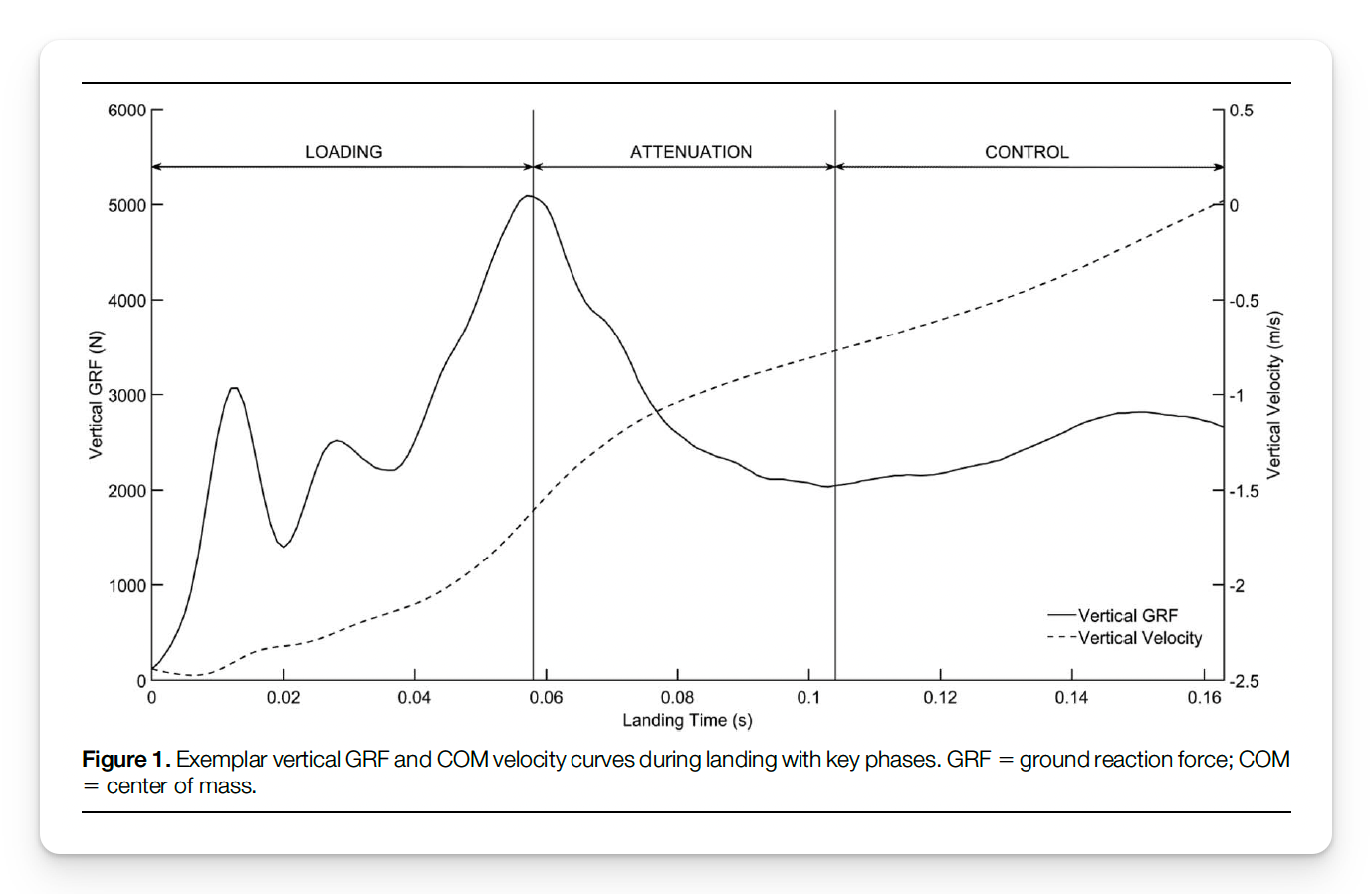
Phase 1: Loading
The loading phase occurs from:
Ground contact → Peak vertical ground reaction force
Loading is the moment when the athlete first collides with the ground.
What happens here
The body experiences the highest forces of the entire landing. Typical values observed in research:
- Initial forefoot peak ≈ 3x bodyweight
- Global peak force ≈ 7x bodyweight during jump landings
These forces occur extremely fast, often within:
0.05–0.07 seconds after contact.
Because of this, athletes have very limited ability to change force after contact. Most of the strategy is determined before the foot hits the ground.
Key metrics in this phase include:
- Peak landing force
- Loading rate
- Loading impulse
These metrics are often discussed in relation to impact stress and injury risk.
Training implication
Since athletes cannot react fast enough after contact, landing quality depends heavily on pre-impact positioning, such as:
- Ankle plantarflexion
- Knee and hip posture
- Body stiffness
For example, greater plantarflexion at contact can reduce peak impact forces.
Phase 2: Attenuation
The attenuation phase occurs from:
Peak vertical force → Local minimum force
Attenuation is the period during which the athlete actively reduces force and slows downward motion.
What happens here
During this phase:
- Ground reaction force decreases
- Downward velocity slows
- The athlete absorbs mechanical energy
This is where the body performs most of the braking work.
Importantly, better landing performers attenuate force faster.
Key metrics
Important variables include:
- Attenuation time
- Average force during attenuation
- Force attenuation rate
Athletes who land well typically show:
- Shorter attenuation times
- Higher average forces during this phase
This indicates they can rapidly absorb force and regain control.
Training implication
The attenuation phase appears to be the most trainable portion of landing performance.
Training strategies that may improve it include:
- Plyometrics
- Reactive jumps
- Landing drills
- Deceleration training
Phase 3: Control
The control phase occurs from:
Local minimum force → Zero center-of-mass velocity
Control represents the final portion of landing when the athlete finishes stopping downward motion.
What happens here
After force reaches its lowest point, the athlete begins to increase force again.
This increase helps:
- Finish decelerating the body
- Stabilize posture
- Prepare for the next movement
The athlete essentially decides whether to:
- Stand and stabilize
- Perform another explosive movement
Key metrics
Important metrics include:
- Control phase time
- Average force during control
- Amortization force (force when velocity reaches zero)
Since control phase is defined as stabilizing posture post landing, this phase may or may not end with standing as in sport athletes often stabilize to performance a subsequent task (e.g. jump again, turn and run back on defense, etc.).
The Landing Performance Index (LPI)
A simple metric to quantify landing performance called the Landing Performance Index (LPI).
LPI is calculated as Landing Height ÷ Landing Time
- Landing height represents how far the athlete falls before ground contact.
- Landing time is the time from ground contact until downward motion stops (when the center of mass velocity reaches zero).
In simple terms, LPI reflects how quickly an athlete can absorb force relative to the height they landed from.
A higher LPI indicates that the athlete can terminate downward motion faster, allowing them to transition more quickly into the next movement.
Interestingly, shorter landing times were the biggest driver of higher LPI, suggesting that better athletes are able to attenuate force more rapidly, not simply land softer.
For coaches, LPI offers a useful way to evaluate an athlete’s ability to absorb force and reorganize quickly, which is critical in sports requiring repeated jumps and rapid transitions.
Practical Takeaways for Coaches
Here are a few simple ways to apply this framework.
Think Beyond Peak Force
Peak landing force alone does not explain landing performance.
Look at:
- Landing time
- Attenuation time
- Average force during landing phases
Focus on Braking Ability
The attenuation phase appears to be the key determinant of landing performance.
Training that improves braking capacity may include:
- Depth landings
- Drop jumps
- Deceleration drills
- Eccentric strength work
Jumping is Only Half the Story
Landing determines how quickly an athlete can reset, react, and produce the next movement.
By breaking landing into these three phases, coaches gain a clearer understanding of how athletes manage force during impact.
And once you can see the phases, you can start training them.
I hope this helps,
Ramsey
The Simplest and Fastest Way to Learn Jump Analysis with Force Plates


