

Non-contact ACL injuries commonly occur during unplanned sidestepping, especially in female athletes.
Too often, the conversation defaults to biology (e.g. hormones, anatomy differences etc.).
This study asked two practical coaching questions:
First, if I make my athletes stronger, will they cut with less dangerous knee loading? And second, should I use isometrics or dynamic lifting to do it?
What Did the Researchers Do?
Subjects
- 21 elite female international rugby players
- 15 completed the intervention
- ~23 years old, well-trained
Intervention
- 4-week block
- 2 sessions per week
- Continued full rugby training during study
Training Groups
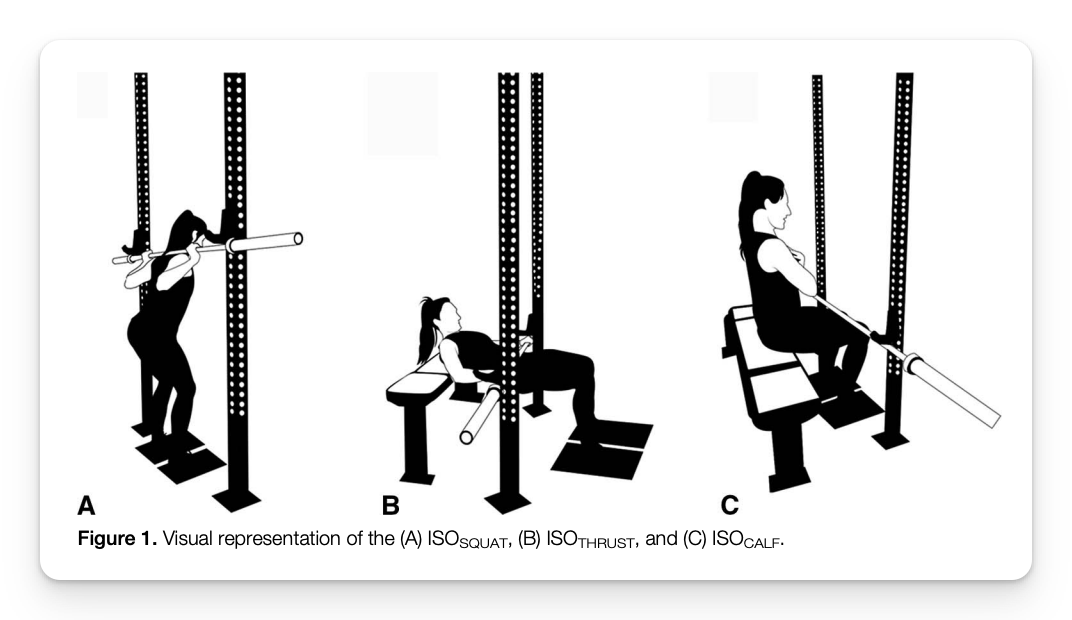
Isometric RT
- Isometric squat (130–140° knee flexion)
- Isometric hip thrust
- Isometric calf raise
- 10 x 3 x 3-second maximal efforts
Dynamic RT
- Parallel squat
- Hip thrust
- Seated calf raise
- 10 x 3 reps @ 85–90% 1RM
- 2-sec eccentric, 1-sec concentric
Testing
Before and after intervention:
- Strength testing included isometric squat, hip thrust, calf, 1RM squat, hip thrust, calf raise
- Unplanned 45° sidestep was measured with force plates and 3D motion capture to assess knee kinematics
Unplanned 45° sidestep
Peak values analyzed during early stance, the high-risk ACL window.
What Were the Results?
Strength Increased in Both Groups
Both isometric and dynamic groups improved most strength measures.
- Dynamic group: strong increases in 1RM squat, thrust, calf
- Isometric group: strong increases in isometric strength, especially calf
So both methods “worked” from a strength perspective.
No Between-Group Differences
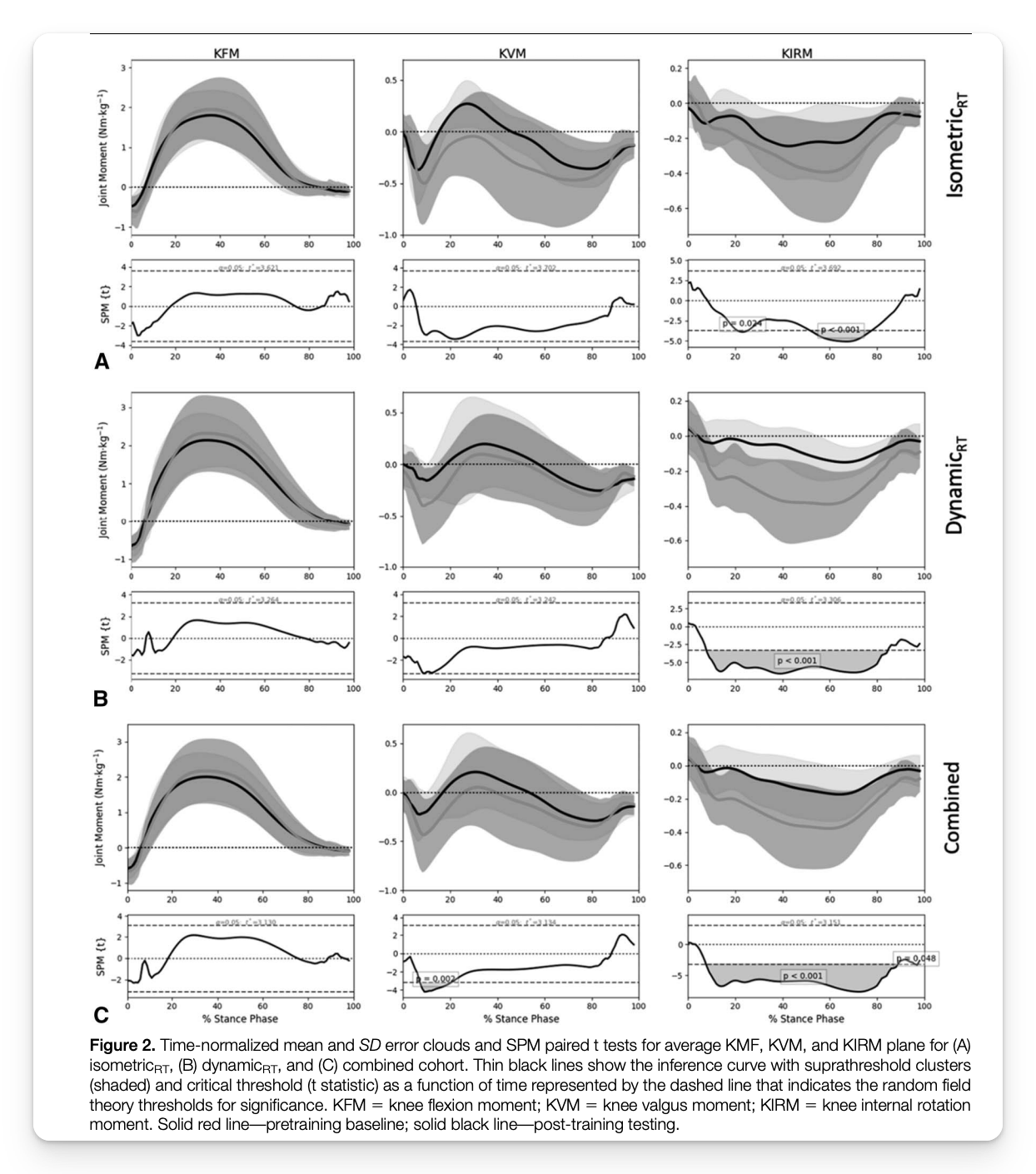
Despite the hypothesis that angle-specific isometrics would reduce knee loading more, there was no significant interaction effects and no clear winner between methods.
Within-Group Findings
Isometric Group
- Decreased Peak knee valgus moment (early stance)
- Decreased KIRM during parts of stance phase
Dynamic Group
- Decreased Peak knee internal rotation moment
- Decreased KIRM across most of stance phase
The dynamic group showed a larger effect size for KIRM reduction.
Combined Cohort Analysis (Exploratory)
When groups were combined:
- Decreased KVM during early stance (7.9–21.8%)
- Decreased KIRM across majority of stance
- No change in knee joint power
This suggests that increasing lower-limb strength, regardless of method, reduces knee joint demands associated with ACL injury risk.
What Does This Mean?
- Strength appears protective ⮕ After the intervention, knee valgus and internal rotation moments during unplanned cuts were lower.
- Skill transfer likely matters ⮕ These athletes continued sport practice and cutting during the intervention, suggesting improved motor recalibration may have contributed.
- Dynamic training may have a slight edge ⮕ The dynamic group showed larger reductions in internal rotation moments and across broader portions of stance, possibly because full-range lifting better matches the joint demands of cutting.
- Range specificity matters ⮕ Cutting spans roughly 110–160 degrees of knee flexion, while the isometric group trained at a single joint angle.
Limitations
- Small sample (n=15 completed)
- Dropouts increased uncertainty
- Wide confidence intervals
This was embedded in an elite environment, which is a strength, but also limits strict control.
Coach’s Takeaway
- Strength reduces key risk factors ⮕ Increasing single- and multi-joint lower-body strength was associated with reductions in knee valgus and internal rotation moments during unplanned cuts, variables commonly linked to ACL strain risk.
- Combine strength with skill exposure ⮕ Strength alone may not change movement patterns.
- Train capacity and coordination together ⮕ Build maximum strength while regularly exposing athletes to game-like change-of-direction demands so that mechanical improvements show up in performance.
I hope this helps,
Ramsey
Reference: Kadlec D, Jordan MJ, Alderson J, Nimphius S. (2024). Examining the effects of dynamic and isometric resistance training on knee joint kinetics during unplanned sidesteps in elite female athletes. Journal of Strength and Conditioning Research, 38(12), 2079–2087.


