

Maladaptive functioning of the fast SSC can impair force production, energy utilization, and attenuation in the short timeframes required in sport.
ACL rehab is full of “check the box” metrics, but athletes often return to sport with lingering deficits in strength, jump performance, and fast stretch-shortening cycle (SSC) function.
This new study provides insight into how strength, elasticity, and performance show up following ACL return to play.
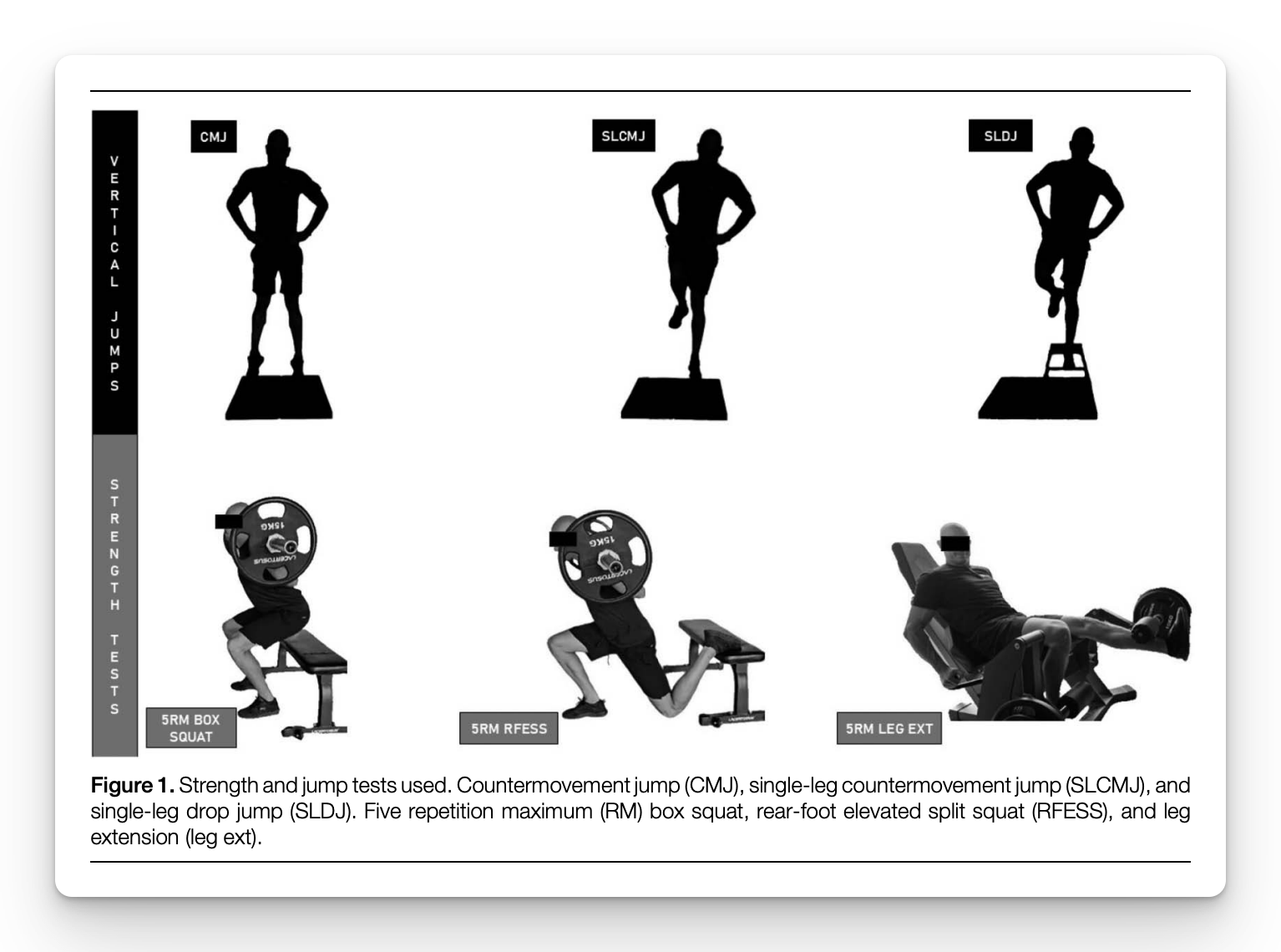
The authors focused on two buckets of strength:
- Multijoint strength: 5RM box squat and 5RM rear-foot elevated split squat (RFESS)
- Single-joint strength: 5RM leg extension (knee extensor strength in isolation)
And they linked those to:
- Performance outputs: CMJ height, single-leg CMJ (SLCMJ) height, RSImod, single-leg drop jump (SLDJ) height, contact time, RSI
- Biomechanics via force plate metrics: phase-specific impulses (concentric impulse and eccentric deceleration impulse)
Which strength qualities actually relate to vertical jump outcomes, and how do athletes create force after ACL reconstruction?
What Did the Researchers Do?
Participants
- Researchers tested 54 amateur athletes (16 female, 38 male), median 27.6 months post-ACLR (wide IQR).
- Most grafts were semitendinosus-gracilis (77.8%), with 20.4% patellar tendon, and one allograf
- ~43% had concomitant meniscal.
Strength Testing
All strength tests were performed as 5-rep maxes, normalized to body mass.
Three lifts were used:
- Box Squat (5RM) ⮕ Represents overall lower-body force production
- Rear-Foot Elevated Split Squat (RFESS, 5RM) ⮕ Represents single-leg strength in a sport-relevant position
- Leg Extension (5RM) ⮕ Represents isolated single joint knee extensor strength
This setup allowed the researchers to compare general strength, single-leg strength, and isolated knee strength.
Jump Testing
All jumps were performed on dual force plates. The jump battery included:
- Bilateral countermovement jump (CMJ)
- Single-leg countermovement jump (SLCMJ) on each limb
- Single-leg drop jump (SLDJ) from a 15 cm box
From these jumps, they calculated jump height and force-time characteristics.
What Did They Find?
Strength Still Matters After ACL
- Across all jump tests, strength explained 25–57% of the variance in performance.
- Even years after ACL reconstruction, strength remains a key driver of jumping ability.
Bilateral Jump Height = Bilateral Strength
- CMJ height was best predicted by box squat strength
- No other strength measure meaningfully contributed
Single-Leg Jump Performance = RFESS Strength
For unilateral jumps, the pattern was clear. RFESS strength predicted:
- Single-leg CMJ height
- Single-leg RSImod
- Single-leg drop jump height
- Single-leg RSI
This relationship was present in both the ACL-reconstructed and uninvolved limbs.
Leg Extension Influenced Force Production, Not Height
Leg extension strength did not consistently predict jump height. Instead, it predicted:
- Eccentric deceleration impulse
- Concentric impulse
Stronger knee extensors were associated with greater eccentric and concentric force production.
Fast SSC Classification (Drop Jump)
For the single-leg drop jump, athletes were visually and mathematically classified based on their force-time curve shape:
- UNC (Unimodal Curve) ⮕ One smooth force peak; Indicates a more efficient, spring-like SSC strategy
- BIC (Bimodal Curve) ⮕ Two distinct force peaks; Indicates a slower, less elastic strategy
While UNC and BIC classifications were not related to limb status or strength levels, indicating that fast SSC efficiency represents a distinct neuromuscular quality rather than a simple byproduct of strength or surgical side.
Here is the critical point: Strength did not predict SSC efficiency. Neither RFESS nor leg extension strength could determine who had a UNC or BIC pattern.

What This Means for Coaches
This study highlights a common disconnect in late-stage ACL rehab and return-to-performance work.
What Strength Does Well
- Improves jump height
- Improves single-leg power
- Builds force production capacity
What Strength Does Not Automatically Fix
- Fast SSC efficiency
- Reactive stiffness
- Short ground contact performance
Practical Takeaways
Build strength as the foundation
- Squats for bilateral force production
- RFESS for single-leg power and symmetry
Keep leg extensions in the plan
- They support braking and propulsion capacity
- Especially valuable for knee-dominant force production
Train SSC efficiency directly
- Plyometrics
- Fast contacts
- Stiffness and reactivity work
- Do not assume strength will take care of this
This study helps explain why athletes can look “ready” on paper but still feel slow, heavy, or delayed on the court or field.
Strength builds the base. Elastic efficiency is a separate skill. If you want complete return to performance after ACL, you need both.
Take your rehab to the next level with our complete force plate course (now 50% off).
The Simplest and Fastest Way to Learn Jump Analysis with Force Plates
I hope this helps,
Ramsey
Reference
Maestroni L, Turner A, Rosalia A, Algeri C, Moioli F, Guastella M, Civera F, Midali C, Bettariga F, Read P. (2026). How do multi- and single-joint strength levels relate to vertical jump performance and biomechanics in amateur athletes returned to sport after anterior cruciate ligament reconstruction? Journal of Strength and Conditioning Research, 40(1), 39–47.


