

Lower-limb muscle injuries remain one of the biggest performance and availability issues in rugby.
Hamstring and hip/groin injuries often lead to repeat problems, long return-to-play timelines, and high reinjury rates.
Most strength-screening research focuses on one muscle group, one time point, or only pre-season testing. That approach misses the actual question coaches face:
How does strength change across the season, how does it change after injury, and which strength patterns matter for reinjury risk?
This study tracked 248 professional rugby players over two full seasons, capturing Nordic hamstring strength and adductor/abductor strength at two positions (60° and 90° hip flexion).
This is one of the most complete longitudinal strength profiling datasets in elite sport, and therefore worth spending time to unpack the details.
Let's get into it.
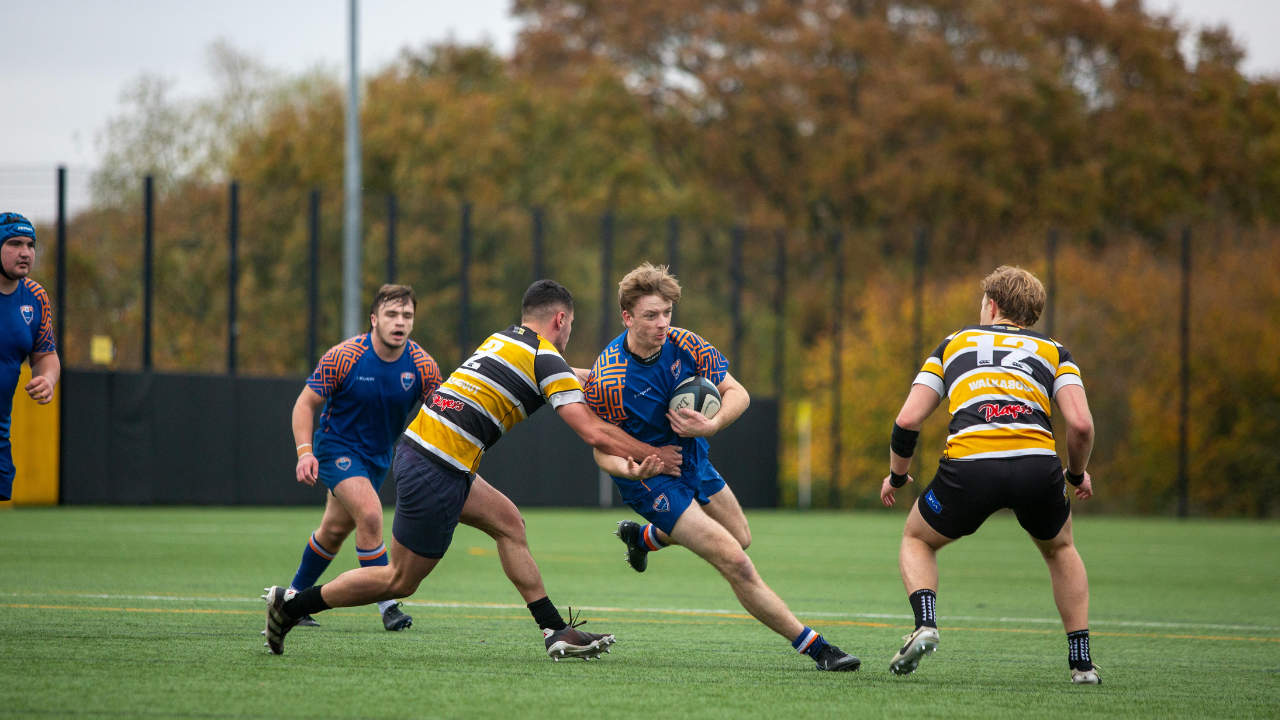
How do hamstring and hip/groin strength change across a season, what happens after injury, and which strength patterns are linked to reinjury in rugby union players?
More specifically, the researchers asked:
- Do stronger or weaker athletes improve strength over time?
- Do in-season strength drops signal risk?
- Are some strength qualities more protective than others?
- Is reinjury predictable based on pre-injury strength or post-injury changes?
What Did the Researchers Do?

Participants
- 248 elite male rugby union players, tracked over 24 months
- Strength testing at 5 total time points: pre-season, mid-season, pre-season, mid-season, pre-season
- 654 total test batteries collected
- Injury surveillance was done across the entire study window
Strength Tests
Using VALD NordBord® and ForceFrame®:
- Nordic hamstring (eccentric knee flexor strength)
- Hip adduction and abduction at 60° (ADD60, ABD60)
- Hip adduction and abduction at 90° (ADD90, ABD90)
All normalized to body mass.

Variables Analyzed
- Pre-season to mid-season strength changes
- 24-month strength changes
- Post-injury strength changes
- Reinjury characteristics using a CART (classification-tree) model
- Injury type distribution across forwards and backs
What Were the Results?
1. Strength changes across the 2-year period
- Forwards improved Nordic, ADD90, and ABD90 over the 24 months
- Backs showed minimal change or a slight decline
- Athletes with lower initial strength gained the most
- Athletes with higher starting strength struggled to maintain
2. Strong correlations among strength tests
- Changes in Nordic correlated with changes in ADD90
- Changes in ADD90 correlated with ABD90
- Changes in ADD60 correlated strongly with ABD90
This supports the idea that hip and hamstring strength are interconnected.
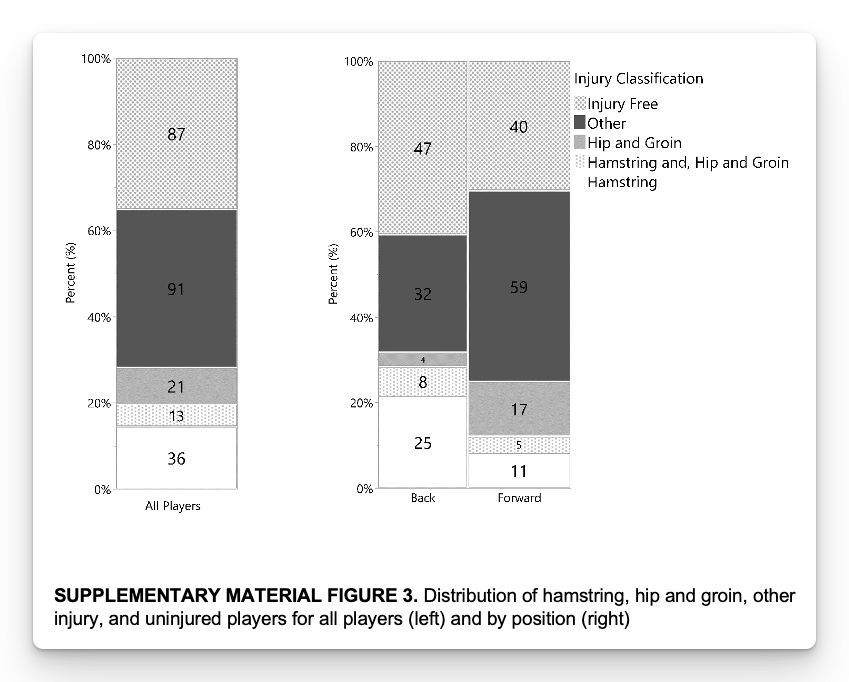
3. 43% of injuries were hamstring or hip/groin
Injury distribution was position-specific:
- Backs had more hamstring strains
- Forwards had more hip/groin injuries
A hip/groin injury increased odds of hamstring injury 4x
4. Strength changes post-injury
Across all injury groups:
- ABD60 was the only measure that consistently decreased post-injury
- Hamstring-specific injuries showed some rebound in Nordic strength and no consistent change in adductor strength
The loss in ABD60 may reflect lingering deficits in lateral hip stability, pelvic control, and change-of-direction capacity.
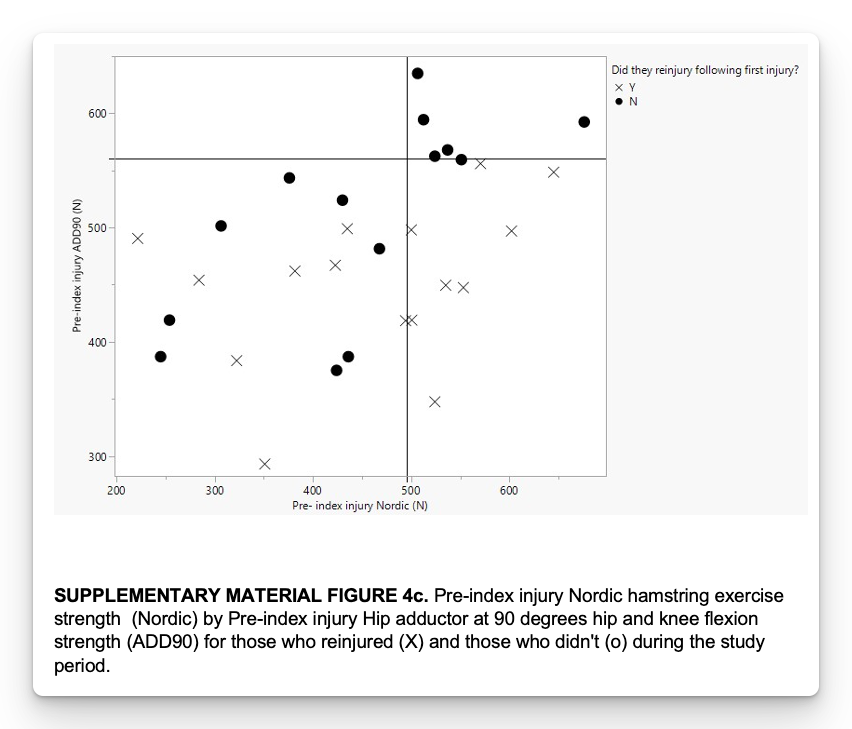
5. Reinjury insights (CART analysis)
Two reinjury profiles emerged:
- Reinjury Profile A ⮕ Low adductor strength at 90° pre-injury and high Nordic strength
- Reinjury Profile B ⮕ Low adductor strength pre-injury and little or no improvement in adductor strength after injury
Protected athletes shared one trait: High ADD90 strength or meaningful improvement in ADD90 post-injury
6. Injury and Reinjury Breakdowns
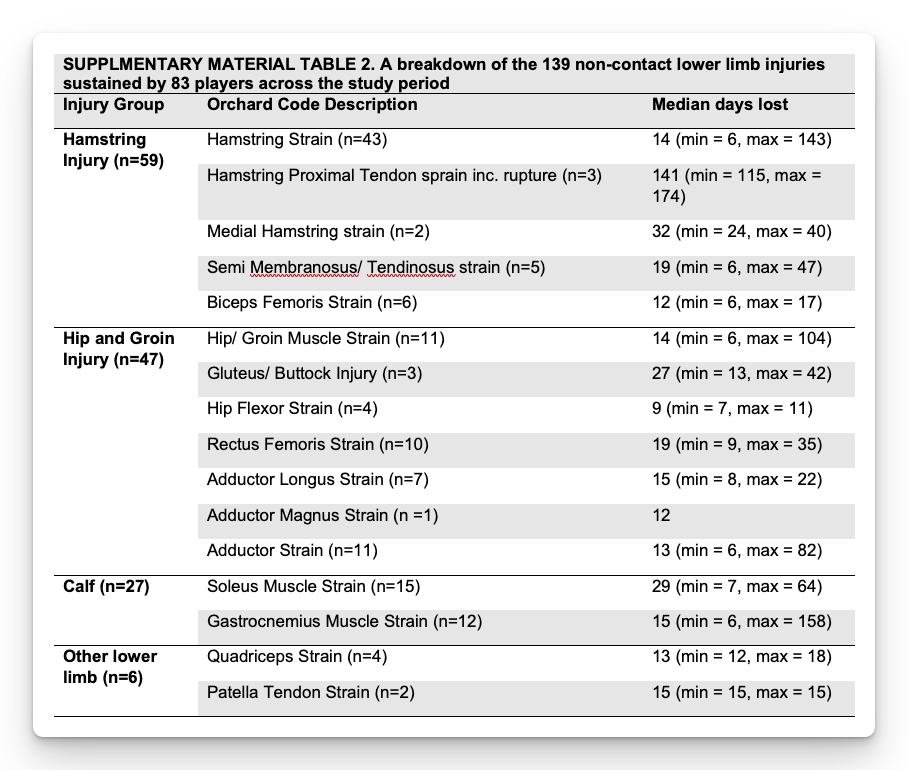
The table below breaks down the 139 non-contact lower limb injuries sustained by 89 players across the study period
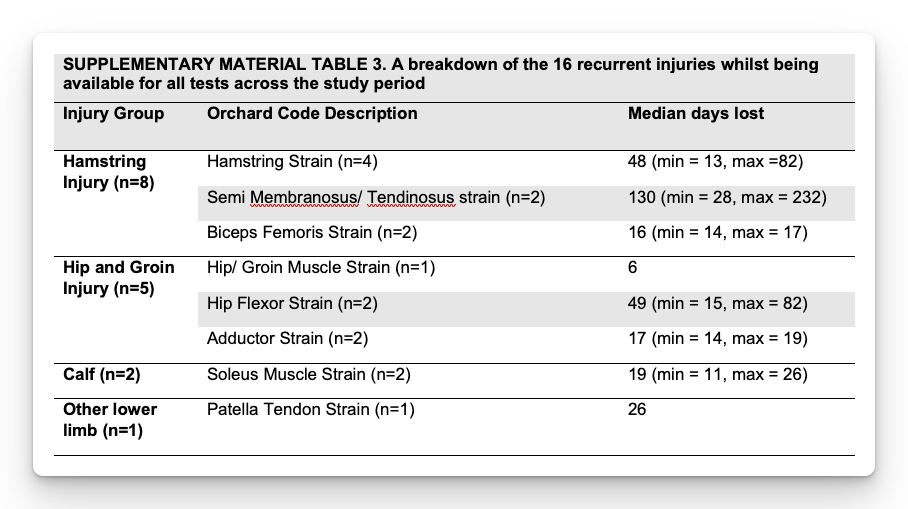
The table below breaks down the 16 recurrent injuries (i.e., reinjuries) from players who were available for all tests across the study period.
What Does This Mean?
1. Strength isn’t static across a season
Weaker players improve easily, and stronger players are harder to maintain, suggesting coaches need to plan in-season exposures accordingly, especially for stronger athletes.
2. Hip adductor strength matters more than we think
This study strengthens the argument that adductor strength is a key protective factor, not just for groin injury but also hamstring injury and reinjury risk.
3. Strength changes, not just levels, are important
Drops from pre-season to mid-season might flag higher-risk athletes.
4. Post-injury strength can mislead
Athletes often return with Nordic partially restored. Adductor strength unchanged and ABD60 depressed; this mismatch may explain why reinjury rates remain stubbornly high.
5. Strong hamstrings alone don’t prevent injury
The reinjury profiles show that high Nordic strength without adequate adductor strength does not reduce risk.
Limitations
- Missing data at various time points
- Strength tests only done twice per season
- No workload or training exposure included
- Generalizability limited to elite rugby union environments
Coach’s Takeaway
- Protect your adductors like you protect your hamstrings ⮕ Adductor strength at 90° hip flexion is a legitimate marker of resilience.
- Monitor strength changes, not just baselines ⮕ When strong athletes drift downward in-season, your programming needs attention.
- Post-injury rehab must rebuild ABD60 and ADD90 ⮕ These deficits were common and linked to reinjury patterns.
I hope this helps,
Ramsey
Reference:
Williams K, van Dyk N, Winkelman N, Opar D, Williams M (2025). Lower limb muscle strength profiles and injury associations: a two-season prospective cohort study in men's professional rugby union. Journal of Science and Medicine in Sport. https://doi.org/10.1016/j.jsams.2025.10.012


