Coaches typically assume tendons only adapt under heavy loads.
Low-load BFR is popular in rehab and return-to-play settings, but we don’t know if tendons adapt the same way muscles do under restricted blood flow.
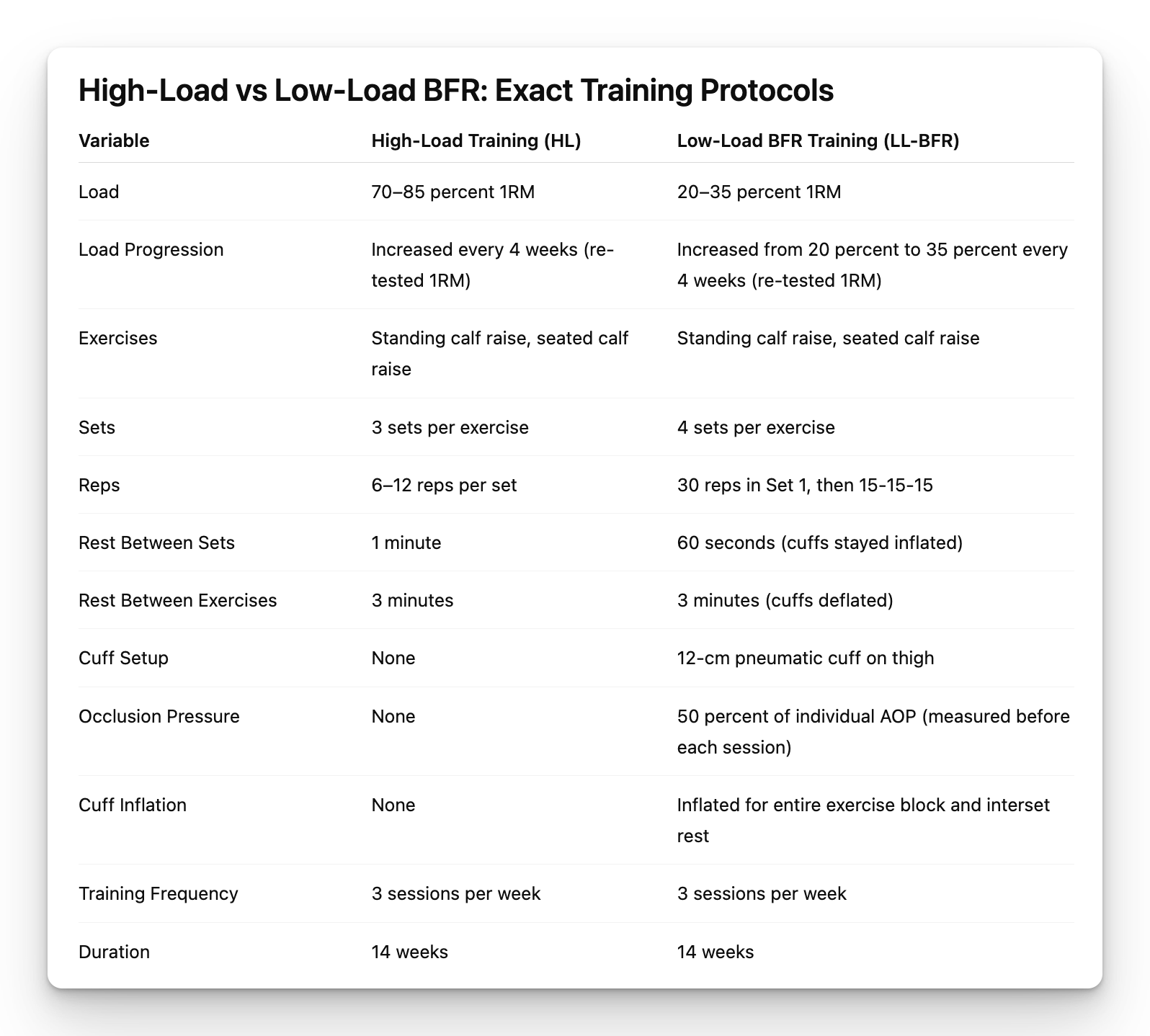
This study tests whether 20–35% 1RM + BFR can improve Achilles tendon morphology and mechanics to the same extent as traditional 70–85% 1RM.
Can low-load BFR stimulate Achilles tendon hypertrophy and stiffness to the same degree as high-load resistance training?
What Did the Researchers Do?
Study Design
55 healthy, untrained males (18–40 years old) were randomized into 1 of 3 groups:
- High-load (HL): 70–85% 1RM
- Low-load BFR (LL-BFR): 20–35% 1RM + 50% occlusion
- Control
Training Duration
- 14 weeks, 3x per week of standing and seated calf raises
- HL group: 3×6–12 reps
- LL-BFR group: 30-15-15-15 protocol
Measurements
- Gastrocnemius CSA
- Achilles tendon CSA
- Achilles stiffness
- Young’s modulus
- Maximal plantar-flexor torque
What Were the Results?
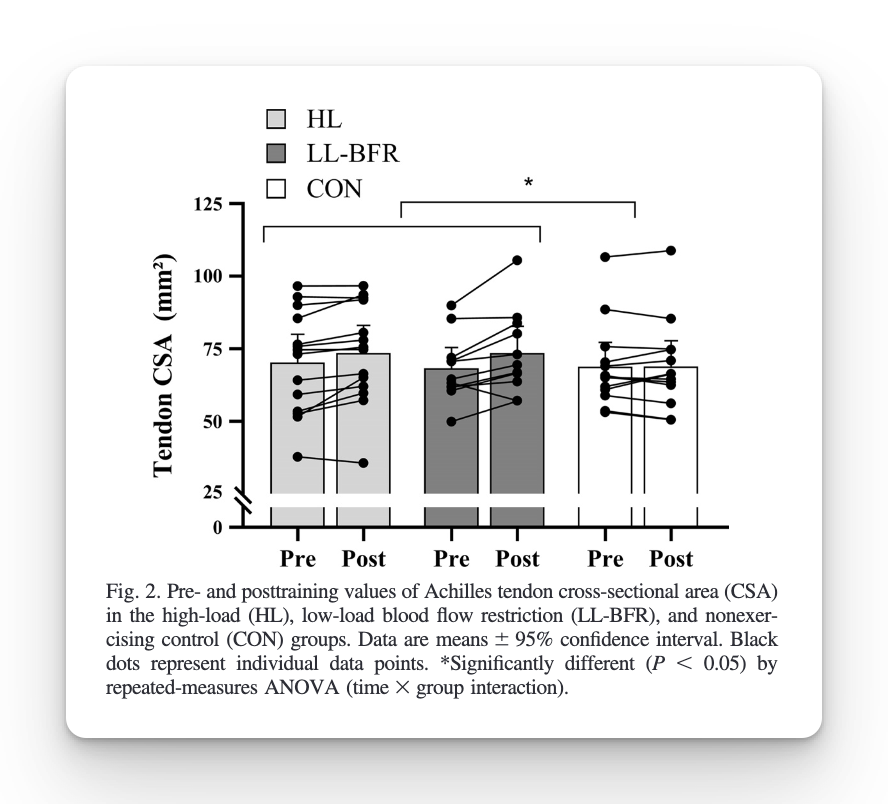
Tendon Hypertrophy
- HL: +4.6% Achilles CSA
- LL-BFR: +7.8% Achilles CSA
- Control: No change
- Adaptations were statistically similar between HL and LL-BFR.
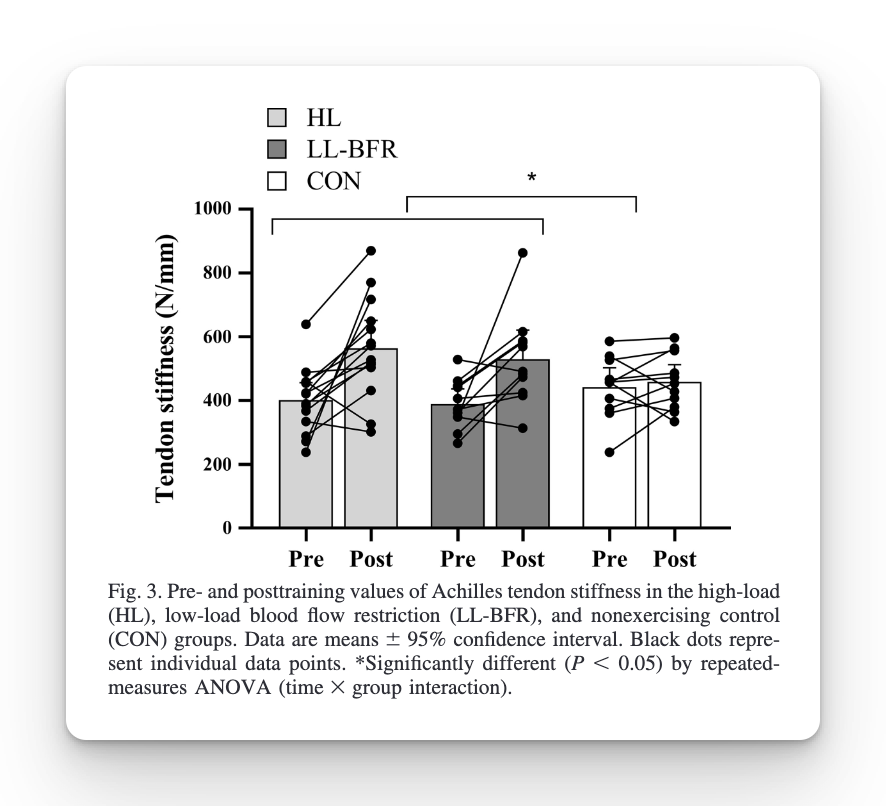
Tendon Stiffness
- HL: +40.7%
- LL-BFR: +36.1%
- Control: No change
- Again, LL-BFR matched HL.
Young’s Modulus
- No meaningful changes in any group
- Indicates stiffness gains were driven by morphological changes, not material properties.
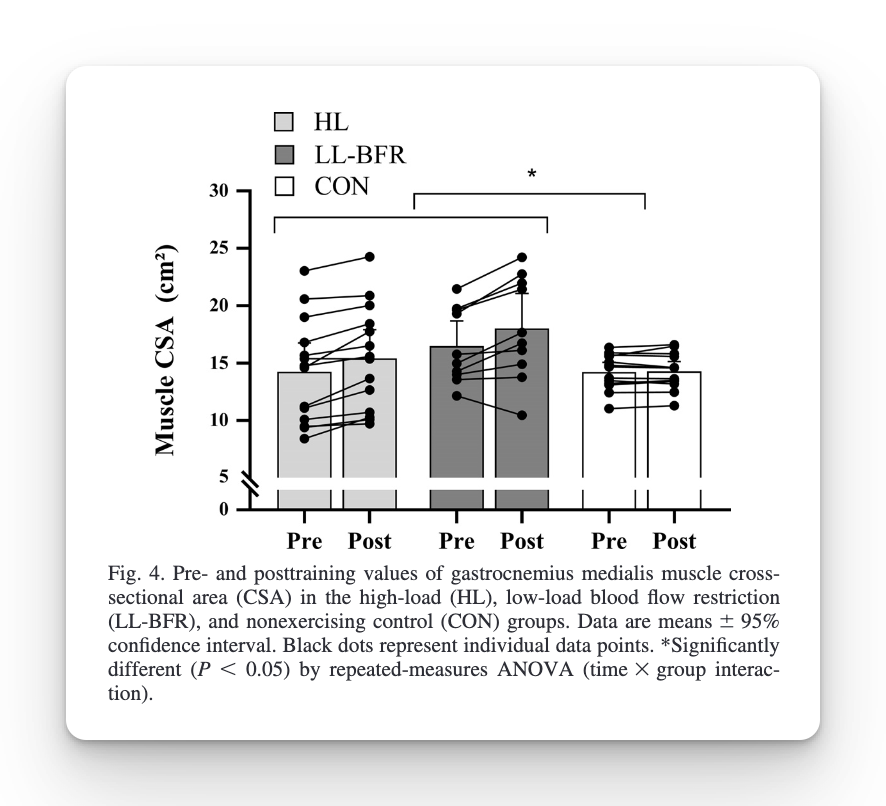
Muscle CSA
- HL: +7.7%
- LL-BFR: +9.1%
- Both were significantly greater than control.
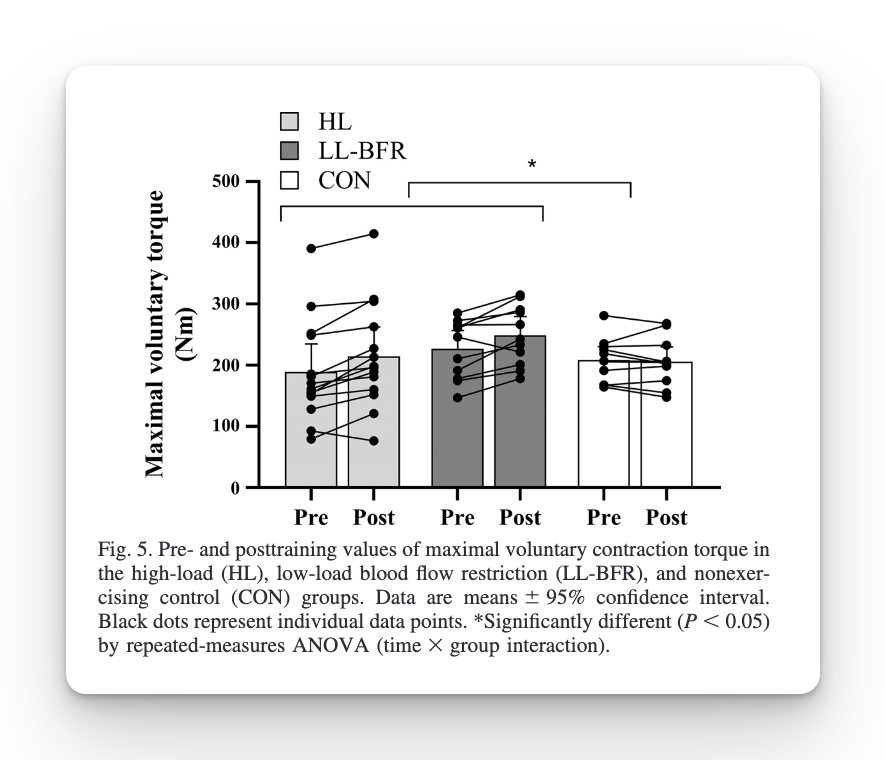
Strength
- HL: +13.5%
- LL-BFR: +9.8%
- HL was slightly better, but both improved in strength.
What Does This Mean?
- Tendons can adapt to light loads if combined with BFR, which is a big deal for return-to-play and painful tendons.
- Mechanical strain might not be the only driver of tendon adaptations.
- BFR may create a hypoxic environment that supports tendon fibroblast proliferation and collagen synthesis.
- LL-BFR provides a viable tendon-loading stimulus when loading tolerance is low.
Limitations
- No LL group without BFR, so the specific role of occlusion is unclear.
- All participants were untrained young males, so findings may not generalize to trained individuals, women, or older adults.
Coach’s Takeaways
- BFR is a legitimate tendon-training tool when heavy loading is not possible.
- Expect meaningful improvements within ~14 weeks, even at 20–35% 1RM.
- Heavy loading is still valuable, but BFR gives you another path to tendon health.
- This is especially useful for early rehab, in-season athletes, and pain-sensitive tendons.
I hope this helps,
Ramsey
Reference:
Centner C, Lauber B, Seynnes OR, Jerger S, Sohnius T, Gollhofer A, König D. (2019). Low-load blood flow restriction training induces similar morphological and mechanical Achilles tendon adaptations compared with high-load resistance training. Journal of Applied Physiology.
Whether you’re coaching athletes, rehabbing injuries, or studying performance, this playbook will give you the clarity and confidence to train tendons smarter.