

Research to date suggests that hypertrophy is similar across a wide range of loads when sets are taken close to failure.
But is load actually irrelevant, or are we just missing what really drives the differences we see between people?
This study tackles that question head-on by separating external variables (load, reps, limb) from internal biology (how a person responds to training).
If the same athlete trains different limbs with very different loads, do they grow differently, or do they grow the same way regardless of load?
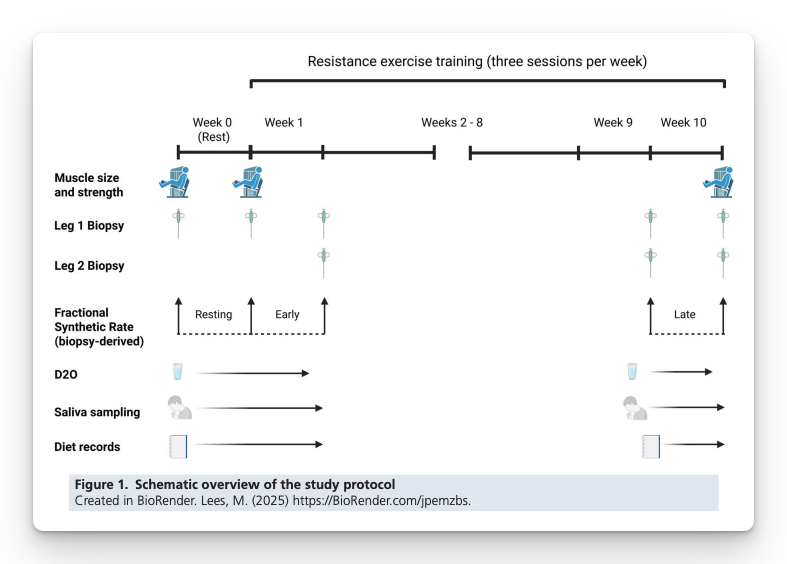
What Did the Researchers Do?
This was a within-subject, unilateral design, which is key.
Subjects
- 20 healthy, young, recreationally active but untrained males
- Average age ~22 years
- No structured resistance training background
Training Loads
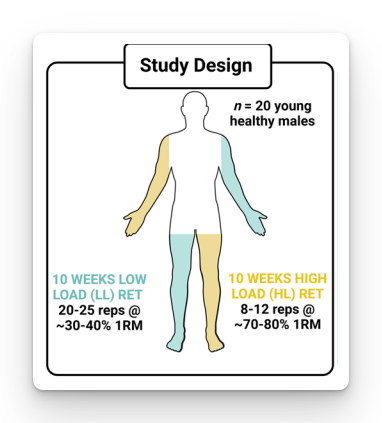
Each participant trained both arms and both legs, but with different loads:
- One arm and one leg trained with high load (HL): 8–12 reps with ~70–80% 1RM
- The contralateral arm and leg trained with low load (LL): 20–25 reps with ~30–40% 1RM
Training Program
- All sets were taken to volitional fatigue, three sets per exercise, three sessions per week, for 10 weeks.
- Unilateral knee extension was performed for the legs and unilateral preacher curl was performed for the arms.
- All participants consumed whey protein to ensure >1.6 g/kg/day
Comprehensive Measurements
- DXA for fat- and bone-free mass (arms and legs)
- Ultrasound for muscle thickness and CSA
- Muscle biopsies for fiber-type CSA (vastus lateralis)
- Strength testing (1RM and MVC)
- Deuterated water to measure integrated myofibrillar protein synthesis (MyoPS) at week 1 (early training) and week 10 (trained state)
What Were the Results?
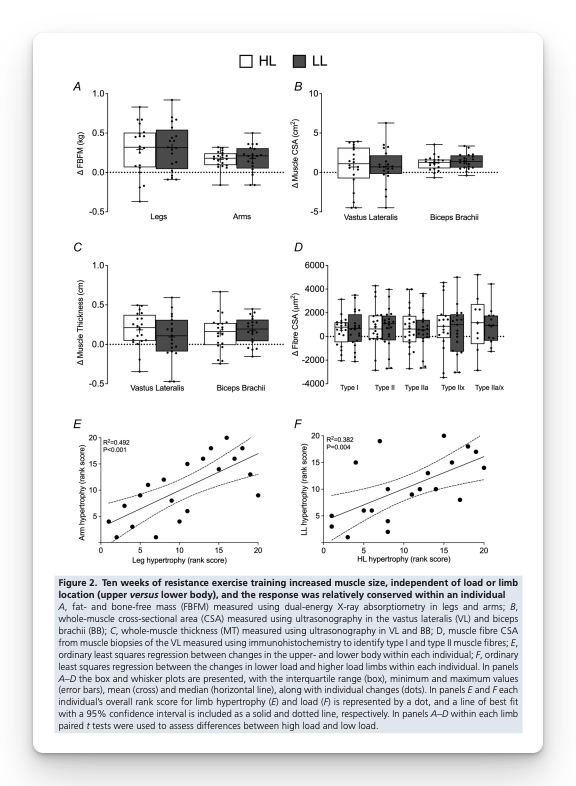
Hypertrophy Was the Same Across Loads
Across every hypertrophy measure:
- DXA
- Ultrasound CSA
- Muscle thickness
- Fiber CSA
There were no meaningful differences between high-load and low-load training.
Hypertrophy Was Highly Consistent Within Individuals
This is the most important finding.
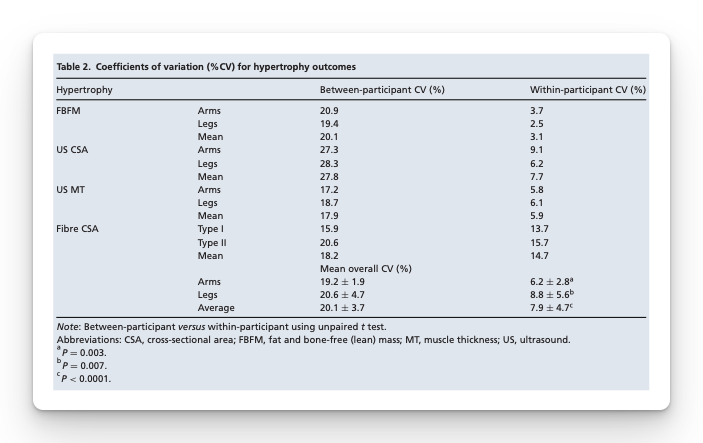
- Between participants, hypertrophy responses varied a lot
- Within a participant, responses were much more consistent
If someone was a “good responder” they:
- Tended to grow similarly in arms and legs
- Grew similarly with heavy and light loads
Within-participant variability was dramatically lower than between-participant variability. That points strongly toward endogenous biology, not programming variables, as the main driver.
Strength and Hypertrophy Were Poorly Related
- Strength gains did not correlate well with hypertrophy
- Strength responses were consistent within individuals, but largely independent of muscle growth
This reinforces what many coaches already see in practice: getting stronger and getting bigger are related, but not interchangeable.
Myofibrillar Protein Synthesis Tells an Important Story
- MyoPS increased early in training (Week 1)
- MyoPS was blunted by Week 10, despite continued training and overload
- No differences in MyoPS between high and low loads at any time point
In simple terms:
- Early training produces a strong anabolic signal
- As athletes adapt, that signal attenuates
- Load does not meaningfully change that trajectory
What Does This Mean?
The study strongly supports the idea that:
- Hypertrophy differences are largely explained by individual biology
- Manipulating load within reasonable ranges produces small effects compared to who the athlete is
This does not mean load doesn’t matter at all. It means load matters far less than many coaches think when the goal is muscle growth.
Limitations
- Young, untrained males participated so how this translates to trained athletes is unknown.
Coach’s Takeaway
- Effort beats load for hypertrophy ⮕ Proximity to failure is more important than the load used.
- Stop over-crediting your program ⮕ Hypertrophy response is more about the athlete than the spreadsheet.
- Use load strategically ⮕ Choose loads that athletes can execute well, recover from, and repeat consistently.
I hope this helps,
Ramsey
Reference
Lees MJ, McLeod JC, Morton RW, et al. (2026). Resistance training load does not determine resistance training–induced hypertrophy across upper and lower limbs in healthy young males. The Journal of Physiology.


