

Ankle injuries are one of the most common issues in court sports, and limited dorsiflexion is tied to worse landing mechanics, poorer COD, and higher injury risk.
Anything that improves ankle function and COD in a real training environment is directly useful.
Can a season-long isometric program improve ankle dorsiflexion and change of direction (COD) performance in professional male basketball players?

I am developing the ultimate basketball performance course and certification program. This is a practical, no-fluff system for training basketball players, from the weight room to game day, and everything in between.
What Did the Researchers Do?
Study Design
- 14 male professional basketball players from a French ProB team (mean ~25.6 years, height ~1.97 m, mass ~95 kg)
- Longitudinal in-season study across the 2023–2024 season
- 3 testing periods; Pre: 4 August; Mid: 4 December; Post: 30 April
Training Interventions (integrated into normal training)
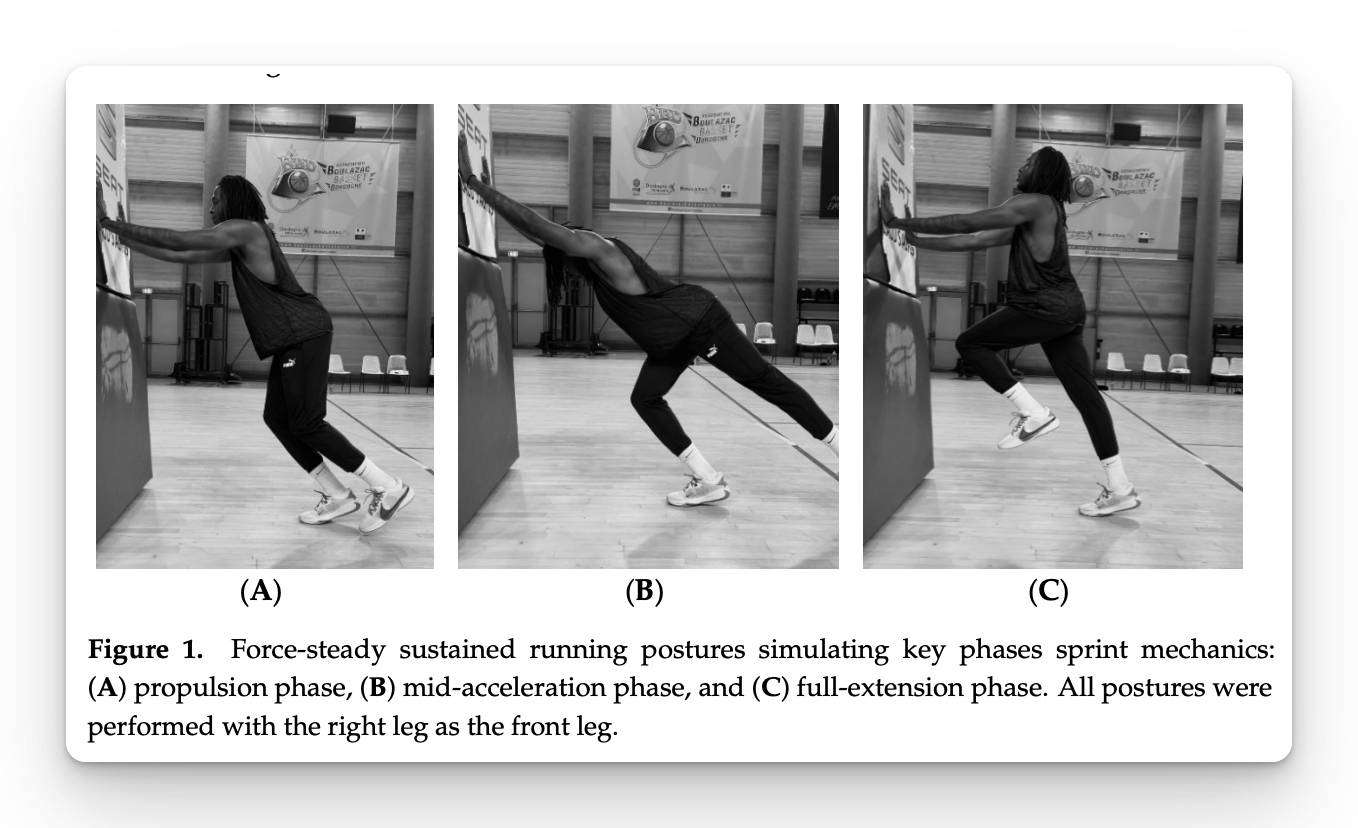
Force-steady sustained isometrics in “running” postures were performed 5 days per week.
- Three sprint-like isometric positions: (A) Propulsion phase, (B) Mid-acceleration, and (C) Full extension.
- ~80% MVC, 15–20 seconds per rep, 12 reps per set, 3 sets per session, 90 s rest.
- Quasi-isometric against a padded wall with elastic resistance, guided by dynamometer-based MVC data.
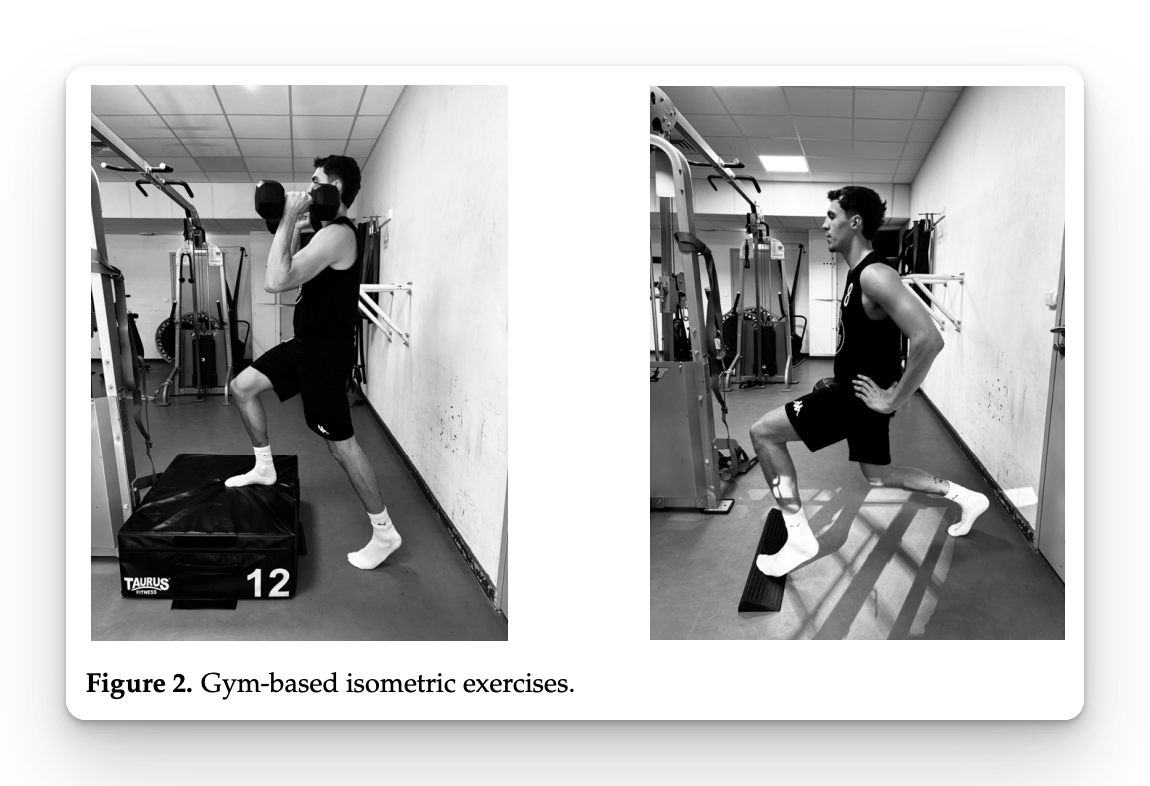
Gym-based isometric exercises were performed 2 days per week.
- Elevated unilateral hold with dumbbells on a 30 cm box, heel down on stance leg, other foot on floor, 30 s holds at ~75–80% MVC.
- Split squat isometric hold with front foot on wedge, rear knee slightly beyond 90°, 30 s holds, bodyweight.
- Progressive load increases (~8 percent every 4 weeks).
Measurements
- Ankle dorsiflexion: Weight-bearing Lunge Test with digital goniometer, best of 3 per leg.
- COD performance: L-Test with photocells.
What were the results?
Lunge Test (ankle dorsiflexion)
- Left leg improved ~34 percent from pre to post.
- Right leg improved ~19 percent from pre to post.
- No meaningful left vs right differences at any single time point.
L-Test (COD times)
- Leftward COD was ~10% faster with a large effect size.
- Rightward COD was ~11.6% faster with a large effect size.
- Improvements seen mid-season and then further by post-season, with no meaningful asymmetry between sides.

What Does This Mean?
A simple, repeatable isometric package embedded into team training was associated with:
- Meaningful increases in weight-bearing dorsiflexion, especially on the more limited side.
- Clear performance gains in a multidirectional COD test.
The program used sport-specific postures (sprint phases against a wall) plus split-stance isometrics, which likely:
- Increased joint-angle specific strength at the ankle.
- Improved postural control and force application in cutting and acceleration patterns.
For pros with a history of ankle sprains, better dorsiflexion and COD capacity may:
- Support more efficient movement.
- Contribute to injury risk reduction, although injury incidence was not the primary outcome here.
Limitations
- No control group ⮕ Impossible to fully separate the effect of the iso program from normal in-season adaptation.
- Small sample (n = 14) ⮕ Single team, male pros only, limits generalizability.
- Mechanisms not directly measured ⮕ No ankle stiffness, tendon properties, or neuromuscular measures.
Coach's Takeaway
- Build ankle-focused isometrics into the week ⮕ Use sprint-like wall postures and split-stance holds at moderate-to-high intensity for 15–30 seconds, several times per week.
- Chase better dorsiflexion in weight-bearing tests ⮕ Use the Lunge Test as a quick screening metric and track changes across the season.
- Connect ankle work to COD outcomes, not just “mobility” ⮕ Pair ankle interventions with COD testing.
I hope this helps,
Ramsey
Reference:
Fernández-Galván LM, Fernández-Viñes R, Sánchez-Infante J. (2025). Effects of Isometric Training on Ankle Mobility and Change-of-Direction Performance in Professional Basketball Players. Applied Sciences, 15(17), 9666.


