

Youth soccer is full of sprints, cuts, and jumps.
Those actions drive performance and also load hamstrings, adductors, and hips, where many non-contact injuries occur.
Strength training is often recommended for both performance and injury reduction, but there is limited data on how a structured, high-load program changes injury incidence, injury burden, and fitness in real teams.
This study asked a simple coaching question:
In elite youth soccer players, do two weekly high-load strength sessions reduce injuries and improve performance?
What Did the Researchers Do?
Design and players
- Randomized controlled trial with 20 U18 male players from the same Spanish “División de Honor” team.
- Experimental group (EG, n=10): usual soccer training plus high-load strength.
- Control group (CG, n=10): usual soccer training only.
- Both groups had similar ages, body size, and positional mix (4 defenders, 4 mids, 2 forwards per group). Goalkeepers were excluded.
Training context
Standard weekly microcycle for all:
- 1 recovery/compensation session
- 3 practices or "acquisition sessions" (tension/endurance/speed)
- 1 match, all around 90 minutes.
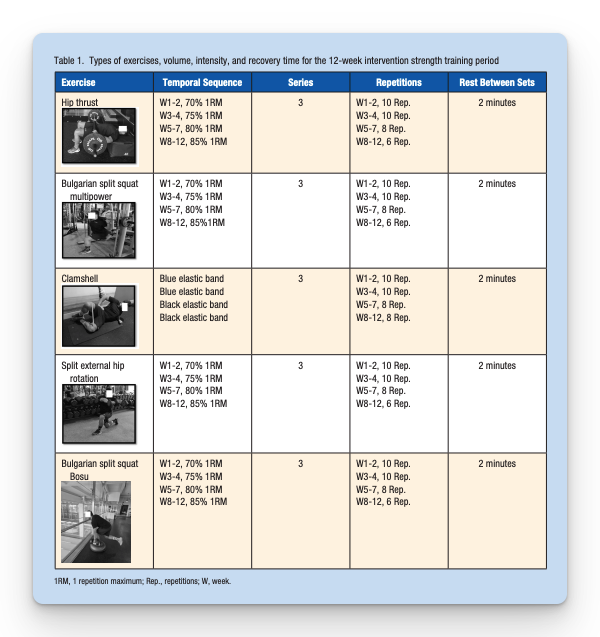
EG added 2 strength sessions per week (Tuesday and Thursday), 45-50 minutes, after field training, for 12 weeks (24 total sessions).
Strength program
- Focused on glute and hamstring dominant work.
- Loading progressed from ~70% to ~85% 1RM across the 12 weeks.
Outcomes measured
Injury profile
- Injury incidence: injuries per 1000 hours exposure.
- Injury burden: days lost per 1000 hours exposure.
Fitness tests pre and post:
- Vertical jumps: CMJ, SJ, single-leg CMJ.
- 505 change of direction (dominant and non-dominant).
- Linear sprints over 10, 20, 40 m.
- Repeated sprint ability (5×30 m).
- Isometric strength: quads, hamstrings, adductors, abductors, dominant and non-dominant limbs.
What were the results?
Injury incidence and burden
Total injuries
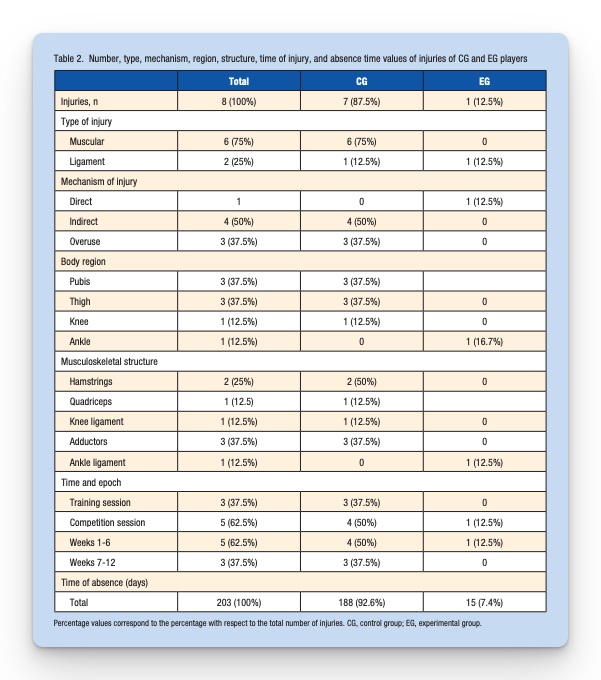
- 8 across the team in 12 weeks.
- CG: 7 injuries.
- EG: 1 injury.
Injury incidence
- CG: 11.34 injuries per 1000 h
- EG: 1.31 injuries per 1000 h
- Rate ratio ≈ 8.6 in favor of the strength group.
Injury burden
- CG: 304.66 days lost per 1000 h
- EG: 19.72 days lost per 1000 h
- Rate ratio ≈ 15.5 in favor of the strength group.
Injury type and days missed
- CG: 7 injuries, 188 days lost to mostly muscle tendon issues in hamstrings and adductors, plus a quad and MCL injury.
- EG: 1 ankle ligament injury, 15 days lost.
Performance
Compared with CG, the EG showed clear pre-post improvements in:
Jumps
- Bilateral CMJ improved by about 6%
- SJ and single-leg CMJ also improved.
Speed and COD
- 505 COD times improved by roughly 2% to 4%.
- 10-, 20-, and 40-m sprint times improved in EG, unchanged in CG.
- RSA total time improved by about 2.5%.
Isometric strength
- Quads, hamstrings, adductors, and abductors all increased 7% to 15% in EG, with a minimal change in CG.
Effect sizes were large for almost every metric in the strength group.
What Does This Mean?
- A simple, heavy, posterior chain-focused program on top of regular training dramatically reduced both how often players got injured and how long they were out when they did.
- The same players got faster, jumped higher, and improved COD and RSA, so the strength work clearly translated into key performance outputs, not just weight-room numbers.
- The exercise selection and loading are practical for team settings: 2 sessions per week, 45-50 minutes, with common movements and clear progressions.
Limitations
- Single team, small sample of highly trained U18 males.
- Only 12 weeks of in-season follow-up.
- No detailed external load or internal load data from field sessions.
Coach's Takeaway
Put heavy posterior chain on the schedule, not in the “optional” bucket.
- Twice-per-week high-load work for glutes and hamstrings is strongly associated with lower injury incidence and burden, even in already highly trained U18s.
- These sessions were practical in terms of time and exercise selection.
Build a simple, progressive template.
- Think hip thrusts and split squats at 70% to 85% 1RM, 3 sets of 10 down to 6, with 2 minutes rest, run in a tight circuit.
- This is realistic inside a team environment.
Sell strength as a performance-plus-health play.
- You are not just “injury proofing.”
- You are giving players better jumps, faster first steps, and sharper COD, which keeps buy-in high and makes the injury reduction a by-product of better physical capacity.
I hope this helps,
Ramsey
Reference
Durán-Custodio R, Yanci J, Raya-González J, Beato M, Castillo D. (2025). High-Load Strength Training Reduces Injury Incidence and Injury Burden and Improves Physical Fitness in Young Highly Trained Soccer Players. Sports Health.


