

Basketball is built on repeated high-intensity actions like sprints, jumps, accelerations, and changes of direction. These external demands drive fatigue, recovery needs, and ultimately performance outcomes.
While most existing data is outdated or from other leagues like the NBA or EuroLeague, this study gives modern, real-world data from a professional league (Australian NBL) using wearable tech.
The researchers asked 3 related and relevant questions:
- Are starters, bench players, and positions actually experiencing different physical demands?
- Do starters vs bench players experience different game demands?
- Do guards vs forwards/centers have different physical requirements?
What Did the Researchers Do?
Study Design
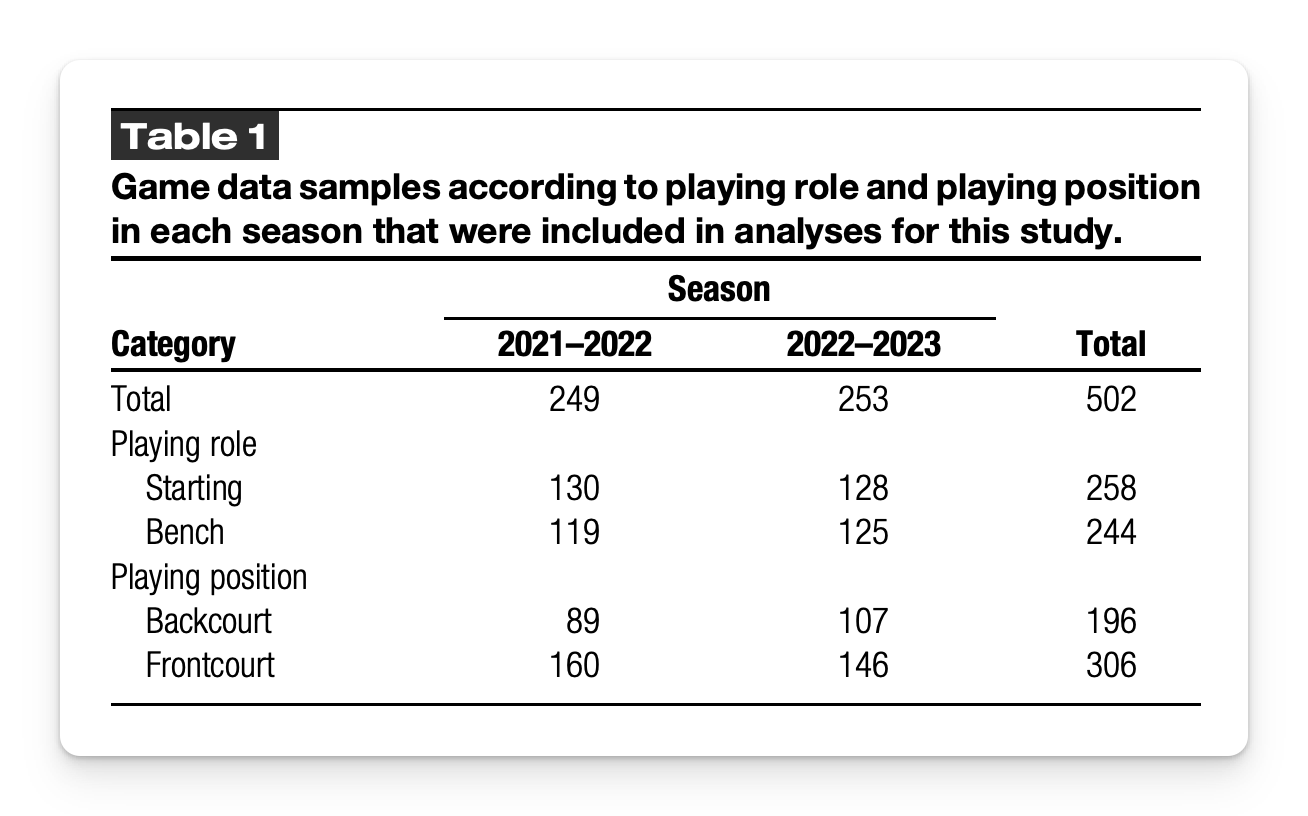
- 22 professional male players tracked across 2 seasons (2021–2023)
- Used Catapult microsensors to measure movement demands during games
- Only live playing time was analyzed (no timeouts, no bench time)
Variables Measured
- PlayerLoad (overall movement load)
- Jumps
- Accelerations / Decelerations
- Change of Direction (COD)
Player Grouping
- Playing Role ⮕ Starters vs Bench
- Playing Position ⮕ Backcourt (guards) and Frontcourt (forwards/centers)
Analysis
- Both Accumulated (total load) and Relative (per minute intensity)
- Linear mixed models to account for player variability
- Effect sizes to interpret practical meaning
What Were the Results?
Total Load
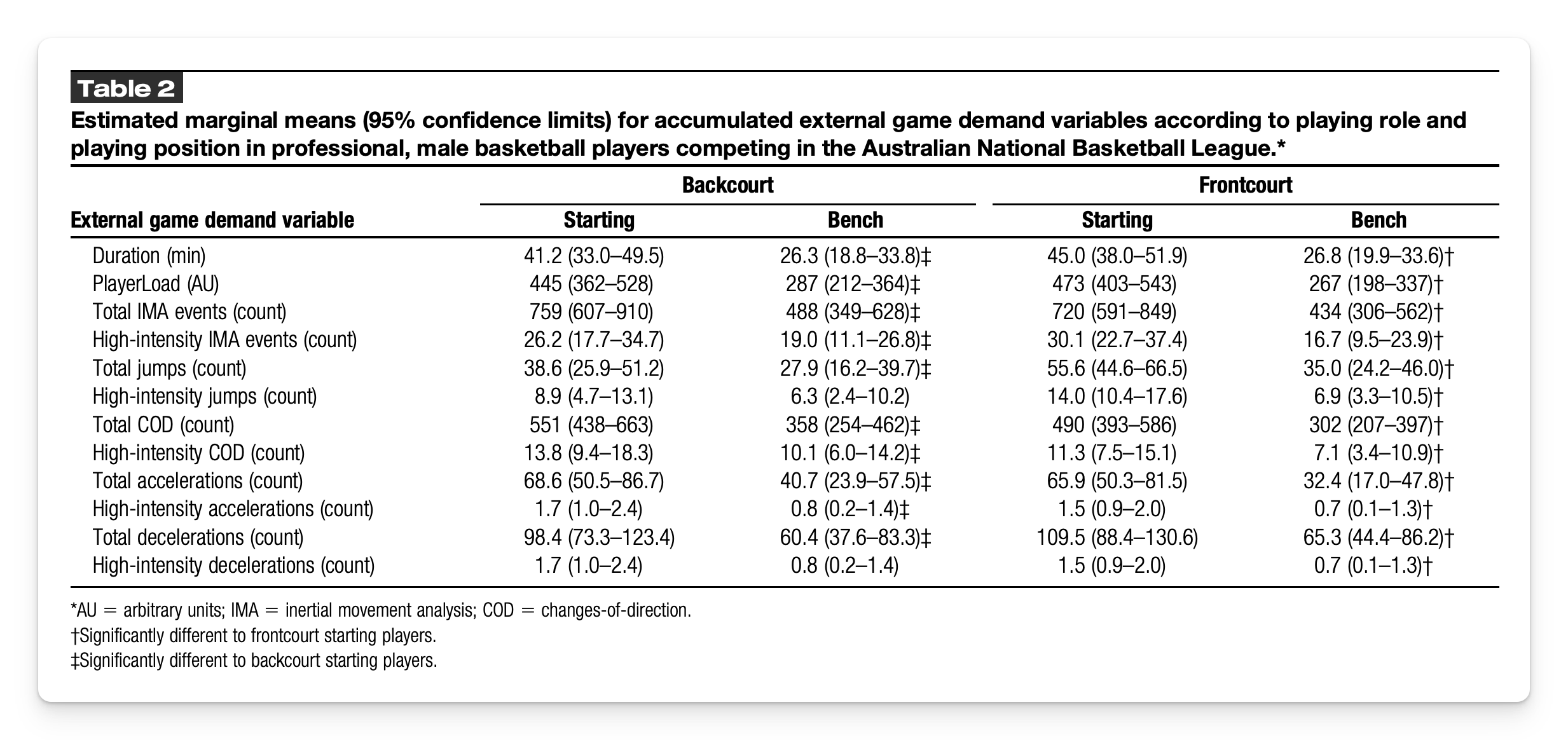
Starters had significantly higher total load across almost everything, including:
- PlayerLoad
- Accelerations
- COD
- Total movements
This was largely driven by more playing time (~40% more minutes)
Per Minute (Intensity)
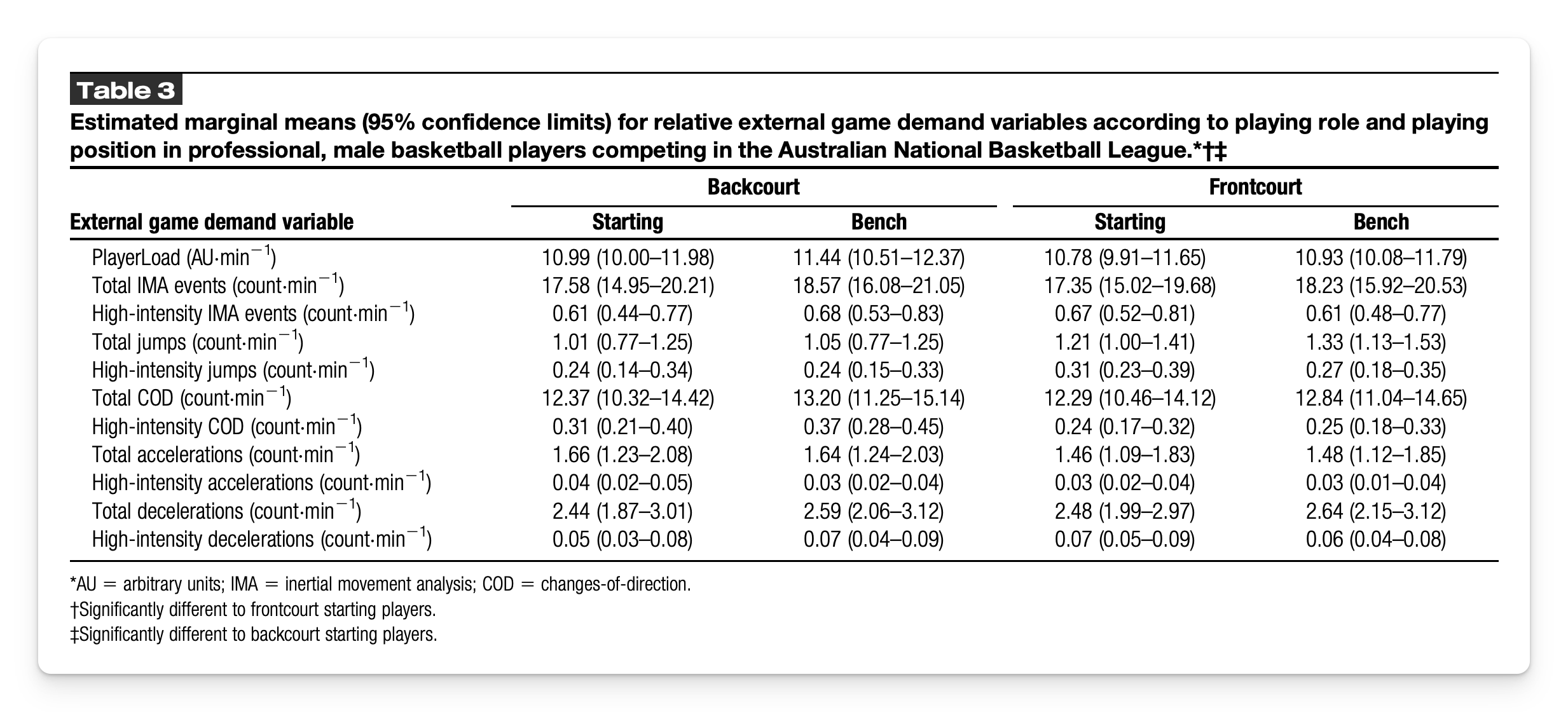
- No real differences in intensity per minute
- Starters and bench players worked at similar intensity levels
This means bench players are just as intense, they just play less
Position Differences
- Most variables were similar between positions.
- However frontcourt players had more total and high-intensity jumps, while backcourt players (especially bench) had more high-intensity COD.
These results make sense; bigs have to protect the rim and rebound while guards have to maneuver around the perimeter.
What Does This Mean?
- Volume vs Intensity Matters ⮕ Starters accumulate more fatigue because they play longer, but intensity is consistent across players
- Bench Players May Be Underexposed ⮕ They experience less total stress, not less intensity which can creates a readiness gap if their role suddenly increases
- Position Is Less Important ⮕ Modern basketball shows movement demand overlap across positions and roles are blending.
- Some Position-Specific Needs Still Exist ⮕ Frontcourt players perform more jumping, while backcourt players perform more COD.
Limitation: Since only one team was studied, results may reflect tactical strategy and results may not fully generalize across teams or leagues.
Coach's Takeaway
- Starters accumulate more load because of minutes, not intensity
- Bench players need top-up work to stay game-ready
- Most conditioning can be shared across positions
- But coaches should layer in specificity (e.g. more jump work for bigs and more COD exposure for guards)
The conclusions from the authors are spot on and is exactly what should be done in practice:
Regarding playing role, because of the lower accumulated external demands experienced by bench players during games, coaches may prescribe bench players with compensatory top-up training to ensure that they are adequately equipped to handle the extended playing durations at game intensities if required to occupy a starting position on short notice.
I hope this helps,
Ramsey
Reference
Shirley, S.K., Scanlan, A.T., Guy, J.H., Bartlett, R.J., Bowe, S.J., & Elsworthy, N. (2026). The external game demands of professional, male basketball players according to playing position and playing role: A multiseason analysis in the Australian National Basketball League. Journal of Strength and Conditioning Research.


