

Force plates are one of the most powerful tools we have in performance and rehab.
They’re also one of the most misunderstood.
Scroll social media and you’d think force plates can tell you everything about an athlete’s muscles, tendons, joints, readiness, injury risk, and future performance.
Thats not true.
But the truth is simpler, and more useful.
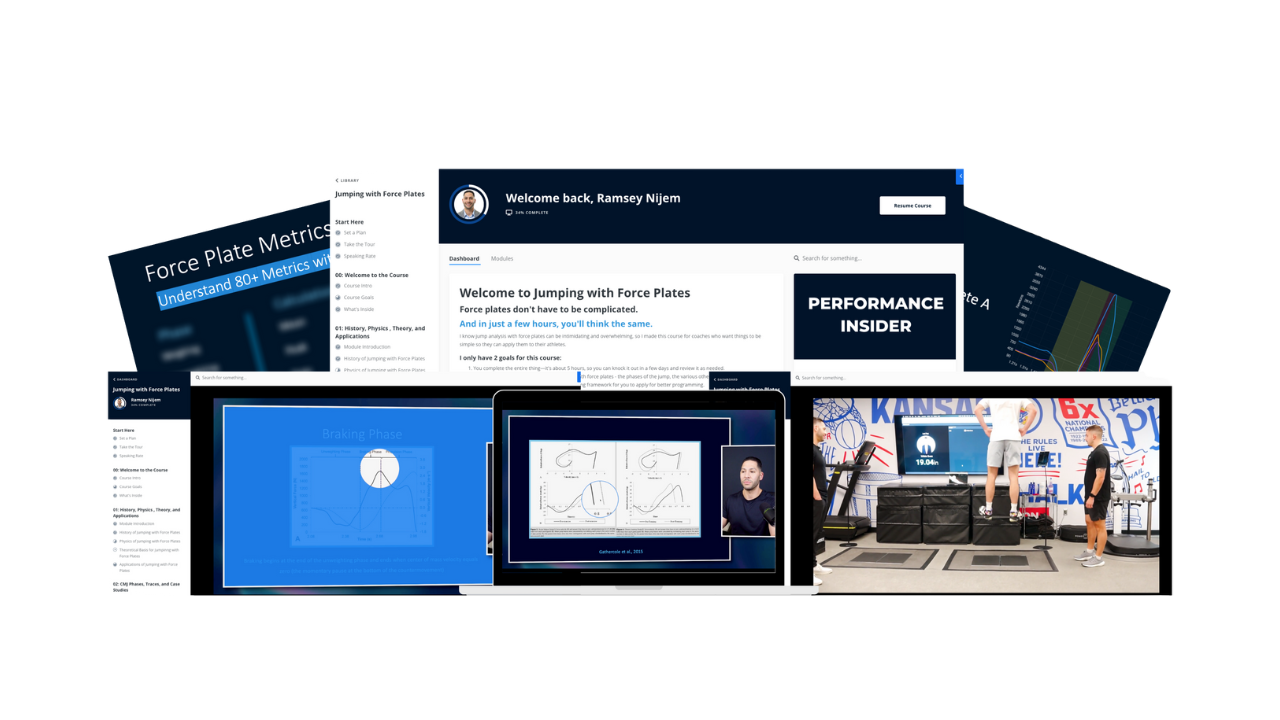
The Simplest and Fastest Way to Learn Jump Analysis with Force Plates
What Force Plates Actually Measure
At their core, force plates measure external ground reaction force over time.
That’s it.
Every test, metric, or dashboard starts with this force–time signal.
From that signal, we can directly observe:
- How much force is applied
- How quickly force is applied
- How force changes throughout a movement
- How force is distributed between limbs
Based on these force-time signals, hundreds of metrics can be calculated.
The First Big Misconception
Force plates do not measure “everything.”
They do not directly measure:
- Internal muscle forces
- Tendon forces
- Joint loading
- Joint angles or range of motion
- Tissue stress or strain
If a metric claims to measure these directly, it is making assumptions based on models rather than measurements.
Typically, these measurements can only be made by combining multiple biomechanical technologies (e.g. force plates with motion capture).
Where Force Plates Shine
Force plates are best used to answer performance questions, not anatomical ones.
They are extremely good at telling you:
- How quickly force is developed
- How braking and propulsion are organized
- How force strategy changes over time
- How limbs contribute differently to the same task
- How fatigue alters movement without obvious performance drops
This is why force plates work so well in:
- ACL rehab progression
- Return-to-performance decisions
- Fatigue monitoring
- High-level performance analysis
They show you the how, not just the outcome.
Jump Height Is Not the Point
One of the biggest mistakes is reducing force plate testing to jump height.
Jump height is an outcome. Force–time data explains the process.
Two athletes can jump the same height with completely different strategies:
- One uses rapid force production
- One relies on longer contact time
- One leaks force during braking
- One distributes load asymmetrically
If you only look at height, you miss the story.
Force Plates Don’t Replace Coaching
Another misconception is that force plates remove the need for coaching judgment.
They don’t.
Force plates don’t tell you:
- Why a strategy exists
- Whether it’s protective or limiting
- What an athlete can tolerate
- How technical constraints shape movement
What they do is sharpen your decisions by removing guesswork. They give you clearer questions to ask and clearer targets to train.
The Bottom Line
Force plates are not magic or crystal balls.
They are tools that measure force and time with high precision.
When you understand their limits, they become incredibly powerful. When you ignore those limits, they create false confidence.
Use force plates to connect assessment to programming, rehab to performance, and data to action.
That’s where they earn their place.
I hope this helps,
Ramsey
The Simplest and Fastest Way to Learn Jump Analysis with Force Plates


