

This week, inside the Applied Performance Coach community, a student asked a great question:
“How can force plates tell us if an athlete is force vs tendon dominant?”
My answer was quick and surprised some:
"They can’t."
This is one of the most common interpretation errors I see, especially as force plates become more popular across performance and rehab settings.
The goal of this post is to help you understand what force plates actually measure and make clear what they can't.
What Force Plates Measure
At their core, force plates measure one thing extremely well:
Ground reaction force over time.
From that signal, we can derive valuable insights into our athletes' kinetic capabilities, allowing us to understand how the system behaves during tasks like countermovement jumps, drop jumps, and isometric tests.
But here is the key point many miss.
Force plates only see the external outcome at the ground.
They do not see inside the body.
Force Plates Cannot Separate Muscle vs Tendon
You will often hear phrases online like:
- “This athlete is tendon dominant”
- “This athlete is more muscle driven”
- “Force plates show elastic vs muscular athletes”
These statements make for good soundbites but go beyond what the data can support.
Force plates do not know:
- Which tissues produced the force
- How the load was shared between the muscle and tendon
- MTU stiffness distribution
- Fascicle behavior
- Tendon strain or recoil
All the plate detects is:
Ground reaction force over time.
Multiple internal strategies can produce very similar external force-time signatures. Two athletes can show similar RSI or jump height while using very different neuromuscular solutions.
So when we label someone “tendon dominant” purely based on force-plate data, we are stepping beyond what the tool can actually tell us.
Misinterpretations from Force Plates
Coaches and clinicians often put their own interpretation on the data, but far too often those interpretations are misguided or based on a misunderstanding of the underlying physics and technology.
Most interpretation errors come from asking force plates questions they were never designed to answer.
Common pitfalls include:
- Over-attributing tissue behavior from COM data
- Treating RSI as a direct proxy for tendon function
- Assuming short contact times equal “tendon dominant”
- Using single metrics or ratios to make complex physiological claims
These leaps may sound logical, but they are not directly supported by the measurement.
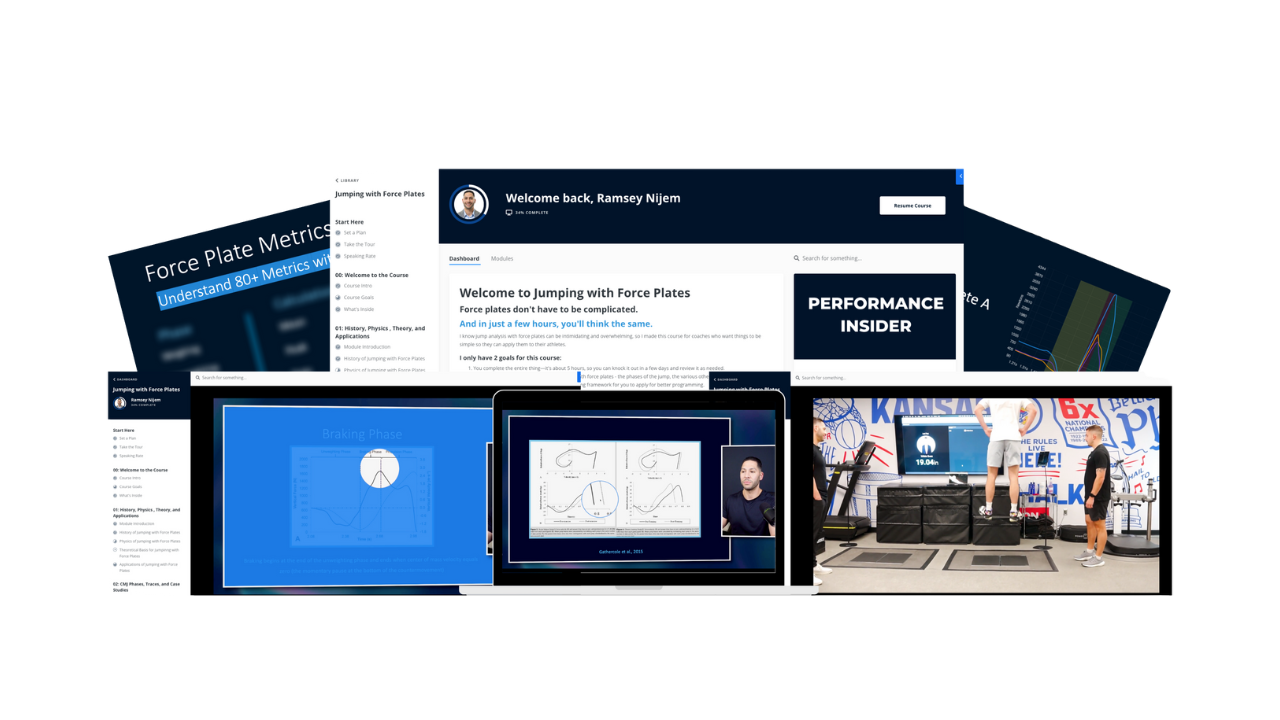
The Simplest and Fastest Way to Learn Jump Analysis with Force Plates
A Better Way to Think About It
Here is the mindset I recommend. Use force plates to understand:
How the system behaves.
Then integrate that with athlete history, training experience, injury context and clinical reasoning.
High-level practice lives at the intersection of good data and good coaching judgment.
Coach's Takeaway
Force plates are incredibly powerful. But they cannot tell you whether an athlete is “force dominant” or “tendon dominant” at the tissue level.
What they can do, and do extremely well, is help you understand how the athlete’s whole system produces and manages force.
Use them for that purpose, and they will elevate your practice. Overinterpret them, and they will lead you down the wrong path.
If you want to go deeper on interpreting force plate data the right way, then check out the force plate course for 50+ lessons to level up your force plate skills.
I hope this helps,
Ramsey


