

The stretch–shortening cycle (SSC) underpins nearly every explosive action in sport. Sprinting, cutting, jumping, rebounding, and rapid deceleration all rely on how effectively athletes absorb force and then reapply it against gravity.
For years, the Reactive Strength Index (RSI) has been the go-to metric for assessing SSC performance because it’s simple and easy to measure in the field. With that said, the RSI ignores the demand from the drop height and biases toward short ground contact times.
This author challenges core assumptions about RSI and argues that RSI:
- Mixes variables with incompatible dimensions
- Over-rewards extremely short contact times
- Ignores eccentric loading and total displacement demands
- Fails to generalize across different SSC tasks (CMJ vs drop jumps)
The purpose of the study was to propose and evaluate a new mechanically grounded metric, the Dynamic Rebound Index (DRI), that better reflects what SSC performance actually requires from a physics standpoint.
Does RSI measure effective SSC performance, or are we just rewarding athletes for being fast off the ground? And is there a better alternative?
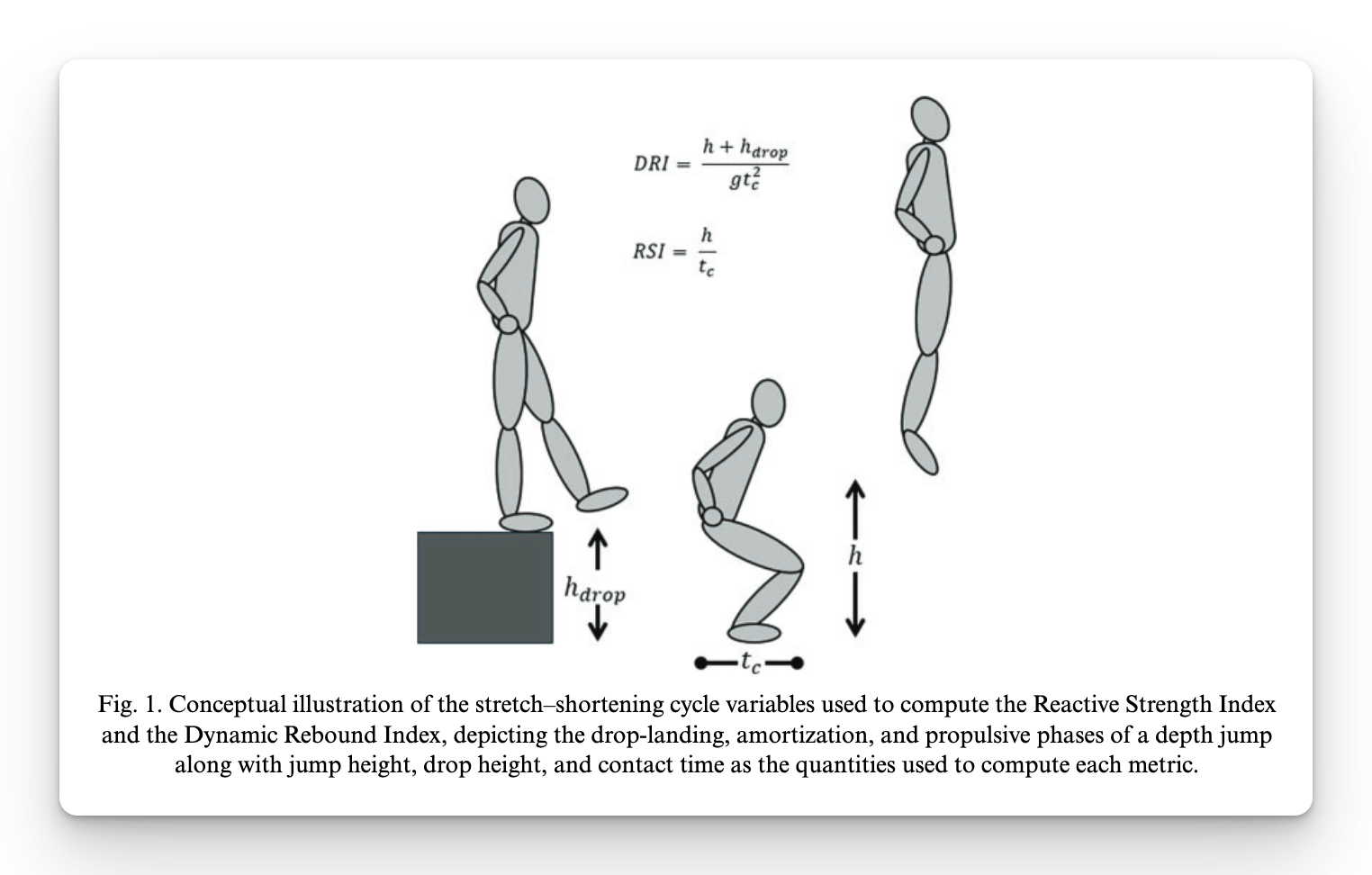
What Did the Researchers Do?
Study Design
- The author proposed an alternative to RSI, which is a mechanical framework grounded in basic kinematics.
- Derived a dimensionless index called the Dynamic Rebound Index (DRI)
Calculating the Ratios
Both RSI and DRI are computed from simple, field-friendly measurements, but they differ in what they emphasize.
Reactive Strength Index (RSI)
- RSI is calculated as jump height divided by ground contact time.
- This ratio emphasizes how quickly an athlete leaves the ground, making it highly sensitive to short contact times.
Dynamic Rebound Index (DRI)
- DRI is calculated as total vertical displacement divided by gravitational displacement over the squared contact time.
- By incorporating both displacement and time under gravity, DRI reflects how effectively the athlete manages the mechanical demands of the stretch–shortening cycle.
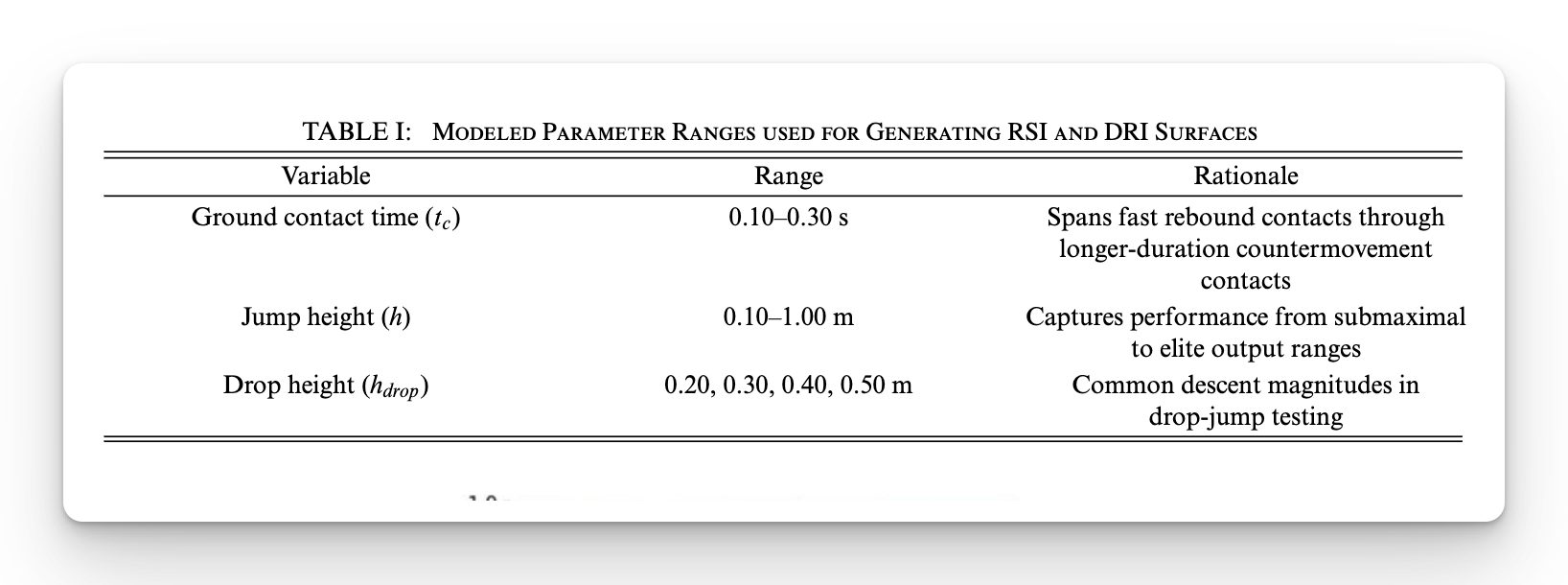
Modeled Comparison
The author compared DRI and RSI using modeled ranges of:
- Contact time: 0.10–0.30 s
- Jump height: 0.10–1.00 m
- Drop height: 0.20–0.50 m
Analyses Performed
- Contour maps (RSI vs DRI)
- 3D surface plots
- Standardized difference maps
- Cross-sectional comparisons
- Modeled movement trajectories (stiff vs effective strategies)
What Were the Results?
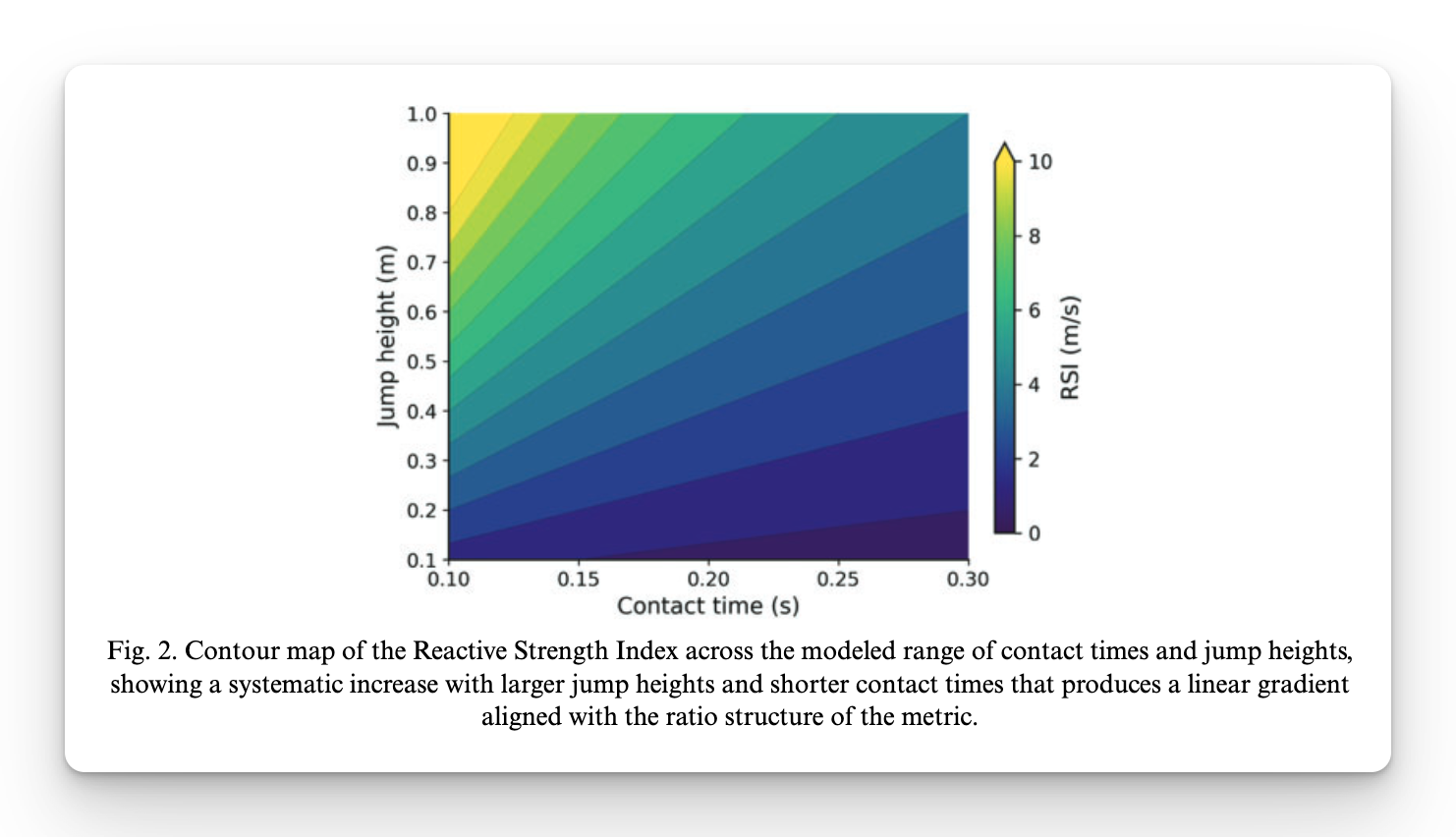
RSI is Dominated by Contact Time
RSI increased whenever contact time decreased, even when jump displacement was small. This means that very stiff, low-displacement rebounds scored well, independent of jump height.
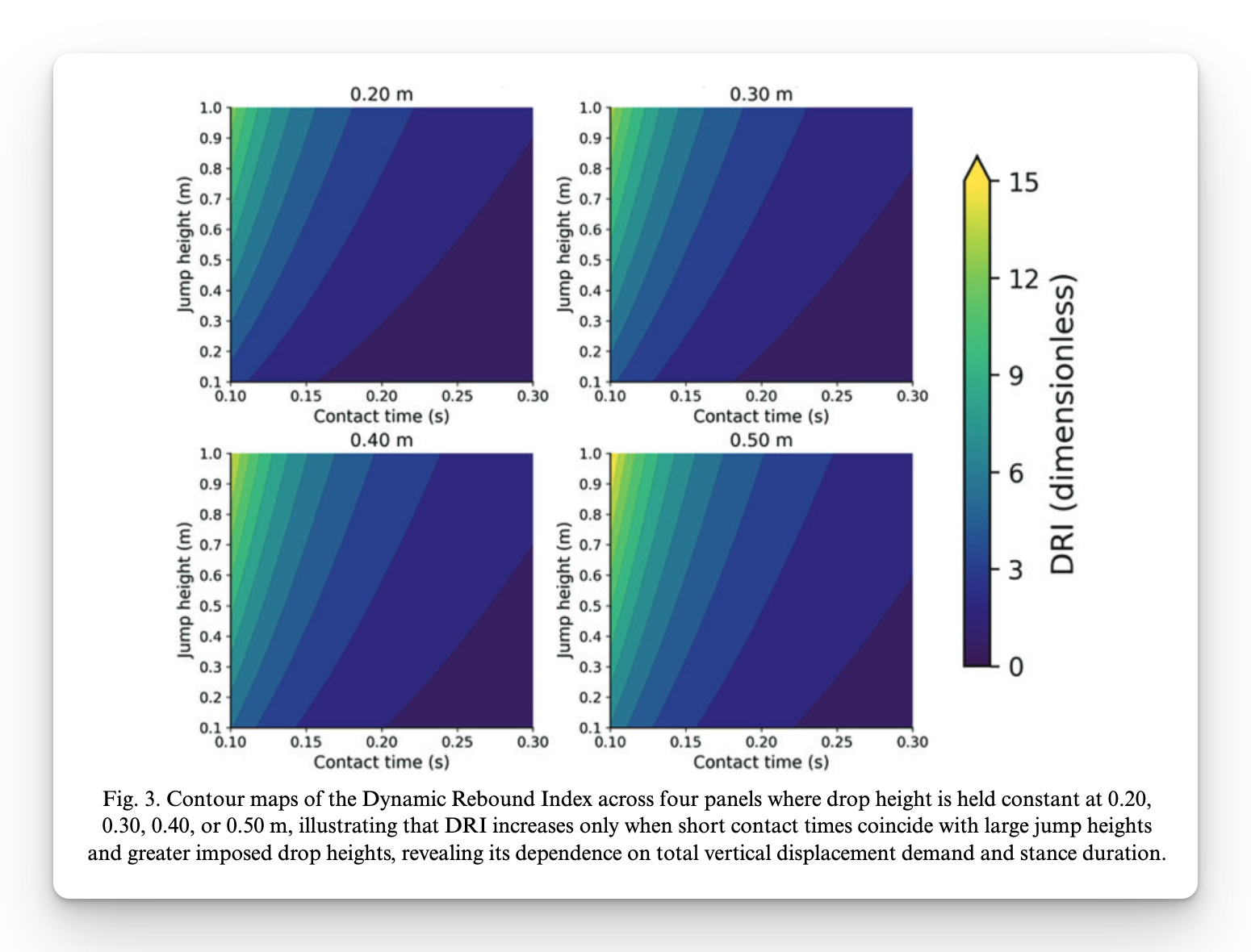
DRI Scaled with Real Mechanical Demand
DRI only increased when short contact times coincided with large total vertical displacement (jump height + drop height).
This aligns with actual SSC demands: reversing downward momentum and producing upward impulse in limited time.
Divergent Responses Between RSI and DRI
When jump height was held constant and contact time increased, RSI and DRI behaved very differently.
- RSI declined gradually and still retained a substantial portion of its maximum value at longer contact times, showing strong sensitivity to time alone.
- In contrast, DRI dropped sharply as contact time increased, indicating greater sensitivity to stance duration when displacement was fixed.
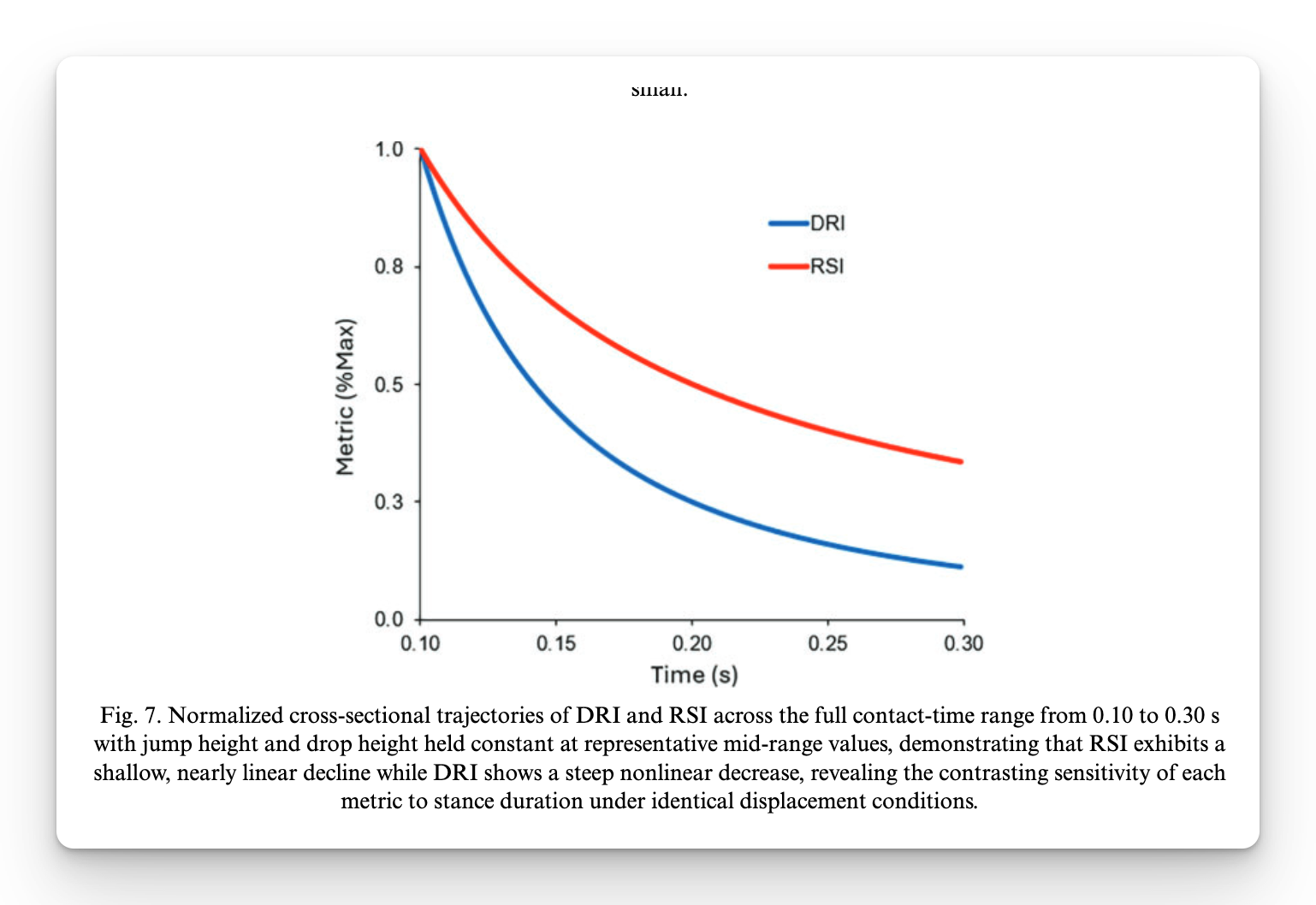
When modeled movement strategies were compared, RSI rose whenever contact time shortened, even if displacement remained modest. DRI only increased when short contact times were paired with large vertical displacements.
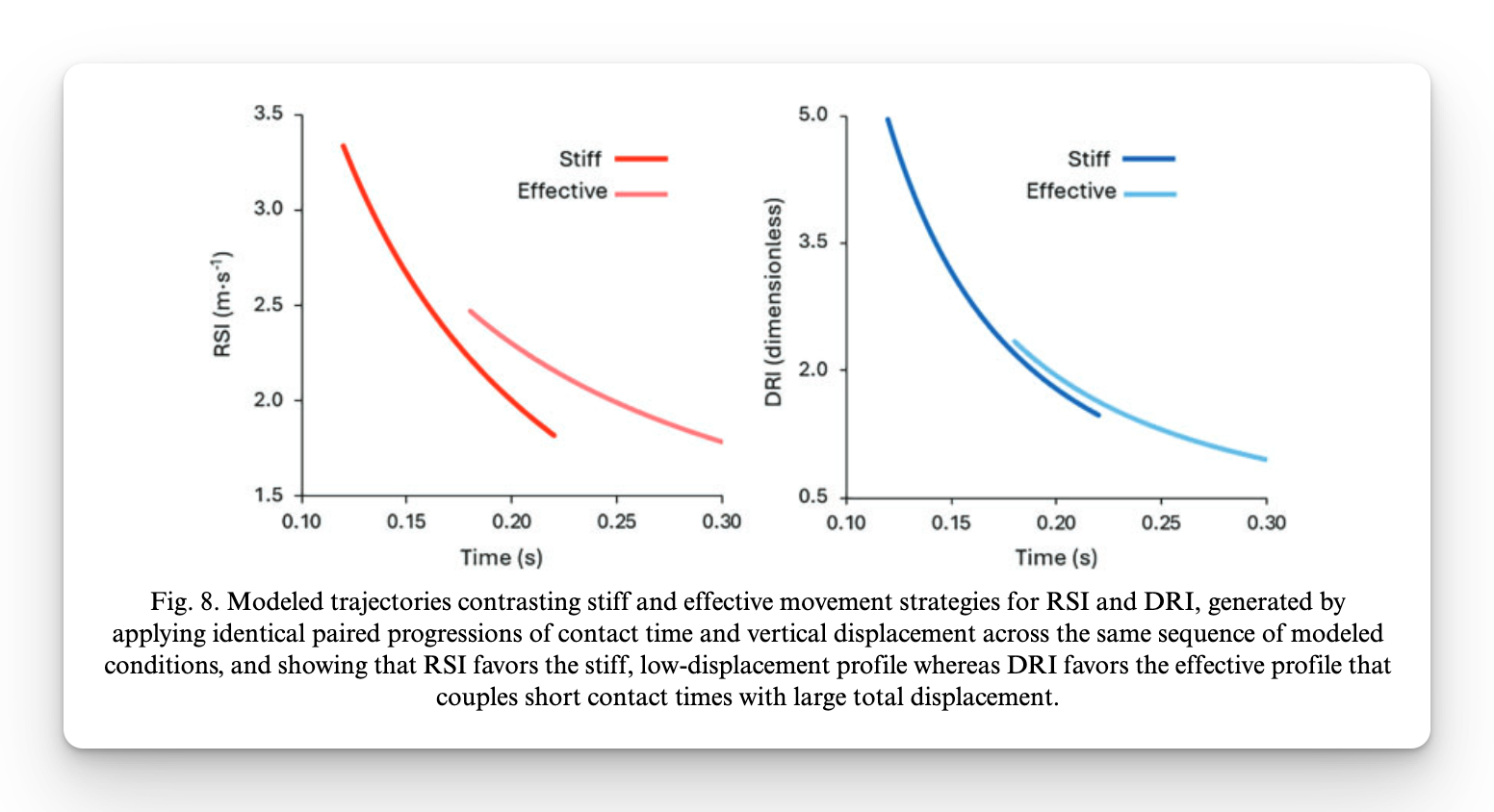
Together, these results show that RSI is primarily driven by contact time, while DRI reflects how effectively displacement is produced under time constraints.
What Does This Mean?
This paper doesn’t say RSI is useless. It points out the limitations of RSI and provides a more mechanically coherent representation of stretch–shortening cycle (SSC) performance than the Reactive Strength Index (RSI).
Practically, the paper highlights that:
- Short contact times alone do not equal quality SSC output
- Stiffness without impulse is not performance
- Effective SSC requires displacement, not just speed
Limitations
- Entirely modeled data, no athlete testing
- Assumes constant average acceleration during stance
- Normative values do not yet exist
This is a conceptual framework, not a finished performance metric.
Coach’s Takeaway
- RSI can reward stiffness without substance ⮕ Be cautious interpreting high RSI scores when jump height is modest.
- SSC performance is about displacement under time pressure ⮕ Metrics should reflect both, not just one.
- DRI offers a cleaner mechanical lens ⮕ Especially for drop jumps and tasks with meaningful eccentric load.
The author finishes with a clear conclusion:
DRI captured essential features of SSC mechanics that RSI did not. Across all analyses, DRI incor-porated both displacement and temporal components, distinguished between effective and ineffectiveshort-contact strategies, and generalized across tasks that varied in eccentric loading and entry velocity. These properties establish DRI as a mechanically interpretable and practically deployable index of SSC performance.
With the math and the logic laid out, I suspect leading force plate companies to add this metric soon.

The Simplest and Fastest Way to Learn Jump Analysis with Force Plates
I hope this helps,
Ramsey
Reference
Brooks, L. C. (2026). A Unified Mechanical Framework for Evaluating Stretch–Shortening Cycle Function. European Journal of Sport Sciences, 5(1).


