

COD is not one thing. Different tests capture different skills with low shared variance, so coaches often misjudge transfer.
For performance staff, this is about whether your added COD sessions matter or if they are just extra running.
This study asked if extra COD work that matches a given test or COD profile actually improves performance more than normal soccer training.
Does adding specific COD drills help athletes improve only in that drill or across different COD tasks?
What Did the Researchers Do?
Study Design
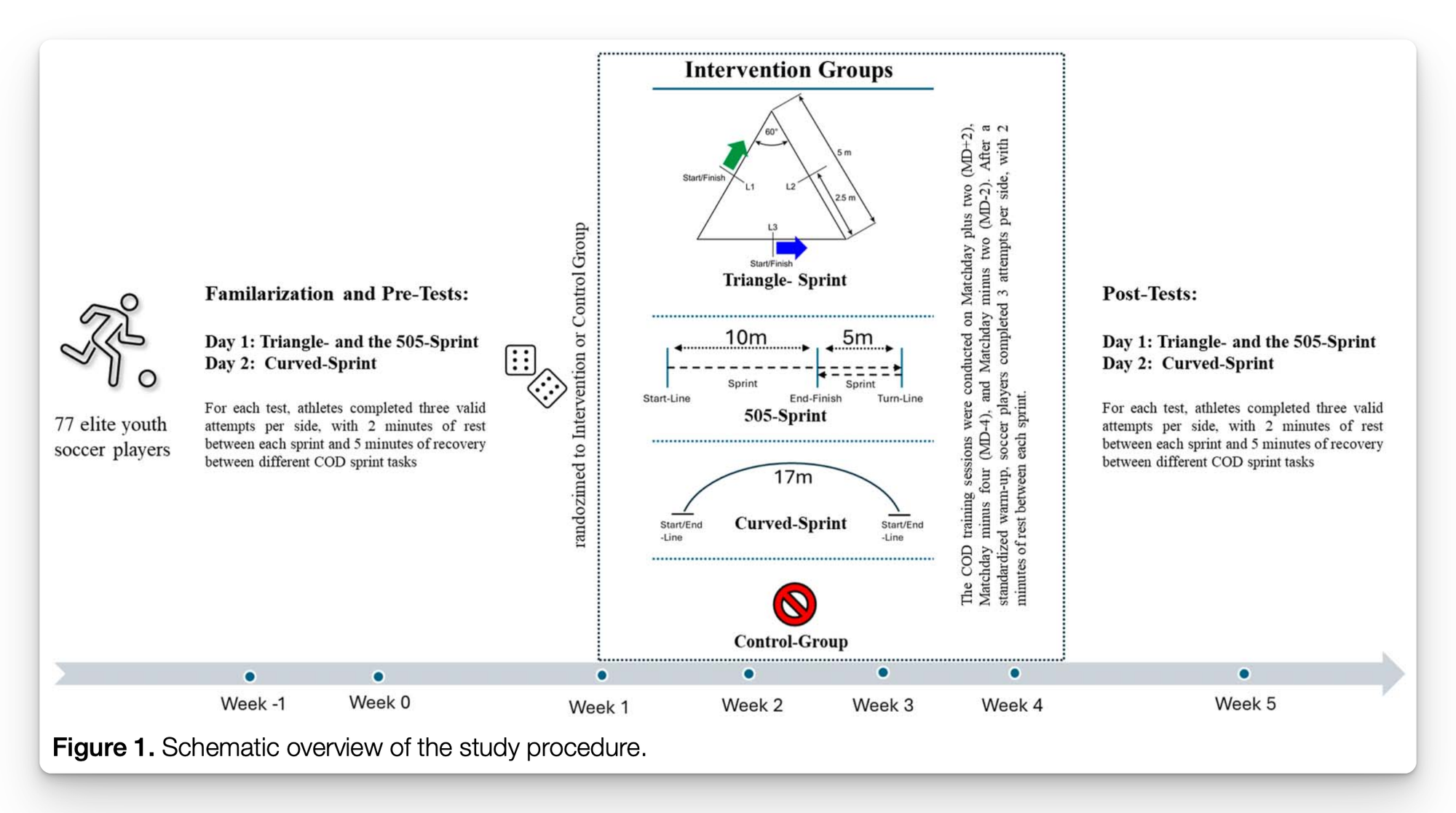
Researchers assigned 77 elite male youth soccer players (12–19 years) from top German academies to 4 intervention groups:
- 505 training
- Triangle COD training
- Curved Sprint training
- Control (only regular soccer)
All players still did 4 soccer sessions per week plus matches.
Training Protocol
- 3 COD sessions per week for 4 weeks (MD+2, MD-4, MD-2).
- 6 maximal sprints per session (3 per side with 2 minutes rest between reps) in the assigned drill only.
- Total ~30 minutes including standardized warm up.
Tests (Pre and Post)
- Triangle test: 2 x 60° cuts, short total distance.
- 505 test: single 180° cut (hard decel and re-accel).
- Curved Sprint: along penalty arc (nonlinear sprint, no hard decel).
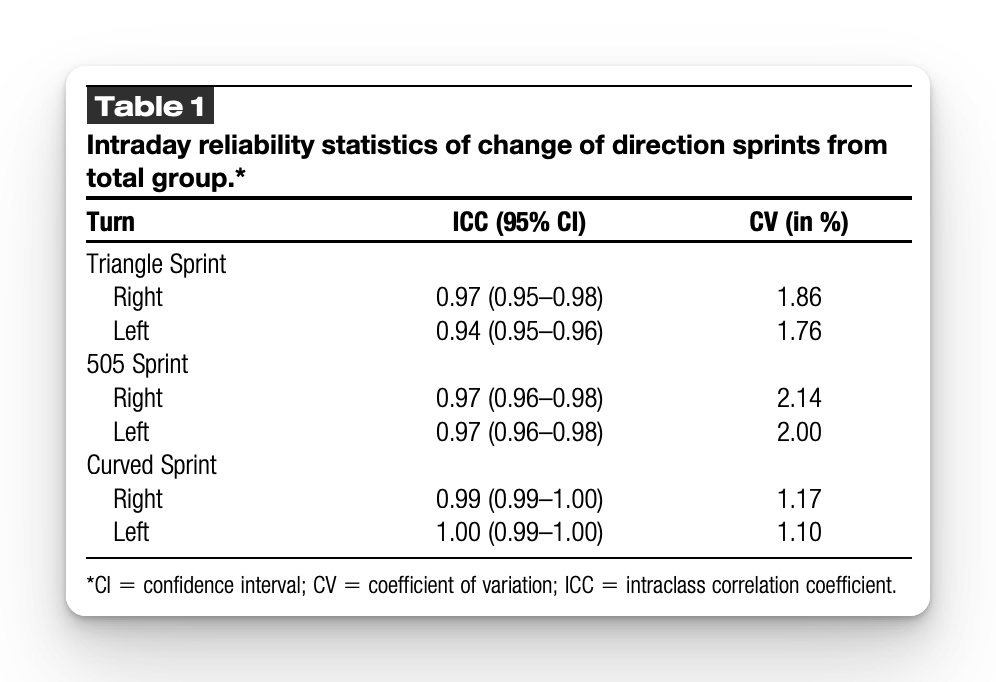
- Best of multiple trials used, high reliability across tests.
Key Variables
- Sprint times on each COD test (both sides).
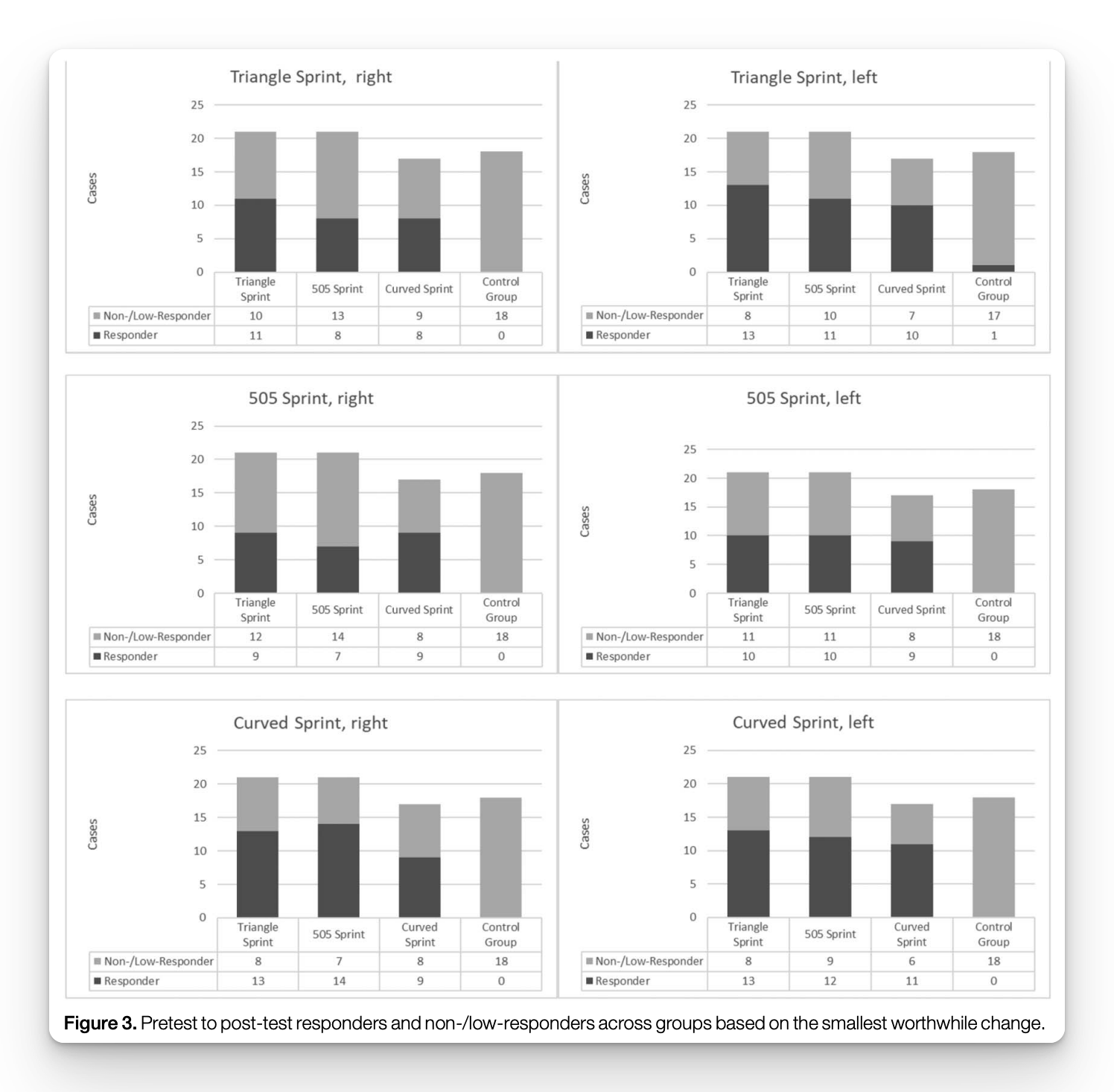
- Proportion of athletes improving beyond smallest worthwhile change.
What Were the Results?
Triangle & 505 training (cuts ≥120°)
- Improved across essentially all COD tests, including Curved Sprint.
- Moderate to large effect sizes in several conditions.
- Sharp-cut work carried over to multiple patterns.
Curved Sprint training
- Improved only the Curved Sprint performance.
- No meaningful transfer to Triangle or 505.
Control (soccer only)
- No significant improvements.
Responders
- Even when training exactly matched the test, only about half exceeded the smallest worthwhile change.
- Signals: short duration, ceiling effects, and need for more than just technical exposure.
What Does This Mean?
- Training with harder cuts and deceleration demands (Triangle, 505) seems to improve those exact tasks while providing broader transfer, including to curved sprints.
- Training only curved sprints builds curve speed but does not prepare athletes for intense braking and re-accel demands of sharp cuts.
- Standard soccer training alone is not enough to shift COD performance in already well-trained youth.
Limitations
- Only 4 weeks with very low volume (6 reps x 3/week) for elite athletes, so adaptations are small.
- Only elite male youth soccer players; other populations and sports may not have the same outcomes.
Coach's Takeaway
- If you want athletes to be better at sharp cuts, train sharp cuts with real braking and re-accel, not just curves.
- Curved sprint work is specific, useful for curve patterns, but does not replace decel-heavy COD training.
- Short, focused, high-intent COD exposures with big angles and braking appear to deliver more global COD benefits than lighter curve-only work.
- Combine technical COD work with strength, eccentric, and reactive strength training to move more athletes beyond trivial gains.
I hope this helps,
Ramsey
Reference:
Keiner M, Warneke K, Skratek J, Kadlubowski B, Beinert K, Wittke A, Wirth K. (2025). Specificity in change of direction training: Impact on performance across different tests. Journal of Strength and Conditioning Research, 39(9), 945–951.


