

Most performance departments are not limited in data. They are limited because data never turns into decisions (or "Actionable Insights" as those in the industry love to say).
GPS, force plates, wellness, video, heart rate, readiness scores. All of it exists. Yet athletes still get overloaded, staff still argue about what matters, and dashboards still sit unused.
Dan Mănescu recently (2025) proposed a six-stage process that transforms high-volume sports data into sustained performance.
Not by adding more technology, but by giving coaches a simple decision pathway.
Let's break it down.
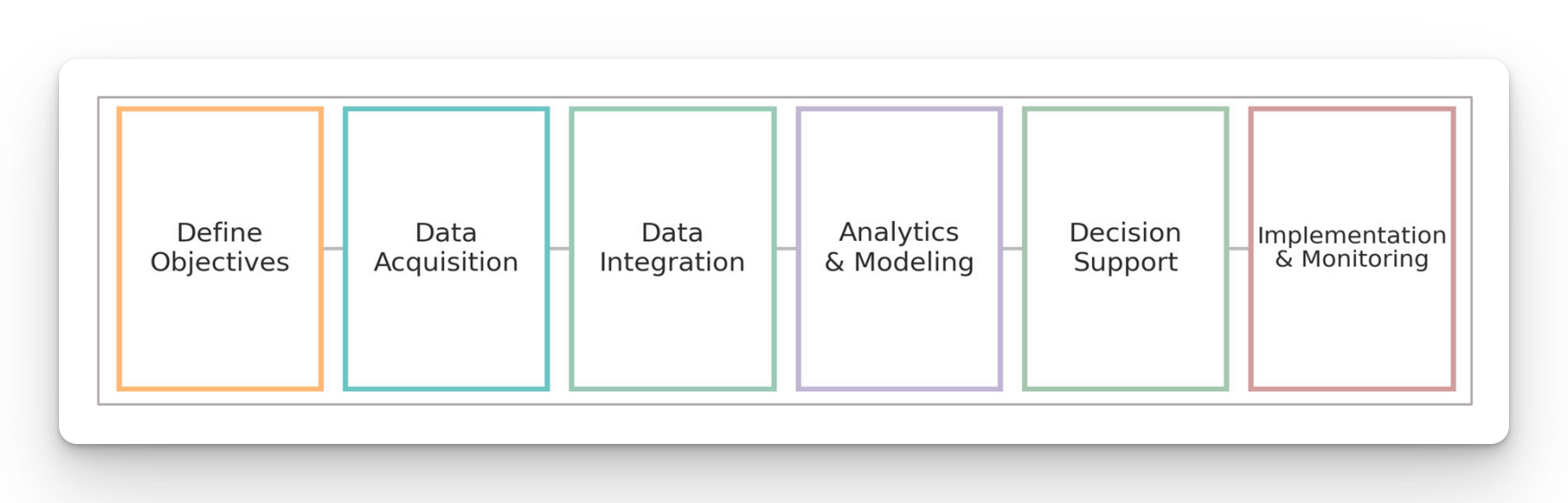
Step 1: Define Objectives
This is where most teams already go wrong.
Data collection usually starts with:
- “What technology should we buy?”
- “What metrics should we track?”
- “What does everyone else use?”
Instead, this model starts with one question:
What decision do we want to make better?
Examples:
- Reduce non-contact soft tissue injuries
- Decide when to pull back training load
- Improve late-game performance under fatigue
- Identify who needs individualized sprint or jump work
If the data does not help answer a real decision, it does not belong in your system.
If a metric does not change a conversation or an action, it is noise.
Step 2: Data Acquisition
(Collect only what serves the objective)
Once the objective is clear, data collection becomes obvious.
You are no longer collecting data “because you can.” You are collecting data with intent.
Depending on the objective, this might include:
- External load (GPS, accelerometers)
- Internal load (heart rate, RPE)
- Wellness or soreness reports
- Force plate outputs
- Simple video or movement screens
Important point: More data does not mean better data.
Three reliable inputs tied to a clear objective beat twelve unreliable ones that no one trusts.
Small, consistent, and repeatable beats complex and fragile.
Step 3: Data Integration
(Where most programs quietly fail)
This is the least sexy step and the most important one.
Integration means:
- Sessions are labeled consistently
- Athlete IDs match across systems
- Dates and time windows line up
- Training, practice, and games speak the same language (or at least are closely related)
If your GPS says “high load” but wellness is logged on a different timeline, your conclusions are wrong before modeling even starts.
You do not need a perfect tech stack. You need one shared understanding across staff
Bad integration creates fake insights.
The Simplest and Fastest Way to Learn Jump Analysis with Force Plates
Step 4: Analytics & Modeling
(Simple beats clever)
This is where people expect magic.
In reality, most high-performing environments rely on:
- Ratios
- Trends
- Comparisons to baseline
- Simple predictive flags
Yes, machine learning can help. No, it is not required.
The real value is not the model. The value is what variables move the output.
If you cannot explain to another coach why an athlete was flagged, the model will never survive the season.
If you can’t explain it in one sentence, don’t deploy it.
Step 5: Decision Support
(This is the money step)
This is where data finally earns its place.
Decision support answers:
- Who needs attention today?
- What action should we consider?
- How urgent is it?
Examples:
- “Two consecutive yellow days equals modified volume”
- “High sprint load plus high soreness equals no max velocity work”
- “Drop in jump metrics plus fatigue equals technique focus, not power”
Dashboards are tools, not solutions. The solution is clarity.
Data should reduce meetings, not create them.
Step 6: Implementation & Monitoring
(Where coaching lives)
This is where staff earns trust.
Actions are taken. Athletes are informed. Plans are adjusted.
Then you monitor:
- Did the intervention help?
- Did performance stabilize?
- Did risk indicators improve?
If not, the model loops back to the start.
This is not failure. This is the system working.
A model that never changes is a model that is lying to you.
Less Dashboards, More Decisions
Sport performance does not need more dashboards.
It needs:
- Clear objectives
- Fewer metrics
- Better conversations
- Faster decisions
If a piece of data does not move cleanly from objective to action, it does not belong in your system.
That is how data actually helps coaches make better decisions for player performance and health.
I hope this helps,
Ramsey
Reference: Mănescu, D. C. (2025). Big data analytics framework for decision-making in sports performance optimization. Data, 10(7), 116.


