

Eccentric strength is often credited for braking, force "absorption," and stretch-shortening cycle benefits, while concentric strength is viewed as the engine for propulsion.
This has led many coaches to assume that having more eccentric strength relative to concentric strength, often expressed as a higher eccentric-to-concentric (E/C) ratio, should enhance jumping and SSC performance.
However, despite how common this assumption is, direct evidence linking the E/C ratio to lower-body power has been limited. This study directly tests the relationships between eccentric strength, concentric strength, and the E/C ratio with lower-body power output during countermovement jumping.
Is lower-body power driven by concentric strength, or by how eccentric and concentric strength are balanced?

What Did the Researchers Do?
Study Overview
By measuring maximal eccentric and concentric force capacity alongside SSC braking and propulsive mechanics, the authors determined how much it eccentric strength matters relative to concentric strength and whether the balance between the two meaningfully contributes to performance.
Testing Overview
178 competitive university athletes (95 females, 83 males) completed:
Countermovement jumps (CMJ)
- Unloaded
- Loaded (30% and 60% body mass)
- Dual force plates (1000 Hz)
Maximal unilateral leg press MVCs
- Concentric and eccentric phases
- Robotic servomotor leg press
Force–velocity profiling
- Used CMJ takeoff velocity under different loads
- Estimated Vmax (maximum velocity intercept)
Key Variables Measured
- Concentric MVC force
- Eccentric MVC force
- E/C strength ratio
- CMJ braking work and power
- CMJ propulsive work and power
- Vmax from velocity–load relationship
What Were the Results?
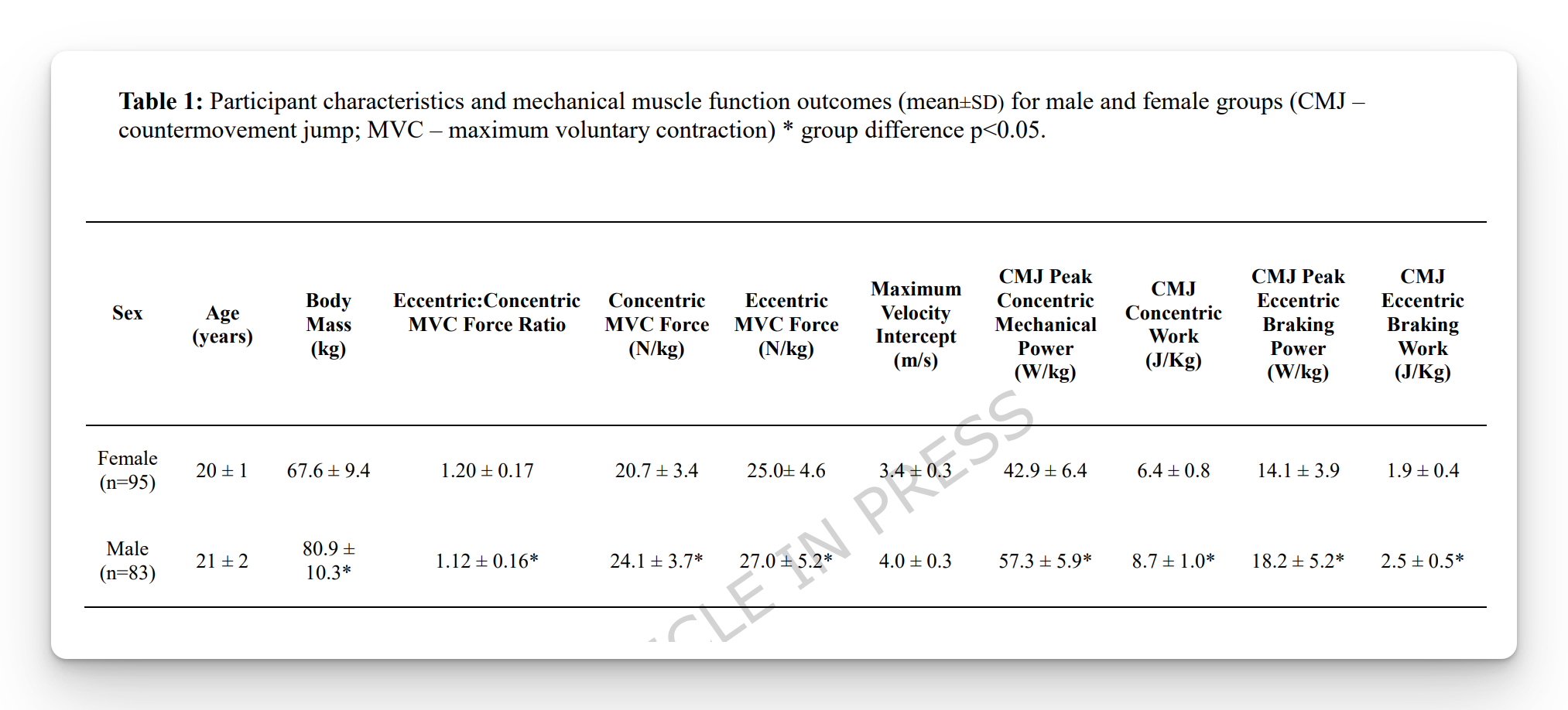
Females Had a Higher E/C Ratio
- Females showed a ~7% higher E/C ratio than males
- This difference persisted even after controlling for strength
What Determines the E/C Ratio?
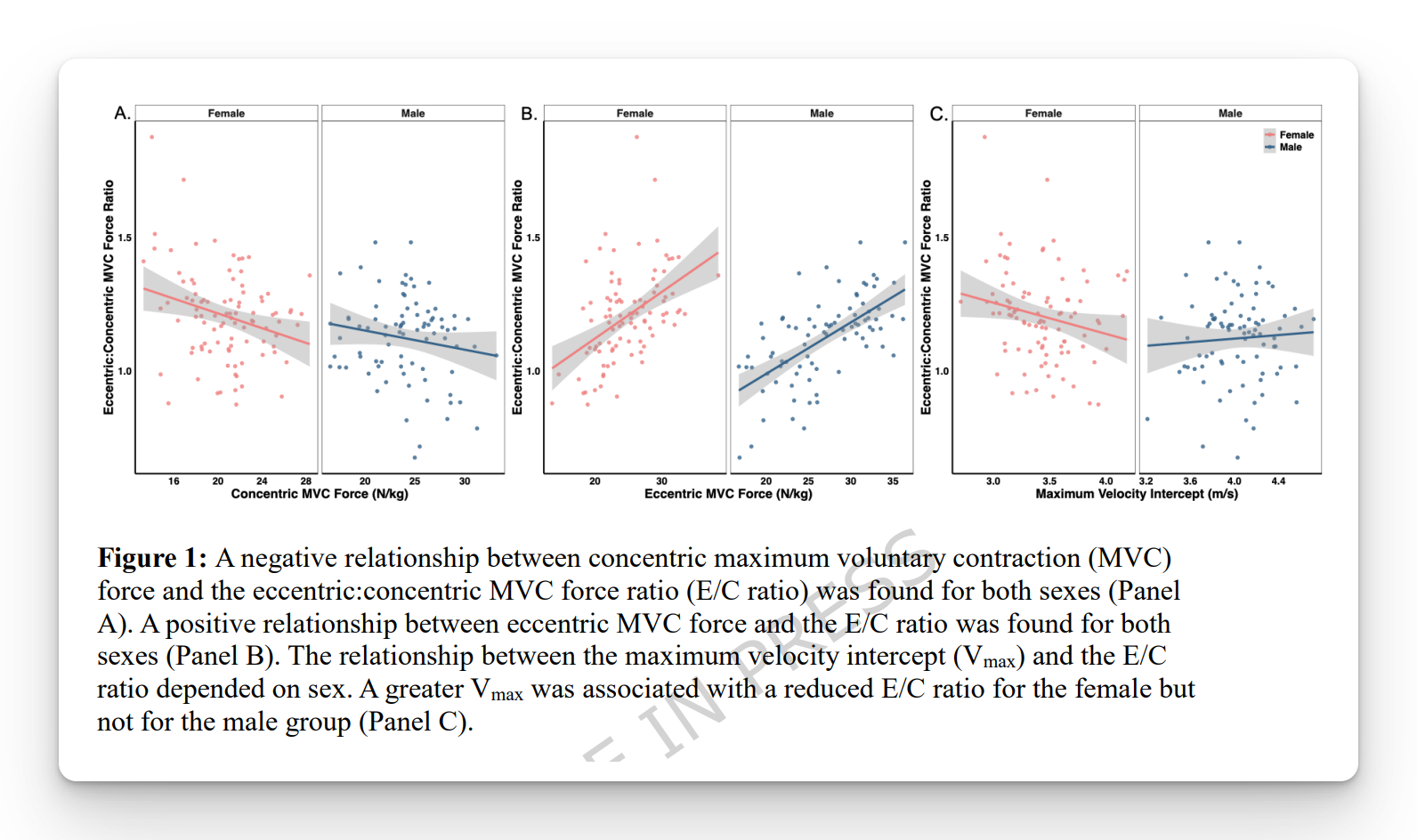
- Higher eccentric strength meant higher E/C ratio (strong relationship, R² = 0.33)
- Higher concentric strength meant lower E/C ratio
- Lower Vmax was weakly associated with higher E/C ratio in females, with no meaningful relationship in males
What Drives CMJ Propulsive Power?
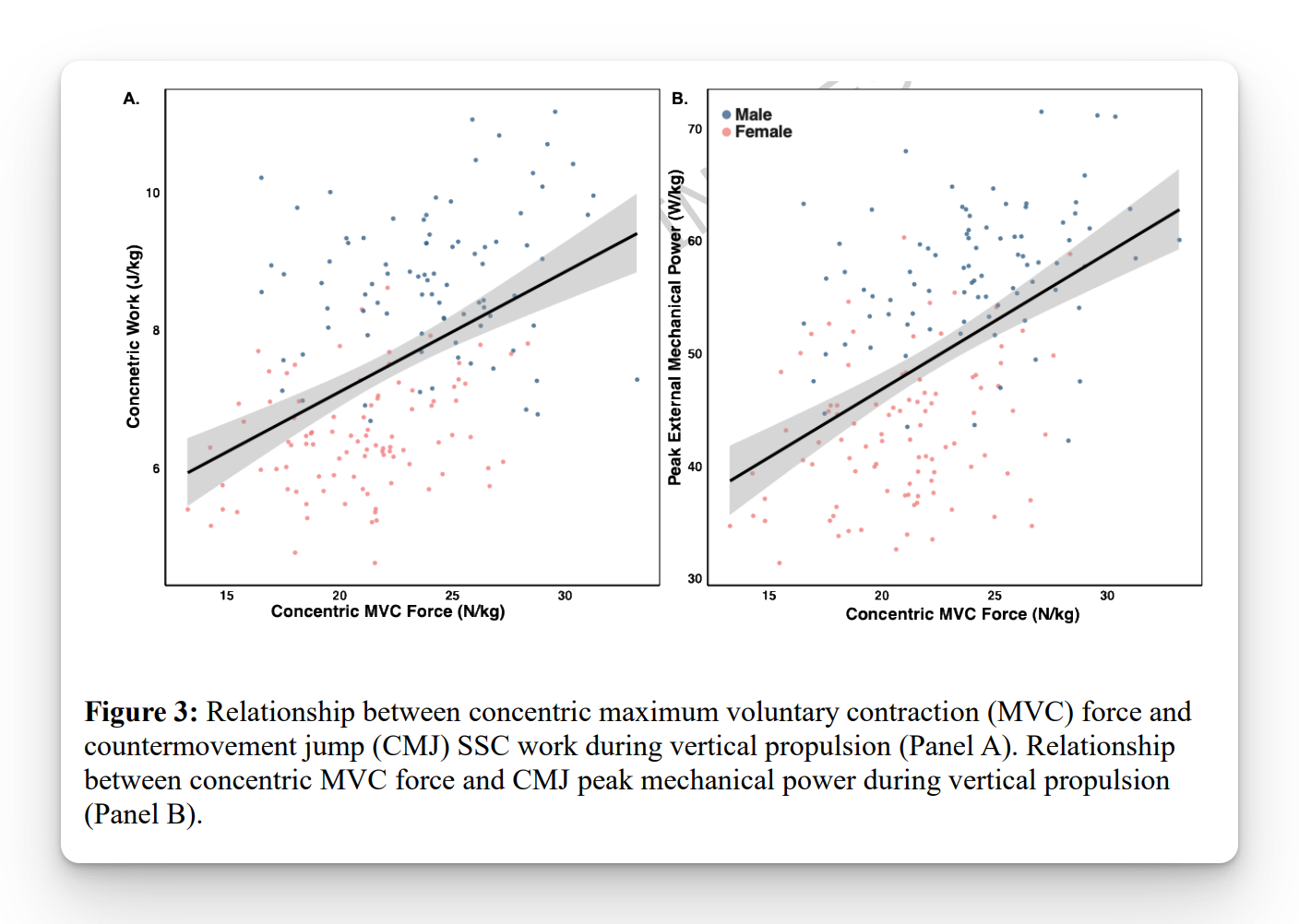
- Concentric strength dominated, explaining ~62–64% of variance in CMJ power and work
- E/C ratio had zero effect on propulsion
- Sex differences in jump power disappeared when strength was accounted for
What About Braking Phase Mechanics?
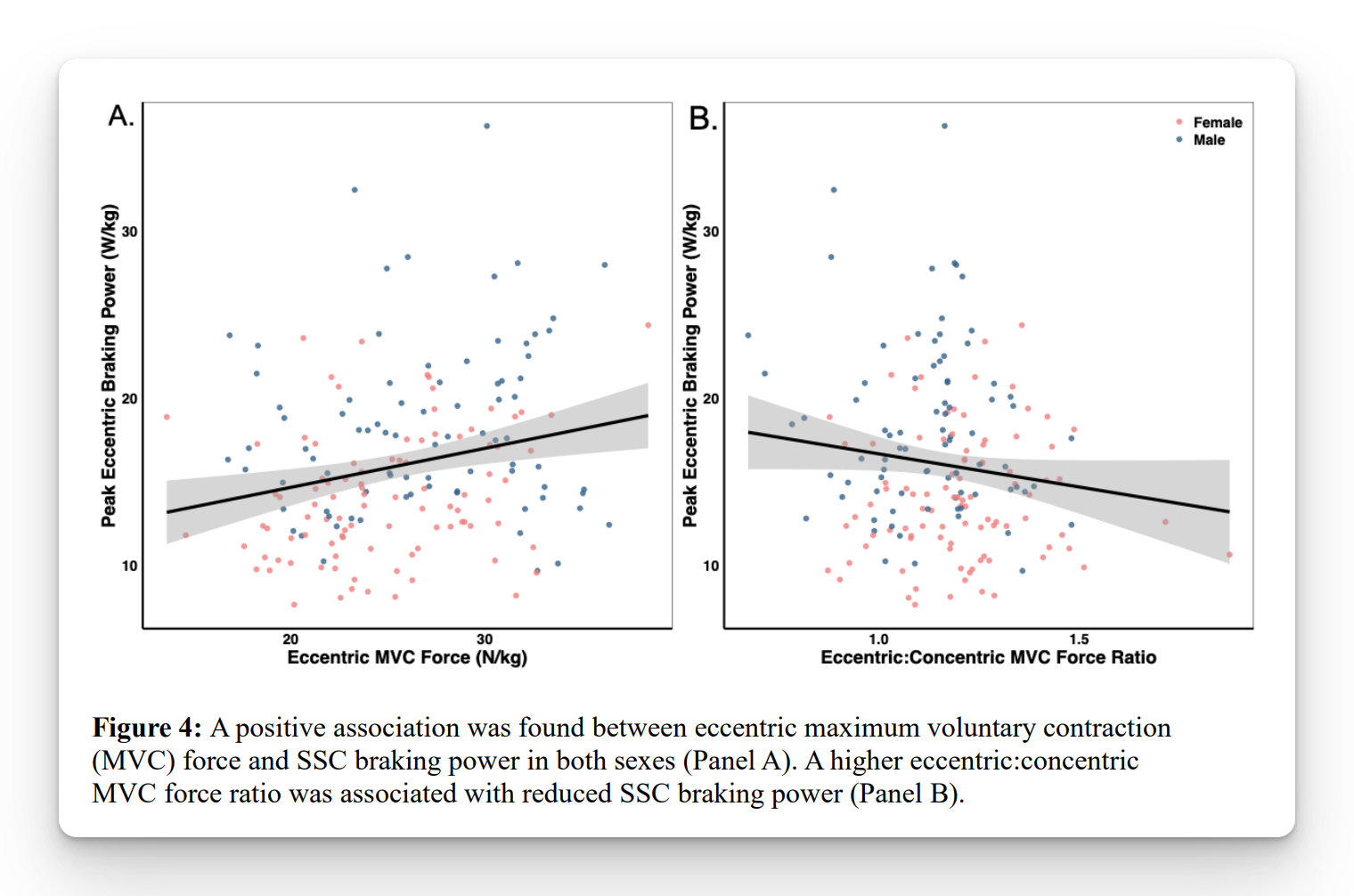
- Eccentric strength had a small positive relationship with braking power (R² ≈ 0.05)
- A higher E/C ratio was actually associated with lower braking power
- Males still produced higher absolute braking power
What Does This Mean?
- Concentric leg strength is a primary determinant of SSC power, particularly for propulsion and take-off.
- The E/C ratio does not enhance propulsion.
- Eccentric strength contributes modestly to braking power, but not enough to override total strength.
- Females’ higher E/C ratios likely reflect differences in velocity capacity and training exposure, not superior SSC mechanics.
Limitations
- Body composition (fat-free mass) was not measured.
- MVC testing was multi-joint, so hip vs knee contributions were not isolated.
- Cross-sectional design, no training intervention.
- Concentric-Eccentric sequencing may have introduced history-dependent muscle effects.
Coach’s Takeaway
- Concentric strength is key ⮕ Concentric strength strongly explains SSC power, while eccentric strength and the E/C ratio have minimal influence.
- Braking Power is Strategy Dependent ⮕ Given the weak relationship between eccentric strength and braking power, these data suggest that braking ability is influenced more by movement strategy than by eccentric force capacity alone.
- Do not chase E/C ratios ⮕ They do not improve jump propulsion.
- Train eccentric strength ⮕ As part of a complete strength system, not as a standalone magic bullet.
I hope this helps,
Ramsey
Reference
Jordan MJ, McClean ZJ, Aagaard P, Pasanen K, Brito Fontana H, Herzog W. (2026). Maximal eccentric–concentric strength determines stretch-shortening cycle leg power across biological sexes. Scientific Reports.


