

Assisted countermovement jumps (ACMJ) have become popular because they allow athletes to jump higher and move faster by reducing bodyweight.
However, research has been inconsistent about what happens during the landing phase. Some studies report higher landing forces with assisted jumps, while others report the opposite.
A likely explanation is simple: landing strategy was never standardized.
This study examined whether landing style explains those differences and how assistance changes the mechanics of the jump.
In coaching terms, the study is asking two practical questions:
• Does reducing bodyweight change the mechanics of the jump?
• Does landing strategy (soft vs stiff) change the landing forces experienced by the athlete?
The Simplest and Fastest Way to Learn Jump Analysis with Force Plates
What Did the Researchers Do?
Participants
• 13 resistance-trained national-level athletes
• Sports included sprinting, rowing, kayaking, cycling, and powerlifting
• All had at least 1 year of resistance and plyometric training experience
Jump Conditions
Athletes performed CMJs under five bodyweight conditions:
• 100% bodyweight (normal CMJ)
• 90% bodyweight
• 80% bodyweight
• 70% bodyweight
• 60% bodyweight
Reduced bodyweight was created using resistance bands attached to a squat rack.
Landing Strategies
Each jump condition was performed with two landing styles:
• Soft landing ⮕ greater hip and knee flexion to absorb force quietly
• Stiff landing ⮕ minimal joint flexion with a louder ground contact
Measured Variables
Force plates recorded several force-time metrics:
• Jump height
• Time to take-off
• Propulsion duration
• Braking duration
• Unweighting duration
• Mean propulsion force
• Peak propulsion force
• Landing impact force
These variables allowed researchers to evaluate both take-off mechanics and landing forces.
What Were the Results?
Jump Performance
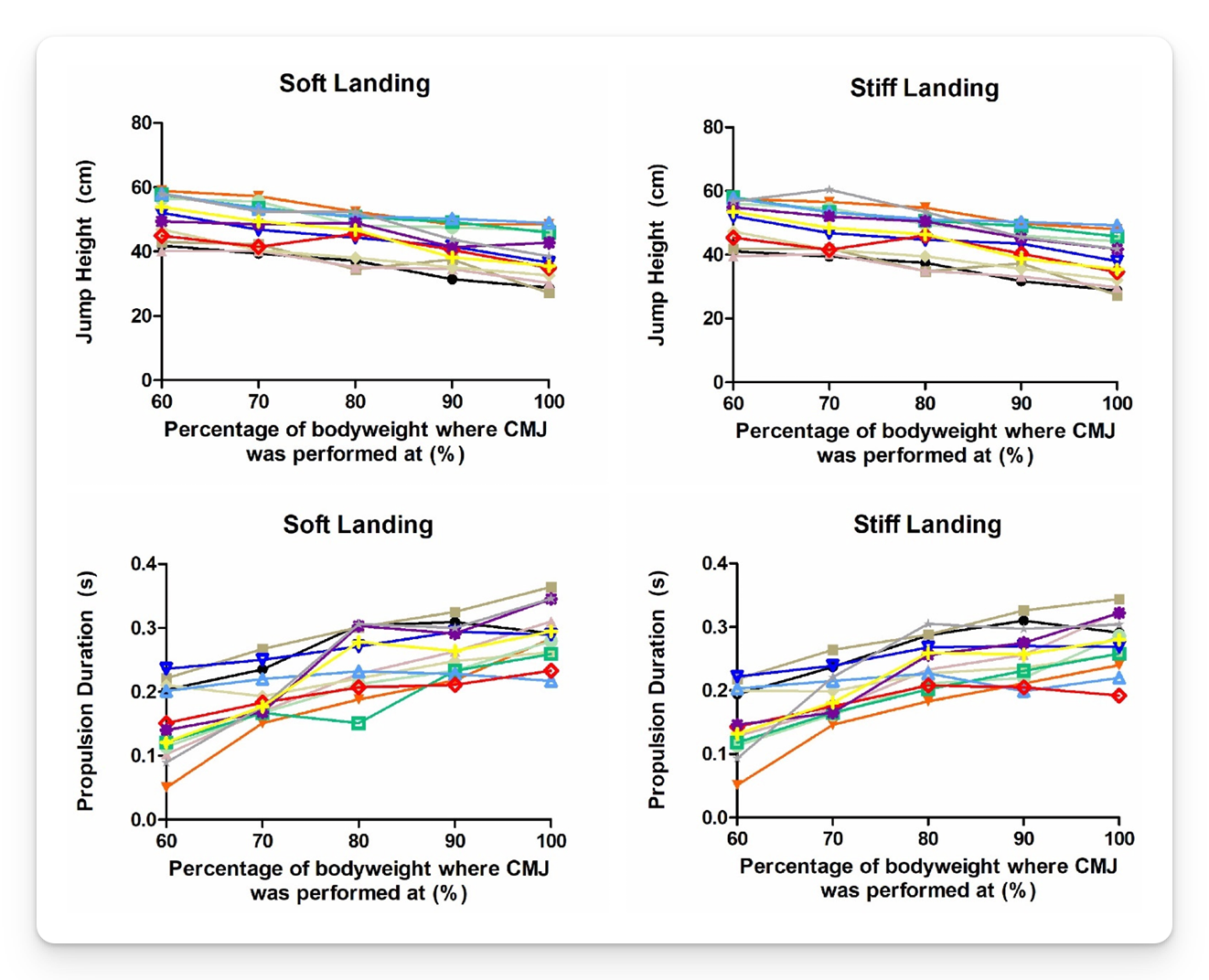
Jumps performed with assistance resulted in:
• Jump height increased
• Time to take-off decreased
• Propulsion duration decreased
Athletes jumped higher and moved faster when bodyweight was reduced.
Propulsion Forces
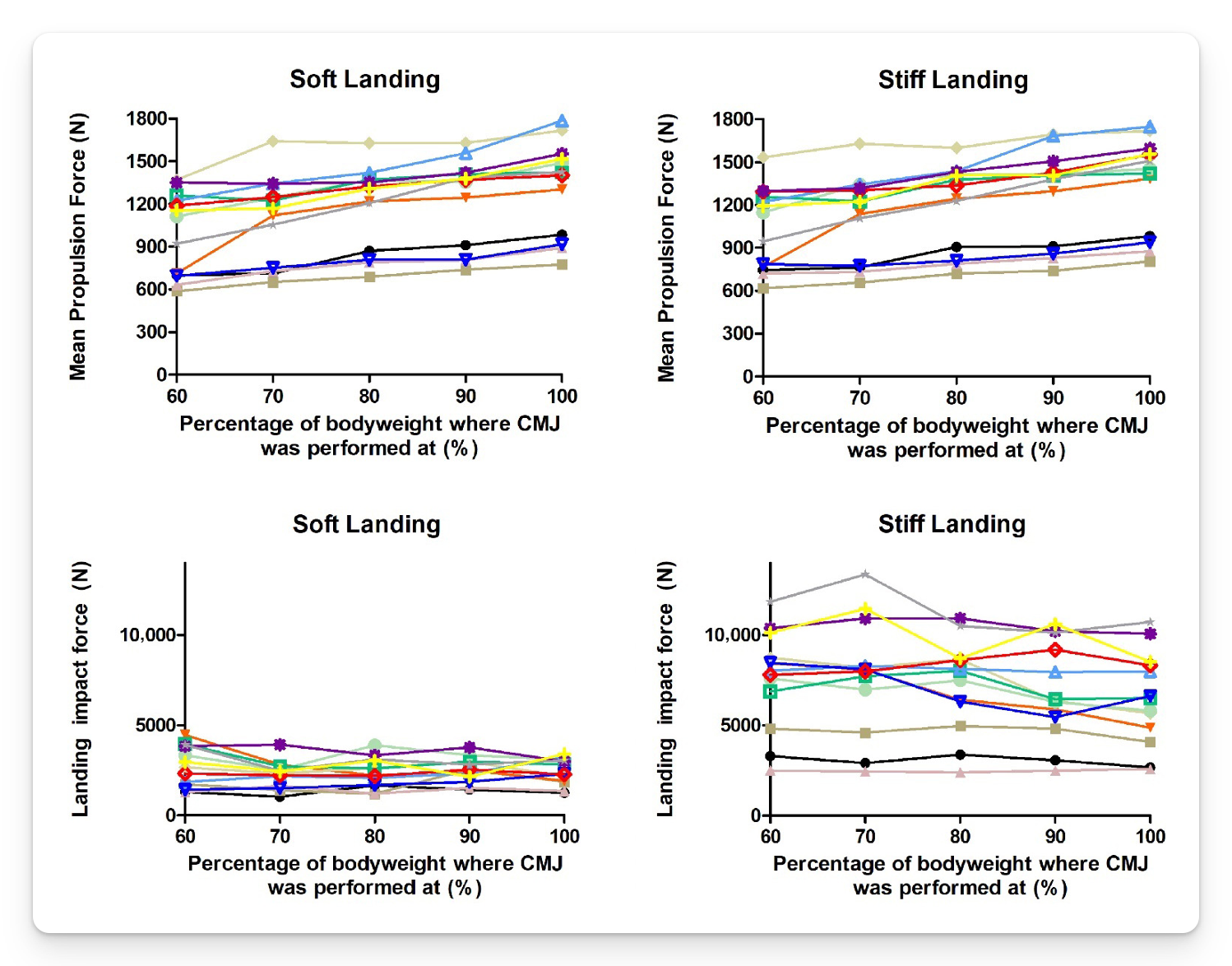
Interestingly, propulsion forces actually decreased with assistance:
• Mean propulsion force decreased
• Peak propulsion force decreased
This occurs because assistance reduces the inertia the athlete must overcome during take-off.
Landing Impact Forces
Soft Landings
• Landing forces did not significantly change across assistance levels
• Greater hip and knee flexion spread the load over time
• Forces remained roughly ~2200–2700 N
Stiff Landings
• Landing forces increased significantly as assistance increased
• Less joint flexion meant less energy absorption
• Forces increased to ~6500–7700 N
Soft landings absorbed the extra height safely, while stiff landings produced much higher impact forces.
What Does This Mean?
Jumping
Assisted jumps change the force-time profile of the movement. Key mechanical changes included:
• Higher jump heights
• Faster propulsion
• Shorter force application time
Assisted jumps are useful for exposing athletes to higher movement velocities.
Landing
Soft landings emphasize:
• Force absorption
• Eccentric muscular work
• Longer deceleration time
Stiff landings emphasize:
• Higher peak impact forces
• Rapid force transmission
• Greater mechanical stress
The same exercise can produce very different training stimuli depending on how the athlete lands.
Limitations
• Small sample size (13 athletes)
• Downward velocity during descent was not measured
• The study examined acute mechanics, not long-term training adaptations
Coach's Takeaway
Assisted jumps are a useful tool for exposing athletes to higher movement velocities and an overspeed stimulus.
• Reducing bodyweight increases jump height and speed
• Propulsion forces decrease because inertia is reduced
• Landing mechanics determine the mechanical stress of the exercise
• Use soft landings to emphasize eccentric absorption and reduce peak impact forces
• Use stiff landings carefully if the goal is exposing athletes to higher impact forces
I hope this helps,
Ramsey
Reference: Zhou, R.Y.S., James, L.P., & Lum, D. (2025). Comparing the Force–Time Characteristics Between Countermovement and Assisted Countermovement Jump with Different Landing Strategies. Muscles.


