

Lower-body power underpins nearly everything we care about in sport.
Jumping, sprinting, cutting, and change of direction all rely on how well an athlete can absorb force and reapply it quickly.
The problem is that heavy loads increase force but slow things down, while light loads increase speed but limit force output.
This creates a ceiling when training power with traditional jump squats or plyometrics.
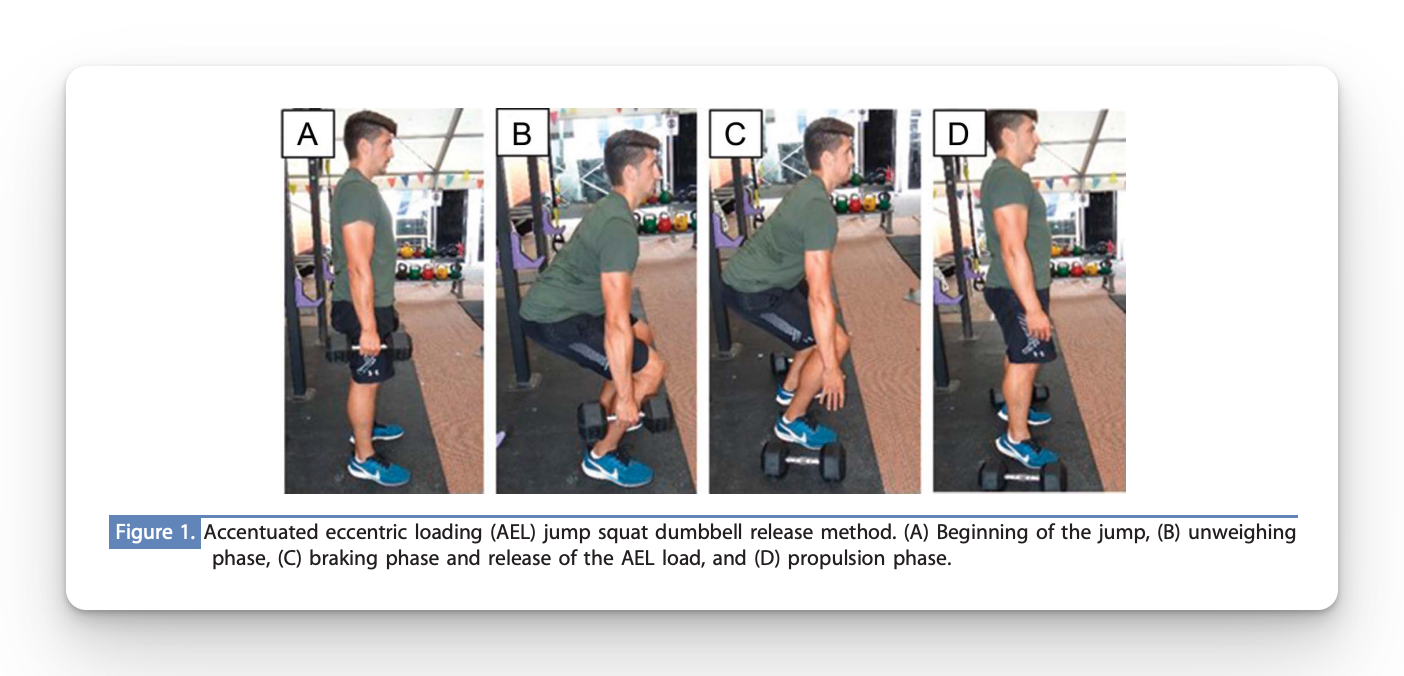
Accentuated eccentric loading (AEL) is an attempt to break that ceiling by overloading the braking phase of a movement while keeping the propulsive phase light and fast.
Can we improve force, velocity, and power in jumping by overloading the eccentric phase only?
What Did the Researchers Do?
Study Design
- The authors reviewed all available studies using AEL with jump-based movements.
- Focused on acute performance effects, not long-term adaptations
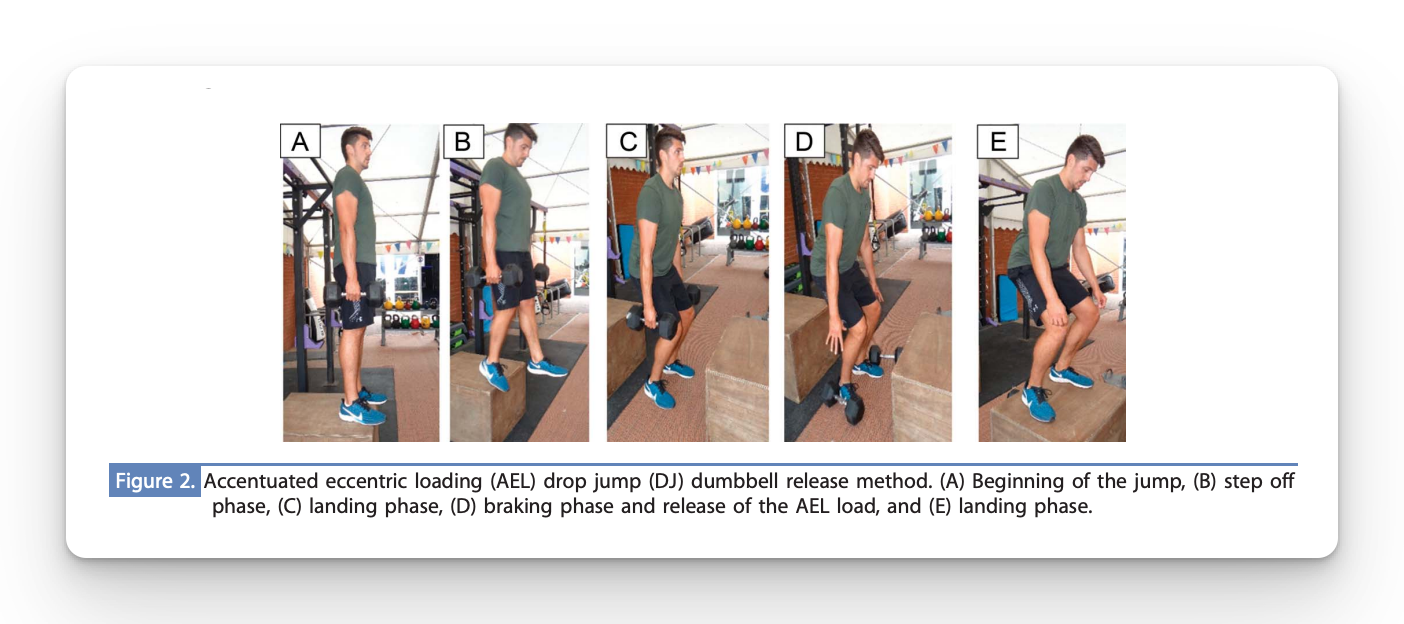
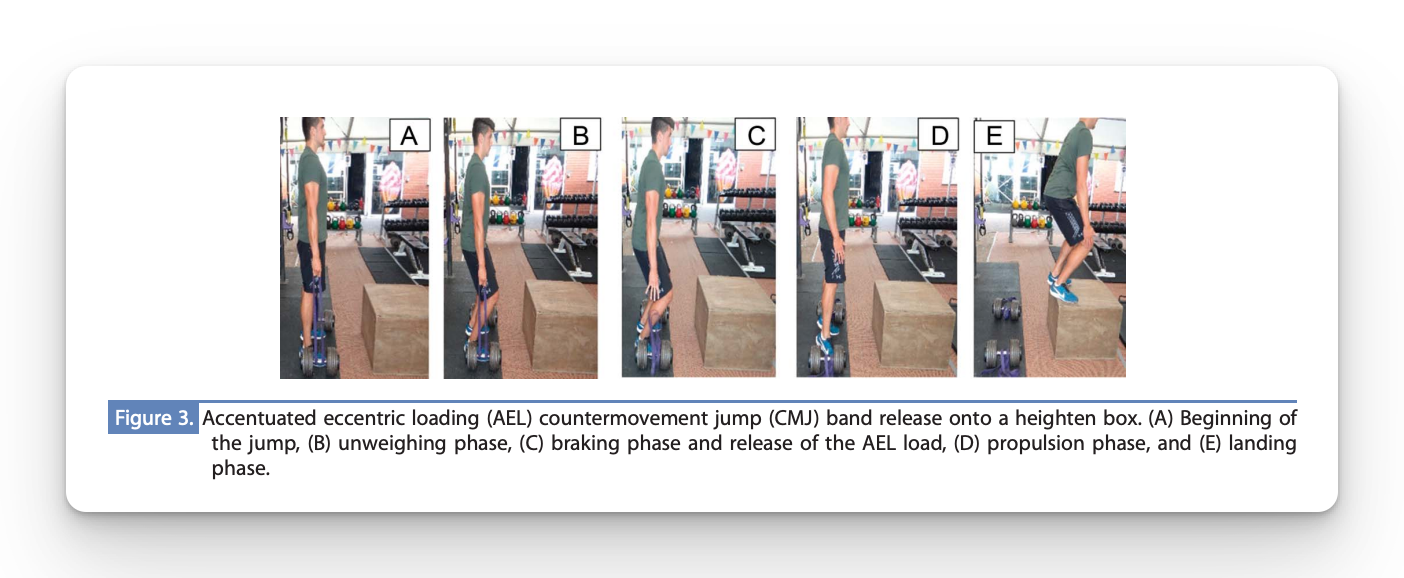
- Compared different exercises (CMJ, jump squat, drop jump), loading methods (dumbbell release, bands, weight releasers) and load magnitudes (typically 10–30% body mass or 1RM)
Subjects
Across the included studies:
- Trained males and females
- Mostly resistance-trained or sport athletes
- Sample sizes were small, typical of biomechanics work
Key Variables Measured
- Peak and mean power
- Peak force
- Takeoff velocity
- Jump height or flight time
What Were the Results?
Plyo-AEL Can Increase Force and Power
Across multiple studies:
- Peak power often increased with AEL
- Peak and mean concentric force tended to improve
- Velocity sometimes improved, sometimes stayed neutral
The biggest improvements were seen when:
- Eccentric loads were 10–30% of body mass
- Concentric phase was unloaded
- Athletes could maintain a fast amortization phase
More Load Is Not Better
When eccentric loads got too high:
- Performance plateaued or declined
- Jump height dropped
- Velocity suffered
In one study using 50–80% 1RM eccentric loads, performance worsened rather than improved, reinforcing an important point:
Plyo-AEL is not max eccentric training. It’s speed-sensitive eccentric exposure.
Exercise Selection Matters
- The best supported exercises we jump squats and countermovement jumps (with self-released load)
- Less clear exercsies were drop jumps with AEL and weightlifting derivatives (limited data)
Note: Depth consistency mattered ⮕ Comparing a BW CMJ to an AEL jump squat muddies interpretation because displacement changes power outputs.
What Does This Mean?
Mechanistically
Plyo-AEL likely works by:
- Increasing eccentric braking force
- Storing more elastic energy
- Enhancing early concentric force production
- Improving neural drive during the SSC
However, this holds only if amortization remains short and the athlete can reuse stored energy.
Once the eccentric load slows the transition, benefits disappear.
Practically
Think of plyo-AEL as:
- A way to expose athletes to higher landing forces
- Without increasing concentric load
- And without changing jump intent
Limitations
- Mostly acute studies and small sample sizes
- Inconsistent loading prescriptions (BM vs %1RM)
- Limited data on chronic adaptations
- Potential safety and logistics concerns with bands and dumbbell release
Coach’s Takeaway
Keep Eccentric Loads Light and Fast
- Start at 10–20% body mass (rarely exceed 30%)
- If the jump height drops, the load is too high
Use Simple, Athlete-Controlled Methods
- Best options are dumbbell release, jump squats and hand-released AEL CMJs
- Avoid band release methods that rely on assistants or anything that compromises landing safety
Treat Plyo-AEL Like Power Training
- Low reps (1–3) with full intent on every jump
- Cluster sets work well to reset equipment and preserve output
I hope this helps,
Ramsey
Reference: Handford MJ, Martín-Rivera F, Maroto-Izquierdo S, Hughes JD. (2021). Plyo-accentuated eccentric loading methods to enhance lower limb muscle power. Strength & Conditioning Journal, 43(5), 54–64.


